

Omdia estimates that augmented reality (AR), virtual reality (VR), and mixed reality (MR) near-eye display revenue will reach $1.2bn in 2026, representing a year-on-year (YoY) growth rate of over 200%. This growth is primarily driven by the widespread adoption of OLED on silicon (OLEDoS), also known as Micro OLED, in smart glasses and head-mounted display devices.
AR, VR, and MR near-eye displays refer to the displays used in AR, VR, MR, and other near-eye display devices. Examples of such devices include smart glasses and head-mounted display devices. The primary applications for these displays are in consumer electronics, entertainment devices, gaming, industrial applications, and for researchers and developers.
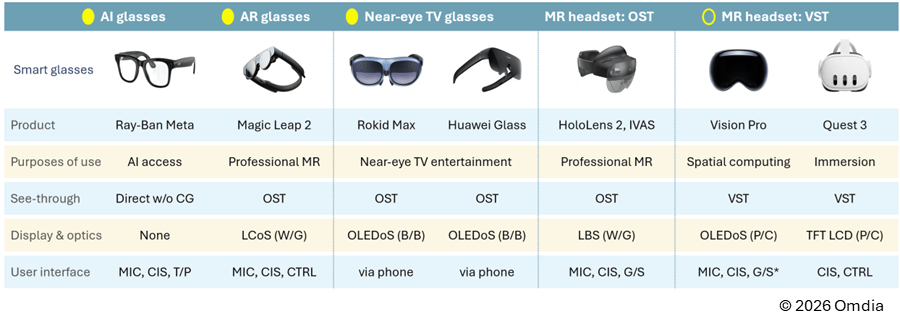
Figure 1 shows some examples of the AR, VR, and MR near-eye devices.
Figure 1: Examples of the AR, VR, and MR near-eye devices
Source: Omdia
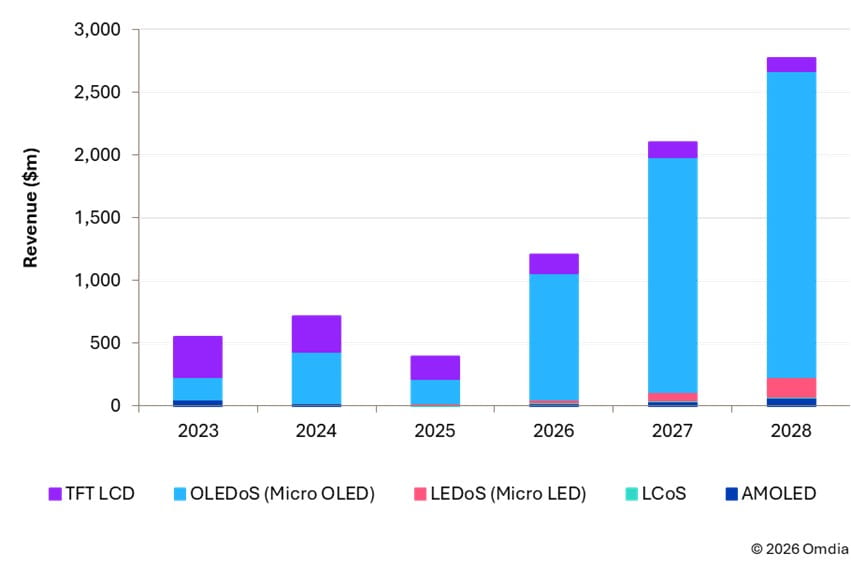
The lack of new VR end-products, including video see-through mixed reality (VST MR) devices, in 2025 has affected shipments of near-eye displays. According to Omdia’s latest report, revenue from VR, AR, and MR near-eye displays declined by 45% from $717m in 2024 to $392m in 2025. However, 2026 is anticipated to be a year of recovery for the AR, VR, and MR near-eye display market. Driven by high sales projections for Meta’s new MR device, shipment volumes of near-eye displays should rebound significantly in 2026.
On the other hand, smart glasses are attracting more attention than head-mounted devices. Major brands will release a variety of new smart glasses products in 2026–27. Beyond creating attractive and stylish products, these brands are also focusing on developing the supply chain, advancing technologies, and fostering the ecosystem. Compared with headset form factors, smart glasses are likely to gain user acceptance in a manner similar to how smartwatches eventually replaced traditional watches. If these new smart glasses products become available in 2026–27, the supply chain will benefit significantly, gaining confidence in developing new related technology and product roadmaps. It is likely that 2026–27 will mark the true takeoff of the smart glasses market.
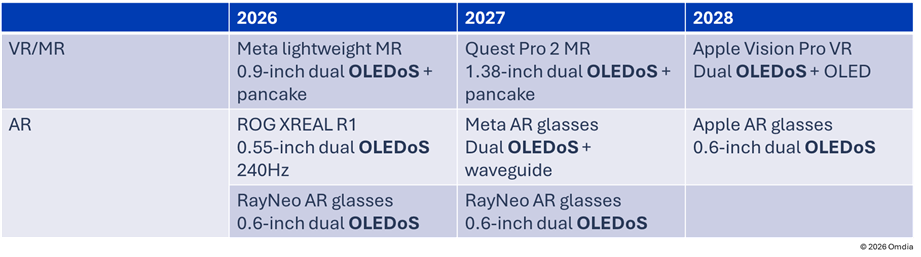
Most leading brands, including Meta, Apple, Huawei, RayNeo, and Pico, should launch new MR products in 2026. All these products will utilize OLEDoS displays, which will significantly affect shipments of near-eye displays (Figure 2).
Figure 2: New AR, VR, and MR near-eye device roadmap 2026–28
Source: Omdia
Among these brands, Meta’s upcoming products are particularly noteworthy. The company plans to release a lightweight MR product with a design similar to the Apple Vision Pro. The battery will be located externally. However, the display will measure only 0.91 inches, significantly smaller than Vision Pro’s display. This smaller size is intended to reduce costs and minimize the headset’s weight. There is also speculation that demand for this product will be substantial. Currently, Meta is in discussions with BOE and SeeYA regarding display supply.
Owing to high sales expectations for Meta’s new lightweight MR device, near-eye display shipments are projected to rebound significantly, reaching 20.2 million units by 2026, representing a 57.9% YoY increase.
With this strong growth, Omdia projects that AR, VR, and MR near-eye display revenue will reach $1.2bn for the first time in 2026, and it will be a $2.8bn market in 2028. Among the various display technologies, OLEDoS will drive this growth.
Figure 3: AR, VR, and MR near-eye display revenue
Source: Omdia
In the long term, Omdia believes that AR displays have greater growth potential than VR displays. This is because the current main applications of VR remain limited to gaming, movie watching, and live streaming. As a result, the overall scope of VR applications is restricted, leading to stable but not explosive growth unless there are significant breakthroughs in future applications. In contrast, although the existing base of AR applications is relatively small, Omdia anticipates a more optimistic growth trajectory for AR displays, supported by the continuous advancement in display and light engine technologies.
Until 2023, TFT LCD with high-brightness backlighting dominated the AR, VR, and MR near-eye display market, accounting for the majority of display revenue. However, this changed in 2024 when OLEDoS, also known as Micro OLED, became the leading near-eye display technology in terms of revenue. However, the market contracted in 2025 owing to the withdrawal of some brands, such as Apple’s Vision Pro, and the fact that consumer behavior was not yet ready to embrace near-eye devices. On the other hand, LED on silicon (LEDoS), or Micro LED, has proven to be a strong solution for near-eye displays requiring high brightness and compact size. Several brands are planning to launch LEDoS-equipped smart glasses targeting the high-end, high-priced segment, while many game console makers and consumer electronics device makers are focusing on OLEDoS glasses or head-mounted displays.
The following is an analysis of the three major near-eye display technologies: liquid crystal on silicon (LCoS), OLEDoS, and LEDoS.
• LCoS displays images by controlling liquid crystal pixels and the backlight. As a result, LCoS can be relatively thick and heavy, and its power consumption is not as optimized as that of other on-silicon displays. There are a few variations of LCoS, including color-filtered (CF) LCoS and color-sequential (CS) LCoS, which are used to achieve full-color displays.
• OLEDoS displays images through the self-emission of OLED pixels. As a result, OLEDoS can be relatively thin and light, and its power consumption can be lower than that of LCoS displays. Additionally, OLEDoS comes in a few variations, including white OLED on silicon (WOLEDoS), and RGB OLEDoS, to achieve full-color displays. However, as of now, only WOLEDoS is available on the market.
• LEDoS displays images through the self-emission of LED pixels. As a result, LEDoS can be relatively thin and light, and its power consumption can be lower than that of LCoS and OLEDoS. LEDoS comes in several variations, including color-converted (CC) LEDoS, RGB LEDoS, stacked RGB LEDoS, and color tunable RGB LEDoS, all designed to achieve full-color displays. However, as of now, only CC LEDoS is available on the market.
More from author


More insights
Assess the marketplace with our extensive insights collection.
More insightsHear from analysts
When you partner with Omdia, you gain access to our highly rated Ask An Analyst service.
Hear from analystsOmdia Newsroom
Read the latest press releases from Omdia.
Omdia NewsroomSolutions
Leverage unique access to market leading analysts and profit from their deep industry expertise.
Solutions
