


IT spending continues its divergence with GDP
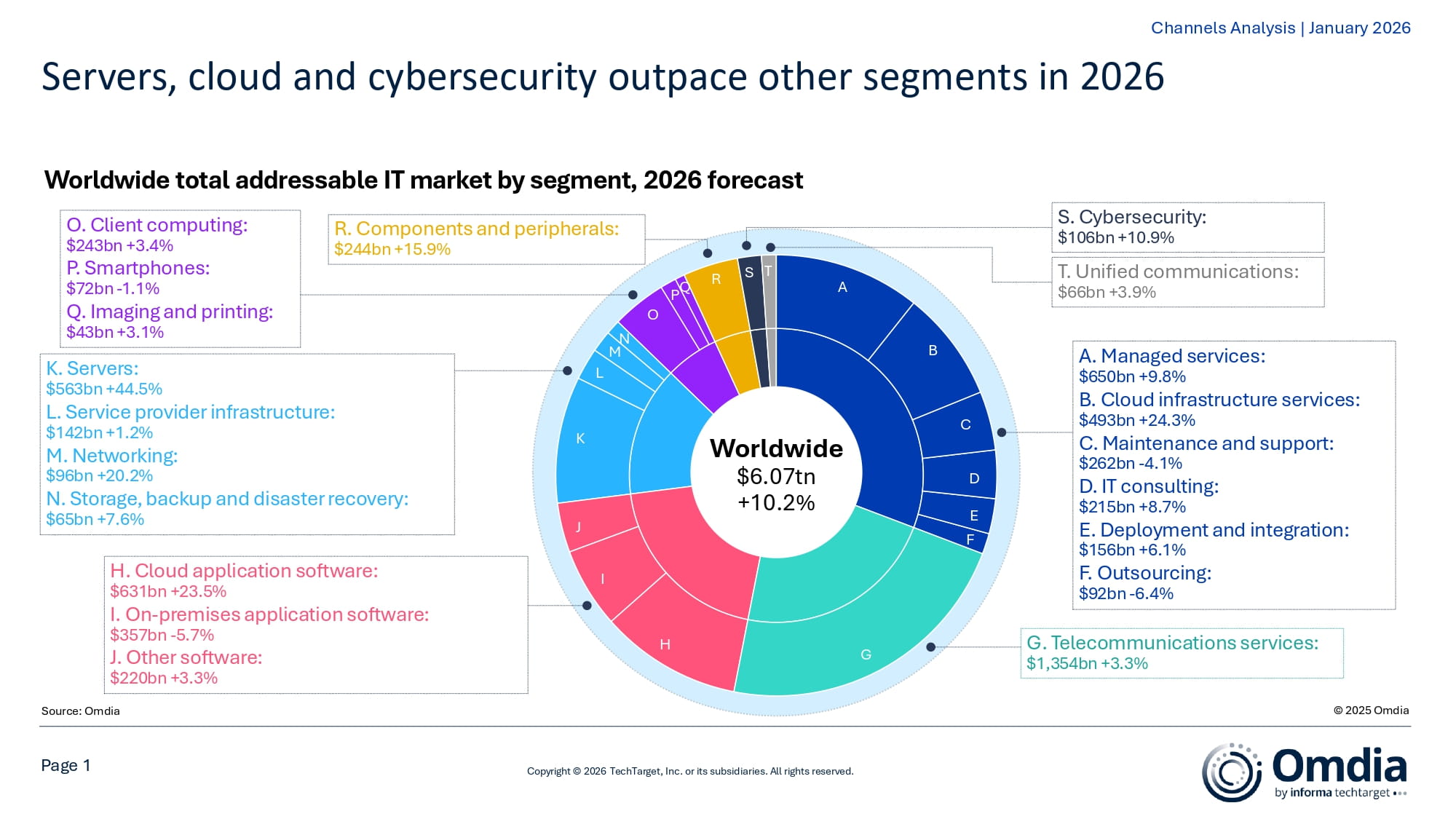
The worldwide total addressable IT market is expected to grow 10.2% in 2026 to reach an overall market size of $ 6.07 trillion. Despite the ongoing macro risks with supply chain disruption, increasing trade tensions, political instability and wider geopolitical issues, IT spending is expected to continue its divergence from GDP growth.
The three major categories are expected to grow as follows in 2026:
- Technology (products): $2.85 trillion, forecast to grow 14.3%
- IT services: $1.87 trillion, forecast to grow 9.6%
- Telecom services: $1.35 trillion, forecast to grow 3.3%
The fastest-growing segment in technology products will be infrastructure at 29.2%, driven by the AI buildout.
The next fastest-growth category will be components and peripherals, with the shortage in components such as DRAM driving a move to stockpile as prices surge.
While IT services are predicted to grow at their fastest rate in years, hardware and software will still grow faster.
Regionally growth expectations vary:
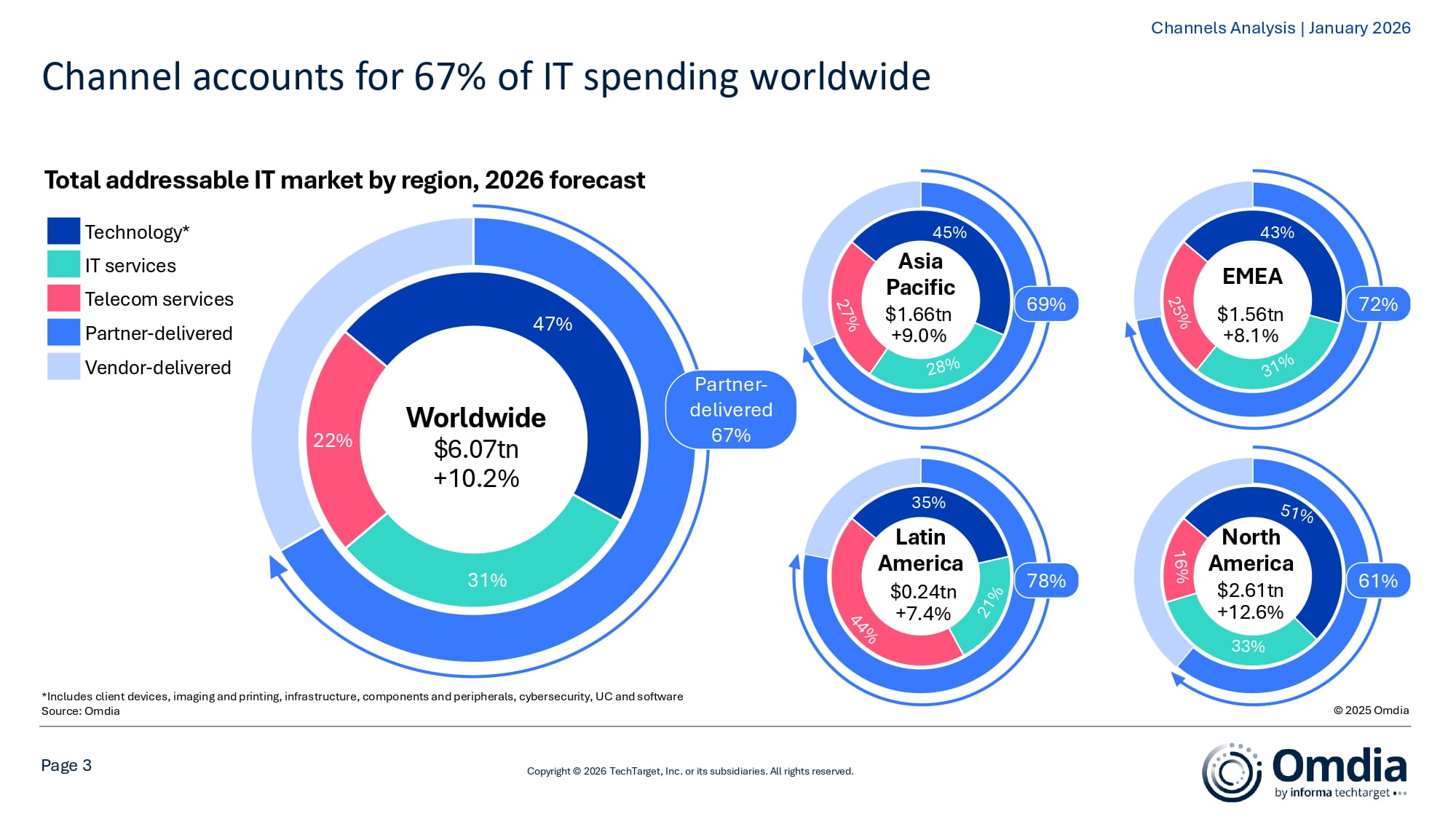
- North America is forecast to grow at 12.6% and will account for 43% of the overall market.
- APAC is forecast to grow at 9% and will account for 27% of the market.
- EMEA is forecast to grow at 8.1% and will account for 26% of the market.
- LATAM is forecast to grow at 7.4% and will account for the remaining 4% of the market.
The United States retains the largest share from a country perspective, expected to drive 40.8% of the total, with China accounting for 13.6%.
From a customer perspective, large enterprise (Over 1000 employees – including public sector) will account for 47% of the overall market, with mid-market (500-999 employees) at 13.8% and SMB (1-499 employees) expected to represent 39.2%.
Omdia’s Enterprise IT Insights survey highlights that 72.9% of organizations expect growth in their IT budgets in 2026, up from 60.2% in 2025. 24.7% expect growth increases of more than 10%, while only 6.5% expect IT budgets to decline.
Despite direct hyperscale expenditure, indirect vendors cannot go alone; partners continue to play a key role
Partner-delivered annual growth is expected to reach 6.7% in 2026, representing a slight improvement on 6.3% in 2025. However, vendor-delivered annual growth is forecast to soar by 18.1%, driven primarily by hyperscaler and neocloud AI infrastructure expenditure, which highlights the shifting dynamics of global IT spending.
Continuing the decade-long decline, partner share of the total addressable IT market will drop to 66.7% in 2026, down from 70.1% in 2025, as hyperscalers continue to increase CapEx investment, initially in cloud and now in AI infrastructure, to deliver services.
Partner influence varies by region and country, reflecting local market dynamics. North America will record the lowest partner share, with partners accounting for 61.1% of the total addressable IT market in 2026, a sharp drop from over 70% just four years ago. By contrast, Latin America will maintain the highest partner-delivered share at 78.1%, while EMEA will stand at 72.2%, down from 80.1% in 2016. In Asia Pacific, partners will represent 68.6% of IT spending.
While partner-delivered share is dropping, partners will continue to hold the most influence on organizations’ IT decisions, and overall spending with partners will increase in 2026. A number of vendors are focusing on SMB growth strategies in 2026, which will see a greater reliance on partners and distributors.
Partners are also faced with mounting complexity, driven by rapid technology shifts, evolving customer expectations, emerging business models, the impact of hyperscale marketplace procurement, and a reset in vendor relationships that increasingly favor larger partners. With the wider supply chain issues, components shortages, and ongoing geopolitical tensions, partners will face a volatile 2026.
Partners who invest in complementary and adjacent skills and develop services capabilities will be well-placed to grow. Many partners create scale through acquisition, but rarely create joint sales motions to drive cross-sell. Partners still operating in siloed sales motions across product areas do not create differentiated value. For example, a partner that operates in infrastructure and cloud services, and acquires a cybersecurity consultancy business should tieying these sales motions to improve business outcomes for customers. Without this the partner cannot, for example, offer compliance services, secure by design infrastructure and cloud services, or vertical offerings, that manage regulated environments.
Supporting the partner ecosystem in 2026
As the partner ecosystem becomes more complex and the pressure on partner business models intensifies, how can vendors best support their partners in 2026?
1. Program structure to reflect partner value
Programs need to support an expanded partner base comprising many different partner types and sales motions.
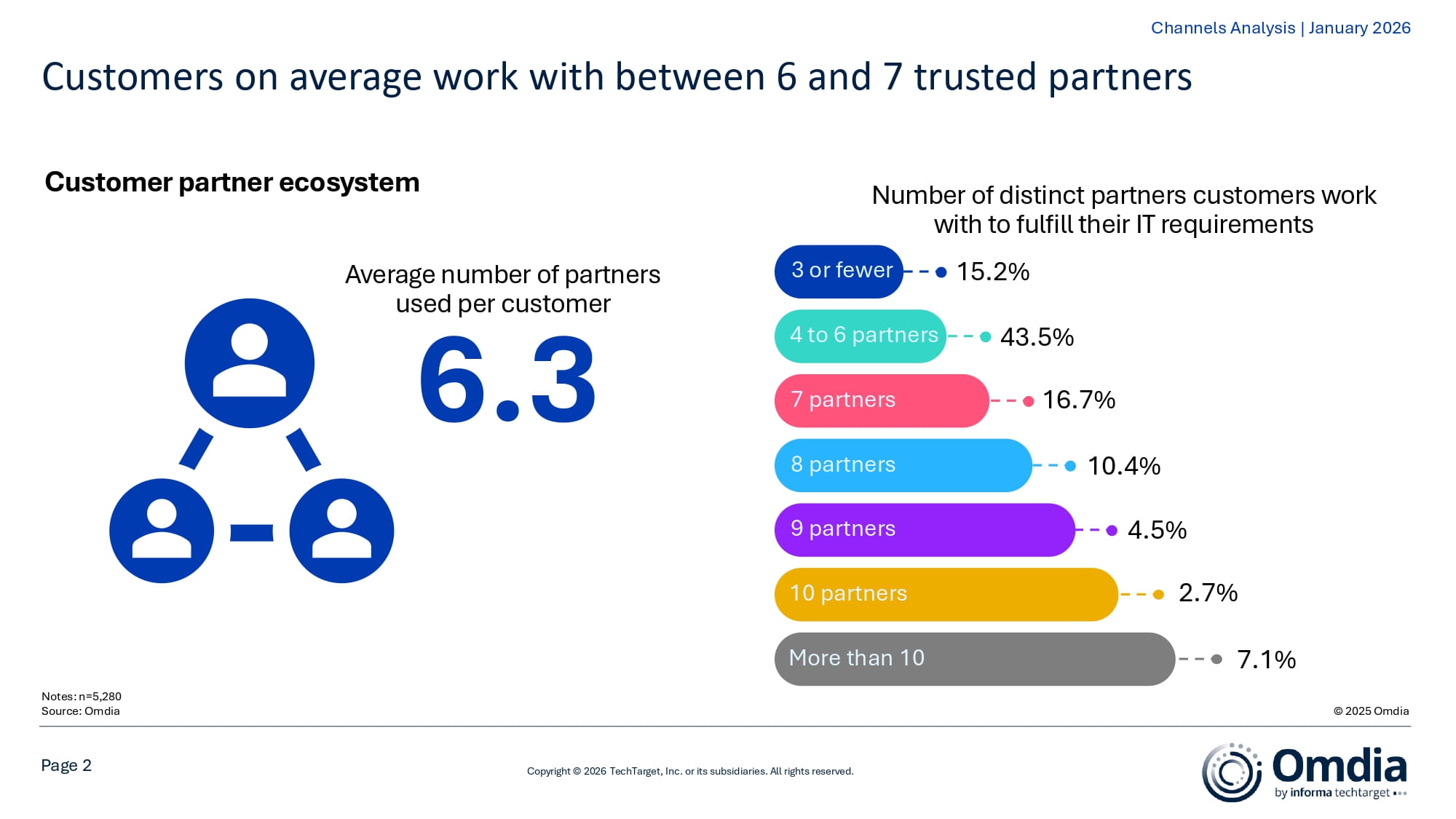
Omdia data shows that customers are working on average with 6.3 partners, reflecting the increasingly complex partner ecosystem that both vendors and partners are facing. This brings further complexity to vendor partner organizations and how vendor partner leaders need to anchor modern partner programs around engagement models.
Partner definitions are blurring. Omdia data shows that partners are operating have at least three business models, for example, resell, managed services, and professional services practices.
2. Path to profitability built around services opportunities
Partner programs, therefore, need to evolve from the tier-based, one-size-fits-all approach to one that supports diverse partner types, partner business models and value-based programs across the customer lifecycle.
Incentives should be balanced to reflect these motions and move beyond the point of transaction and reward partners for specific outcomes such as up and cross-selling, pre-sales engagements, retention and renewals, training and certification.
3. Simplification and automation
Partners are also seeking improved user experience. Vendors need to move from basic PRM portals and enablement platforms to provide ecosystem management platforms, with integrated tooling across internal and external platforms.
In order to support these rapid shifts, vendors need to move from siloed data and disconnected tools to provide a unified data layer, capitalizing on AI for automation and personalization.
4. Co-models become the norm
To support the fact that their partners are often working as part of a wider ecosystem supporting customers across complex lifecycles, vendors need to support co-creation, co-selling, co-marketing, co-innovation co-development and help facilitate engagements between partners, ISVs, distributors, resellers and GSIs. Programs will need to adapt to recognize the value that the influence each partner providesplays at the different stages across the customer journey. Increasingly, vendors will need to track all of the different touchpoints in a deal to truly understand the value that partners bring.
5. Wider partner ecosystem
Driving engagement across the expansive partner ecosystem will be key to vendor success. Those who thrive in 2026 will continue to drive investments in GSIs, services partners, ISV and alliance partners as well as placing focus on newer routes-to-market, including hyperscaler marketplaces.
More from author


More insights
Assess the marketplace with our extensive insights collection.
More insightsHear from analysts
When you partner with Omdia, you gain access to our highly rated Ask An Analyst service.
Hear from analystsOmdia Newsroom
Read the latest press releases from Omdia.
Omdia NewsroomSolutions
Leverage unique access to market leading analysts and profit from their deep industry expertise.
Solutions
