

The coronavirus disease now raging across the world is an unexpected disaster for the makers of smartphone display panels.
The coronavirus disease now raging across the world is an unexpected disaster for the makers of smartphone display panels. With markets worldwide suddenly brought to a standstill, smartphone panel shipments for the first quarter of 2020 are now projected to be down a steep 19% compared to the much more optimistic forecasts made previously in December 2019.
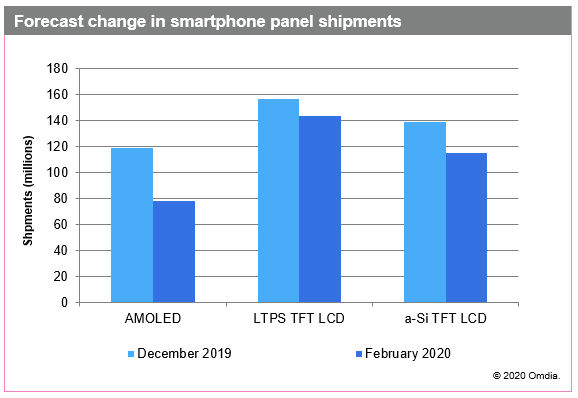
Because of the disease, also known as COVID-19, total smartphone panel shipments for the three-month period ending in March 2020 have now been revised to 78 million panels, a considerable adjustment down from the original projection of 119 million.
These findings are contained in the Omdia report, Smartphone Display Shipment & Price Tracker – February 2020, the most recent edition of a monthly tracker that monitors smartphone panel shipments by display size, resolution, and technology.
The steepest fall in percentage terms occurred in the segment for AMOLED panels, which are utilized by marquee brands such as Apple and Samsung for their priciest flagship smartphone models. Here shipment volume was adjusted down by 35%. Similarly, shipment volumes were cut for TFT LCD panels, by 17% for the low-temperature polysilicon (LTPS) LCD segment; and by 8% for the amorphous silicon (a-Si) LCD segment. The chart below shows the disparity in the forecast between the two periods for all three smartphone panel segments.
Forecast change in smartphone panel shipments, Omdia
The decline in shipments applied to virtually all 13 display panel makers, without exception. The makers include the South Korean giants Samsung Display and LG Display; China’s BOE, also a colossus in the display panel business, as well as a smaller but still considerable contingent comprising CEC Panda, CSOT, IVO, and Tianma; the two Japanese makers of Sharp and Japan Display; and Taiwan’s AUO, HannStar, Century, and Innolux.
Prior to the arrival of COVID-19 and its eventual turn into a pandemic, smartphone panel makers were in good shape, building up inventories in anticipation that average selling prices would go up to reflect rising component prices—market trends that would have benefited the panel makers and increased their revenues. But COVID-19 put a freeze on the smartphone market, and initial high hopes for a thriving market very quickly evaporated as panel makers—like the rest of the world—adjusted to a new reality.
February results
For the month of February, smartphone panel shipments amounted to 102 million units, down 17% from a month earlier in January. In the panel size category, the steepest drop in monthly shipments was in the segment for panels measuring 6 inches or more, down 24% from January.
While shipments during the period also fell in the 5.x-inch-size segment, the opposite was true for smartphone panels in the two smallest segments. February smartphone panel shipments surged 57% in the 3.x-inch segment, and by a more modest but still respectable 12% in the 4.x-inch segment. Overall, shipments of mobile display panels in February amounted to 162 million—a total that includes display panels for smartphones and the lower-end type of mobile phones known as feature phones.
Feature phones, priced much lower than smartphones and characterized by their button-based input and small displays, continue to be popular in the developing world. Chinese display manufacturers HannStar and BOE are the most prominent makers of feature phones.
The Smartphone Display Shipment & Price Tracker – February 2020 is offered under Omdia’s Components & Devices research pillar. Omdia subscribers also have full access to our Displays research service and its five research categories, namely Display Manufacturing & Supply Chain, Display Materials & Components, Large Displays, Small & Medium Displays, and Touch & Interface.

