Mass consumer spending in the US will be affected, business investment will be delayed, and the motion controls market is estimated to show a significant contraction in Q3 2020 as a result.
The spread of Covid-19 in the United States is impacting the economy. Talk of recession in 2020 has started to increase. The growth rate of the motion controls market in the United States dropped from 6.2% in 2018 to roughly 3.4% in 2019.
From our contacts in the motion controls market, it seemed that the daily operations of many were not impacted before the shutdown. They had enough components and little foreseeable problems with the supply chain. However, as the outbreak progresses, the story is likely to be very different. Mass consumer spending in the US will be affected, business investment will be delayed, and the motion controls market is estimated to show a significant contraction in Q3 2020 as a result. Overall the decrease in end-consumer demands will eventually impact the revenues of manufacturers of motion control products.
In the 3C electronics industry, for example, the unit shipments of the five notebook brands (HP, Lenovo, dell, ASUS and Apple) were down 40% in February 2020 (compared to the January) and 38% compared to the same period last year. Although China's factories are now almost fully operational, with capacity back to 70 percent of normal levels, the decline in capacity between January and March was significant. The National Bureau of Statistics reported that China's production capacity for mobile phones fall 34% in January and February from a year earlier. As the outbreak of Covid-19 spreads across the world, this is a situation that we expect to see repeated in Europe, the US, and beyond.
The performance of the semiconductor industry in 2020, driven by the 3C electronics industry, is largely dependent on how quickly the outbreak can be contained and when most people can return to normal life. For electronics and semiconductors, the two key factors are supply and demand. Two weeks ago, some American interviewees were not too worried about the future, as they saw increase in their Q1 2020 revenues and believed factories may not be impacted seriously by a one or two month lockdown, as there were no concerns with supply chains.
Most motion control vendors in the US, reply mainly on domestic components. The belief is that production will soon recover, once the outbreak is over. However, with the development of Covid-19 in the US, people are becoming more uncertain toward the future. Even if Covid-19 is brought under control by the end of June in the US, second-half production won't fully make up for first-half production losses.
More importantly, the demand side is different. Companies are downsizing their employment to buffer against the economic slowdown due to the Covid-19. Many families will see their incomes fall and they will reduce unnecessary spending as a result, potentially reducing demand for electronic products. Much of the spending will be postponed until the outbreak is controlled and people are back to normal life. Electronics assembly and semiconductor sectors will certainly see significant declines in the first half of 2020 due to supply constraints and a falloff in demand. Assuming Covid-19 is controlled by the end of Q2 2020, and the US government can protect the economy from significant job losses, supply and demand should return to normal levels by the end of the year.
Covid-19 is also adding to the woes of the automotive industry, which has been sluggish for a couple of years. The big three U.S. automakers closed their plants, as a precaution against the virus, whilst closures elsewhere are estimated to increase disruptions to the supply chain. In addition, car sales have suffered as people have been restricted on their movements. From what we saw in China, demand for automobiles in the US could decline by over 90% during the outbreak. The forecasted drop in demand could lead some automakers to adjust production.
michellewhitcombinformacom_2020_3_26_21_14_3_capturepng
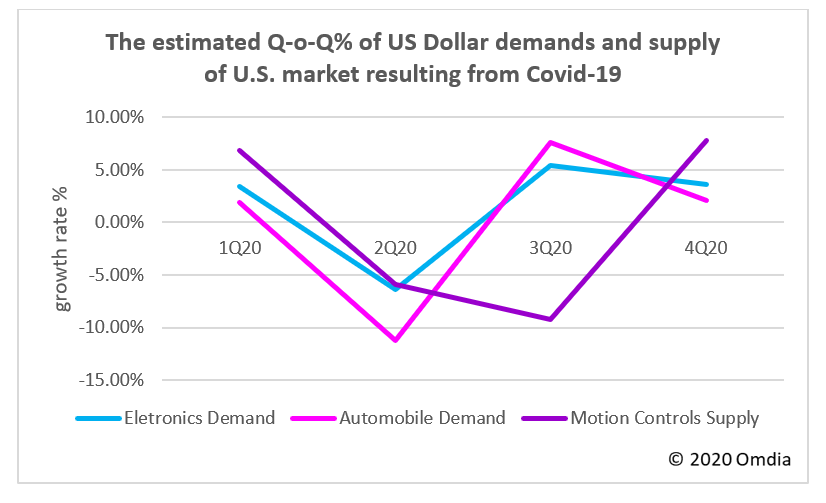
Omdia predicts that US consumer electronics and automotive demands will decline in Q2 due to the uncertainty of the current outbreak, and motion control manufacturers will see significant declines in production in Q3 as a knock-on effect. Once the US controls the outbreak, the demands for electronic products and cars are forecasted to rebound. This is expected to happen in Q3, whilst the motion controls market is likely to be 3 months behind and will show recovery in Q4.