

Changes in display demand for 2020 are forecast based on short- or long-term impacts of COVID-19.
Key Findings
- If the impact of COVID-19 extends over a long period of time, set manufacturers will face a long-term production setback and panel production lines will most likely be affected. Accordingly, panel demand in the second half of 2020 (H2 2020) may be less than previous forecast, triggering instability in panel supply and demand.
- If the impact of COVID-19 ends up being short-term, the production line of set manufacturers will be normalized and panel demand reduction in H2 2020 would be expected to be limited. Tight panel supply and demand could prolong if the existing supply capacity shutdown is carried out as planned.
The coronavirus that originated in China has led to many variables in the display industry, bringing unpredictable changes in market conditions. At present, issues involve production and the supply of panels at fabs and various major component facilities. The original equipment manufacturers’/original design manufacturers’ (OEM/ODM) fab utilization that correspond to panel demand are being directly affected.
Omdia periodically updates the Omdia mid- and long-term forecast at the end of every quarter, and there is a planned release in early April. Prior to this, Omdia examined the changes in demand by major application.
First, Omdia examined applications such as liquid-crystal display (LCD) TVs, desktop monitors, notebooks, and tablet panels that take up a large share in terms of area among large-size displays. Also, Omdia studied changes in demand with two assumed scenarios below, which will allow for an assessment in changes in demand in accordance with future developments caused by COVID-19.
Scenario 1
- Prolonged Covid-19
- Long-term production setback for OMDs/OEMs and a slowdown in end market sales
Currently in February and March 2020, there is a slight decrease in panel shipment, but the panel line utilization rate is not on a significant decline compared with the existing view. Panel lines located in China are contributing to production setbacks, but the panel line capacity utilization of relatively less-affected countries such as South Korea, Japan, and Taiwan has temporarily gone up. Also, set manufacturers have not significantly reduced panel orders amid concerns over short-term panel production issues.
However, although set manufacturers are believed to be facing bigger production setbacks, they are not reducing orders while increasing inventory reserves. This is why there may be changes according to future market conditions. In particular, this scenario would cause the set manufacturers’ inventory to dry up in a short period of time. In addition, if sales volume shrinks because of a fall in end market demand, set manufacturers will inevitably have to reduce panel purchases compared with the existing plan from the second quarter of 2020 (Q2 2020) onwards.
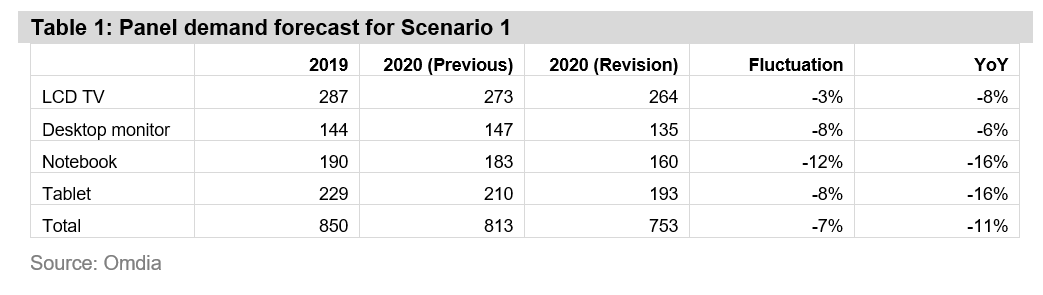
In such a case, the panel demand of major applications is forecast to fall up to 7% compared with the previous forecast and 11% compared with the previous year.
michellewhitcombinformacom_2020_3_12_19_42_37_capturepng
Scenario 2
- COVID-19 has a short-term impact
- Eased production setback for OEMs/ODMs and minimized fall in end market demand
On the other hand, under scenario 2 in which the impact of COVID-19 is limited and production and supply issues are resolved quickly, the impact on panel demand will be reduced.
If production setbacks are resolved, set manufacturers will bring up production to the maximum to meet 2020 sales targets, and it will be difficult to reduce panel purchases because of high-season market demand in the H2 2020 on top of the summer sports event demand.
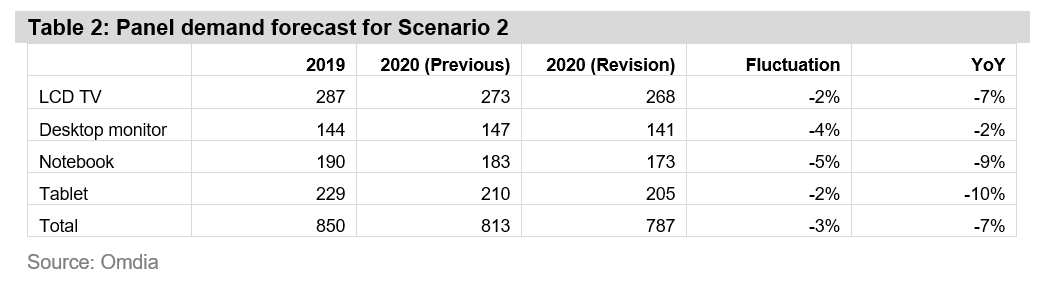
In such a case, the panel demand of major applications is forecast to fall by a limited 3% compared with the previous forecast and 7% compared with the previous year.
michellewhitcombinformacom_2020_3_12_19_43_24_capturepng
Omdia will update and publish the latest long-term demand forecast in early April. Omdia will adopt the latest changes in the market depending on how COVID-19 spreads.
