

Starting from an estimated $17 billion in 2019, the market for global NFV software and services is projected to hit $35 billion in 2024. Questions remain around how 5G business models will shape up and how the broadening partner ecosystem will share revenue, so Omdia remains conservative on NFV spend growth over the forecast period.
Omdia view
Summary
Network functions virtualization (NFV) is positioned as a software that will allow operators to drive down costs, improve network operations, and deliver new, innovative services to customers. After a year in lockdown due to the COVID-19 pandemic, these promises are more important than ever—especially as major cloud providers take their piece of the 5G digital service pie. Omdia believes operators’ investment in NFV (and other carrier network software) will continue to rise over the next four years, as operators try to stake their claim as leading digital service providers.
NFV SDN adoption in 2020
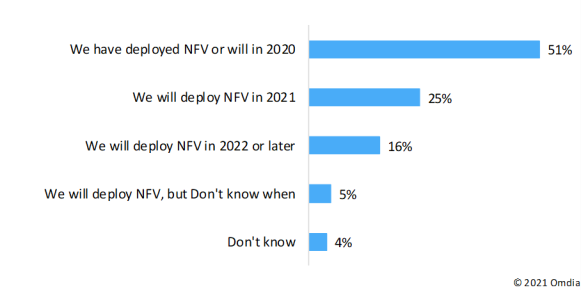
The telecoms industry is nearing the end of 2020—a year in which the COVID-19 pandemic drove employees back into their homes to work, to entertain, to teach their children. Perhaps more so than any other year in recent history, 2020 reminded us of connectivity’s significance. Reliable connectivity helps industries thrive through new service offerings; and operators lay the foundation for this progress. Which brings us to service providers’ NFV adoption. In August 2020, Omdia surveyed 102 global operators about their attitudes and behaviors towards NFV; and its adoption is on the rise. 96% of respondents reported that they will deploy NFV over the next five years. In fact, over 50% of respondents indicated that they have already deployed NFV. These adoption figures and projections help drive Omdia’s NFV forecast, which will be updated twice yearly in 2021.
Figure 1: NFV adoption in operators’ networks
 Source: Omdia
Five-year forecast for operator investment in NFV
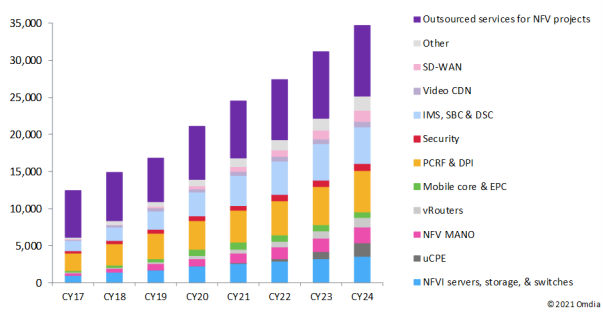
Omdia’s NFV technology forecast represents the sum total of multiple regional and software product forecasts. Starting from an estimated $17 billion in 2019, the market for global NFV software and services is projected to hit $35 billion in 2024. The main drivers for the forecast are network agility, lower costs, and new service delivery. Questions remain around how 5G business models will shape up and how the broadening partner ecosystem will share revenue, so Omdia remains conservative on NFV spend growth over the forecast period.
Figure 2: Operator spend on NFV, by application, 2017–24
 Source: Omdia
Other key drivers for NFV are mobile edge computing, network slicing monetization, and 5G core migration.
Network slicing: Operators will need to be clear regarding what they can offer in terms of network slicing. Cloud-native infrastructures still need upgrades before 5G slicing can take place across all major domains (i.e., core, transport, RAN). Progress has been made in the virtualization of core and transport, but more work needs to be done in the RAN.
NFV + edge: When used in conjunction, NFV and edge compute can lead to scalability and low latency—two critical elements in next generation networking. As operators continue (or start) the move toward virtualized networks, edge infrastructure will become critical to support 5G services and applications. Today, operators are faced with three top challenges to deploying edge:
- high costs
- unclear business case
- technical issues.
As technical issues get worked out, and the business cases sharpened, Omdia believes the industry will move closer to commercialized edge applications. This is likely in three to four years.
5G core migration: The migration to 5G core also factors into the NFV forecast. 5G introduces several innovations to support new services. The first is upgrading the legacy mobile core to a service-based architecture 5G core. The new core provides greater capabilities, built as elements, to provide operators greater flexibility to allow new use cases. These elements are broken down into network functions that take advantage of virtualization and cloud-ready software.
For additional data around NFV software applications, regional breakouts, and NFV hardware equipment, refer to Omdia’s recently published NFV forecast excel deliverable.
Appendix
Further reading
Network Function Virtualization (NFV) Technology Forecast: 2017–24, (December 2020)
The Intersection of NFV and Edge: NFV adoption and vendor leadership, (September 2020)
Market Landscape: NFV technology, (July 2020)
Author
Stephanie Gibbons, Principal Analyst, Carrier Network Software