

China’s box office was higher than the US’ for the first time in 2020, and local films took a high market share. Hollywood needs a deal to form a future relationship with the Chinese market.
Omdia view
Summary
China’s box office was higher than the US’ for the first time in 2020, and local films took a high market share. Hollywood needs a deal to form a future relationship with the Chinese market.
Hollywood lacks a deal with China
China’s box office was higher than the US’ for the first time in 2020, albeit in unique circumstances, and this is likely to repeat in 2021. The Chinese box office earned ¥20.4bn ($2.9bn), down 68.3% compared with 2019. However, the market was running at 92% of 2019 levels (weekly comparisons) by the end of 2020, which was unusually high relative to the world.
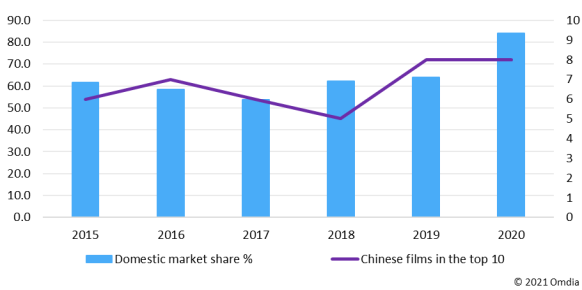
The absence of US films left the market fully open for Chinese movies to flourish, with The Eight Hundred and The Sacrifice taking the top two places at the box office and accounting for one-fifth of total revenues at the box office. This is a high concentration level for the leading two films. Local films accounted for an elevated 83.7% of the market compared with 64.1% in 2019, with overseas films making up a measly 16.3%. There were very few US films among the highest-grossing films, and the best-earning movies in China all had local themes of struggle, honor, and sacrifice. This is an indication of the way Chinese films are now appealing to their audiences, and this also has implications on the type of movies they need to sell to China.
The import quota deal that regulates the number of overseas productions coming into the country on a revenue-share deal was not successfully renegotiated before COVID-19 changed the cinema world, and the deal expired in 2017. There was the outline of a deal in early 2017, but poor US–Sino relations ended any chance of a new agreement.
The terms of the previous deal gave Hollywood a 25% takeaway share for a total number of 34 movies allowed into China on a revenue-sharing basis. The number of revenue-sharing films began to exceed the allowed quota in 2016, a year when the elevated box office growth rates of the previous decade came to a halt and authorities and distributors may have looked at pushing the market up.
Figure 1: The success of China’s domestic films
 Source: Omdia
The Chinese film sector does use overseas skills in some key areas (such as visual effects [VFX]). Those professionals found it difficult to travel into China in 2020, which caused production blocks. Production fell from the now-normal level of over 1,000 domestic films to 650 in 2020.
Within the production sector and in line with the Chinese government’s strategy, there has been a move toward larger-budget domestic productions with local themes. Overseas skills are less relevant in these cases, and COVID-19 may have exacerbated this trend. This has a potentially long-term impact on the success of non-Chinese productions in the increasingly important Chinese market.
Domestic films have improved in ambition and quality thanks in part to the overseas expertise that the US and other countries brought to China’s film production sector. This has had a downward effect on Hollywood’s share of the market and may require a rethink of the strategy for films that may come to rely on China. The US studios' market share is unlikely to rise, especially in the light of Chinese government domestic support strategies, but the longer-term question is whether the US’ share of the market will further decrease or whether it has stabilized.
This would depend on the new US government’s ability to negotiate a new deal that gives Hollywood defined access over a period. Currently, US films are being allowed in despite there not being a deal in place, which does not inspire the business certainty that Hollywood would like to see.
Until we see the outlines of such a deal that will shape the next steps of a China/Hollywood relationship, it is difficult to assess China’s future potential for non-Chinese rights holders. However, the stakes are high because potential Chinese revenues are an increasingly important part of a film’s revenue potential. APAC’s proportion of the global box office in a normal year will approach 50% in the next five years, and China will make up a large slice of that. Content producers that aim at a global audience cannot ignore this, films will need to be greenlit with these audiences in mind, and different cultural and political norms are likely to require artistic and economic compromises. This will be a sensitive path for Hollywood to navigate but doing so is key to its future success.
Appendix
Author
David Hancock, Chief Analyst, Cinema
