

Omdia view
Summary
James Bond’s No Time To Die was released in UK cinemas on Thursday 30 September, nearly two years after its original release date, and 18 months after the COVID-affected push back from April 2020. The iconic British movie was the first major film to postpone its global release once COVID-19 hit the world, and had to do so second time as the virus was still prevalent by November 2020. This is one of the reasons why this movie release is so anticipated: its perspicacity on the original postponement and accuracy of the data surrounding the second gave it the role of bellwether for the “industry versus the virus.”
Bond aiming to prove it is no time for cinemas to die
The first data out of the UK and global releases is highly encouraging. In the first four days, the film had racked up 1.62 million pre-sold tickets (on a par with Skyfall) and generated £4.6m ($6.3m) in the first day of release (Thursday), which is 13% above Spectre (2015 and a Monday release), and 26% below Skyfall (Friday opening in 2012). The first weekend in the UK grossed $29m, and $119m in global revenue, exceeding expectations. The two predecessor films are the third and second highest-grossing movies ever in the UK respectively, after Star Wars: The Force Awakens. All in all, Eon and Universal couldn’t have hoped for a better opening or higher global anticipation for Daniel Craig’s last outing as the British spy.
For obvious reasons, the UK is a key market for a Bond film. Overall, in a given year, the UK accounts for 4–5% of global box office. However, the UK has accounted for 14% of the last two Bond title’s revenue, and launching strongly in its “domestic” market is crucial to Bond’s global success. The film is a global event though, with traditionally strong performances in Scandinavia, Germany, Switzerland, the US, Australia, New Zealand, and others.
Table 1: Highest-grossing Bond titles ($m) (not inflation adjusted)
Title | Year | US BO | Int’l BO | Total BO | UK BO | UK as % of |
|
|
|
|
|
| total |
Skyfall | 2012 | 304.4 | 804.2 | 1108.6 | 161.2 | 14.5% |
Spectre | 2015 | 200.1 | 680.6 | 880.7 | 124.5 | 14.1% |
Casino Royale | 2006 | 167.4 | 449.1 | 616.5 | 120.6 | 19.6% |
Quantum of Solace | 2008 | 168.4 | 421.2 | 589.6 | 80.8 | 13.7% |
Die Another Day | 2002 | 160.9 | 271 | 431.9 | 59.2 | 13.7% |
Source: boxofficemojo
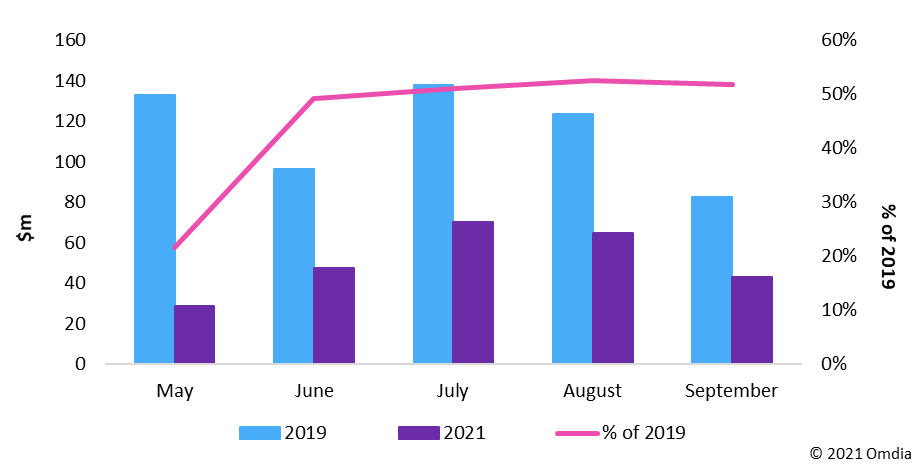
The variables behind successful cinemagoing post-COVID-19 are relatively few. Broadly speaking, revenue will be affected by how many cinemas are open, how many films there are, what restrictions are in place in cinemas, and what is the level of consumer hesitancy. As of September 2021, 83% of the world’s screens are open, and there is a stream of attractive movies in the pipeline (Dune, Top Gun, Spider-Man, Ghostbusters, Eternals, Matrix). Most countries do still have some form of social distancing measures in place, although the UK does not. The more unknown figure is the level of consumer hesitancy. In the UK, since June, the cinema market is tracking at around 50% of the 2019 level.
Figure 1: UK box office, 2021 against 2019
 Source: Omdia
Maybe not uncoincidentally, in the US (no UK data) around half (49%) of admissions are generated by 11% of cinemagoing people—the high frequency users that are avid consumers of the cinema experience. The remaining half of admissions are made up by the less frequent cinemagoers, who pick a few movies a year to watch in the cinema. Therefore, the reason behind lower attendance than two years ago seems to be consumer hesitancy, probably amongst the older demographic and less frequent audiences.
It would be logical to assume that a majority of those going to the cinema over summer 2021 are keen cinemagoers; those who have missed the experience and went back as soon as they could. No Time To Die is a key marker in the return to cinema for this reason: data from Odeon shows that 40% of the circuit’s pre-sold tickets were to people who are returning for the first time since the re-opening earlier this spring. In addition, older audiences have been more prone to stay away from social spaces, including cinemas. However, around a third of Odeon’s pre-sold tickets have been to people aged 46 and over. This is absolutely crucial in overcoming hesitancy. I was lucky enough to go on holiday over summer, which required a flight. Despite not really wanting to, once I had been in an airport and on an airplane, the fear of doing that dissipated pretty quickly. I normalized my old behavior of taking a flight and this is the hope with Bond’s latest outing: if this film gets people back into cinemas once, the behavior will be normalized.
Bond is also a true test of the cinema, not just of a movie. The idea of Bond being sold to a streamer was briefly discussed in the industry but was a non-starter for one reason: Bond is the ultimate cinematic spectacle, and this was never going to happen, not only due to the film’s producers love for the cinema, but also because sending Bond to TV first would destroy the value that is carefully built up around each of the franchise’s outings, all conceived to be a truly cinematic experience. The experienced producers behind it understood the importance of open cinema screens to its true value, hence the delays, and any thought of experimenting with other release windows was far from their minds. How this film performs in cinemas is a crucial test to understanding if the pandemic has altered the perceived place of the cinema experience in people’s minds. So, while the revival of cinema is down to more than one film, this particular movie can speed up the process of overcoming a natural and understandable hesitancy in older audiences to go back to the cinema, and shaping the attitude of distributors and rights holders as the world re-opens.
In the sporting world, there has been recent discussion about holding the Football World Cup every two years, instead of the current four. The majority of people do not like this idea, saying it would devalue the event. Similarly, a Bond film every two years (as was common in the 1990s) would have the same effect. Bond is now a once every four years event for the world. There are technical reasons for this, mainly being because it is the output of one company, and not a part of a studio with slate financing behind it. Four years is also how long it takes to make this movie: the casting is painstaking; the financial, product placement, and merchandising deals take time to build, the locations time to choose, the sets time to build, and so on. This creates an anticipation for this film like few others (we can probably put Avatar 2 in this bracket too) and makes the new Bond even more anticipated than usual.
All in all, and with due respect to other films that have been released and performed well over the summer, this movie has the capacity to relaunch the cinema sector after a brutal 18 months. The type of film it is, and the global buzz it creates, not only highlights the unique nature of this property but also showcases why cinemas remain relevant. For cinema, this is no time to die.
Appendix
Author
David Hancock, Chief Analyst, Media and Entertainment
