

The open RAN RIC and app ecosystem continues to develop as more vendors enter the telecom space. Commentary includes excerpts from Omdia’s recent research in this space and a view of vendor perspectives.
Omdia view
Summary
In the just published Self-Organizing Networks and RAN Intelligent Control – 2023 report (see Further reading), Omdia uncovers the progress of the Open RAN (O-RAN) Alliance vendors and their innovative developments. This alliance of operators and vendors promotes competition for transforming telecom RAN infrastructure, and the RAN Intelligent Controller (RIC) platform and application vendors work hard to deliver on the promise of the technology. Paraphrasing NASA, the objective can be summarized as making the RAN “smarter, better, cheaper.” The O-RAN Alliance paves the way for a rich ecosystem of platform and application vendors seeking to enter the telecom market. An obvious goal is encouraging the upstarts to reduce RAN costs, but there is much to gain as innovative companies and forward-thinking operators look to innovations to generate additional revenue.
Leading RAN vendors are taking note and preparing to evolve their centralized SON (C-SON) solutions to accommodate the non-real-time RICs and rApps. However, their views on the near-real-time RICs and xApps range from wanting nothing to do with them to work-in-progress. The RAN vendors reasonably argue they can best implement the near-real-time functions, but this does not preclude expanding their reach by incorporating the best of the xApp vendors. Get ready and watch the RAN markets as the solutions mature and competition heats up.
Is open RAN ready?
As the cliché goes, “it’s still early days.” While that is true, the industry is at the left side of the S-curve as open RAN ramps to adoption and gains momentum. A common criticism of the operator-driven O-RAN Alliance is that the RAN is not ready, but that view glosses over “the innovator’s dilemma.” This is the phase when disruptive innovation starts as “not good enough,” but over successive improvements, it eventually meets the needs of the mainstream user (in this case, the telecom operator).
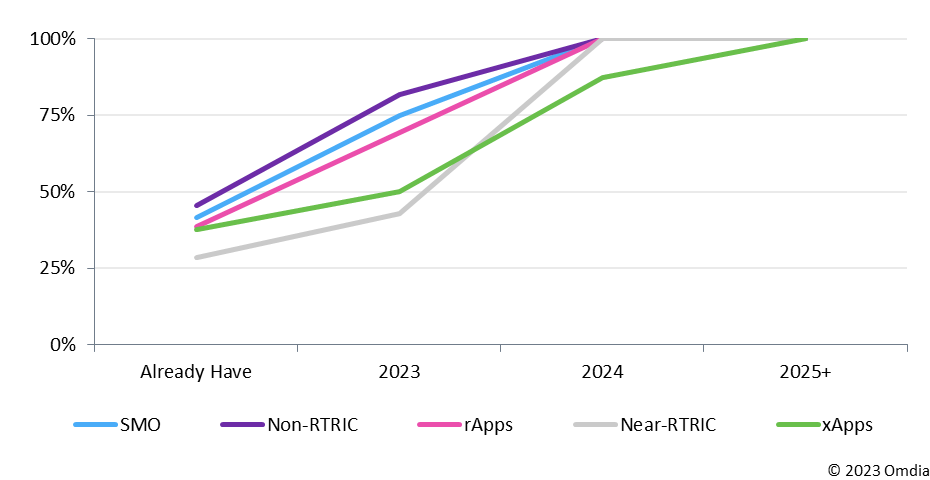
One piece of evidence that surfaced during Omdia’s research for this year’s Self-Organizing Networks and RAN Intelligent Control report was the market readiness of the RIC ecosystem (i.e., the RIC platform and application vendors). Surprisingly, about one-third of these vendors reported they have already received orders for service management and orchestration (SMO) and non-real-time RICs and their corresponding rApps. The early orders indicate that operators are willing to put their money on the line to find the benefits vendors promise. Virtually all the vendors expect orders by 2024, with the near-real-time open RAN RIC and xApps lagging slightly.
Regardless of the naysayers, the open RAN 5G vendors are ready and eager to deliver on their promises. Market competition is heating up as platform vendors add more app partners; one RIC vendor stated it would have around 50 partners by year-end.
Figure 1: Percentage of vendors that expect orders for open RAN components by year
 Source: Omdia
RIC engagements
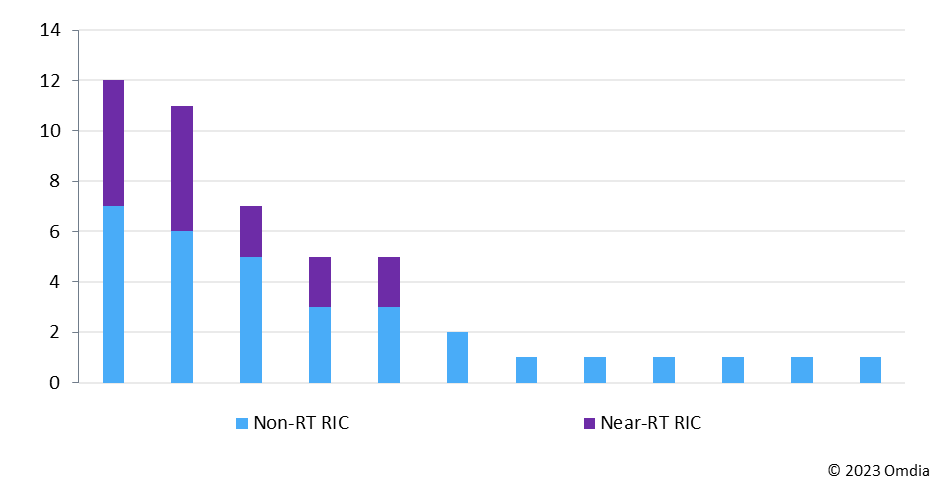
Omdia’s survey of vendors revealed their RIC engagements. We asked them: How many operators have you engaged with in proofs-of-concept or trials? Two-thirds of the vendors reported specific operator engagements with the non-real-time RIC (32 engagements in total). Understandably, vendors say the most popular solutions providing the quickest ROI that justify deployments are those that address opex and capex. The non-real-time RIC and rApps gain the most attention and are the most popular. Even the near-real-time RICs are in demand, though with fewer projects—at the moment. About one-third of the vendors cited engagements for the non-real-time RIC and xApps (16 engagements in total).
Figure 2: RIC engagements
 Source: Omdia; names of vendors are under NDA
The slower uptake of near-real-time solutions largely reflects the immaturity of the specifications and vendor solutions. Another factor is that some prominent RAN vendors prefer to keep near-real-time control within their centralized and distributed units (CUs/DUs), not third-party applications. Additionally, vendor and operator focus is currently on early wins and the “low hanging fruit.” For example, at Informa’s Big 5G Event, multiple vendors showed results for their r/xApps that manage the RAN energy consumption as examples of tangible benefits.
Omdia is looking for more activity in the RIC space in 2H23 as additional vendors get on board and the benefits of both the non- and near-real-time RIC and r/xApps become more tangible.
Appendix
Further reading
Self-Organizing Networks and RAN Intelligent Control – 2023 (June 2023)
Self-Organizing Networks and RAN Intelligent Control Market Forecast – 2023 Database (May 2023)
Author
Joe Hoffman, Principal Analyst, Service Provider