
Analyst opinion from Aaron West, senior smartphone analyst at Omdia, on the new AI announcements from Google
Omdia view
Summary
Google used its annual Made By Google keynote in October 2023 to launch Gemini AI on its Pixel 8 series. On August 13, Google brought forward this event to announce the Pixel 9 series earlier in the year and to show off Google’s latest AI innovations and plans, including how Google will manage personal data within hybrid AI.
Yet, despite more investment than ever, questions surrounding AI’s profitability and sustainability remain.
New Pixel 9 series’ AI features
The biggest announcement was that Gemini AI is taking over from Google’s personal assistant to allow users to ask questions and control their calendar, tasks, emails, notes, and more with their voice. In a live demonstration, which took multiple attempts to work, Gemini was used to scan a concert tour poster and combine that information with a personal calendar to suggest a day the user was free to attend.
By embedding truly context-aware AI, Google has brought us one step further to welcoming fully personable and knowledgeable AI into our lives. It is slowly looking more and more like the Scarlett Johansson–voiced AI assistant from the 2013 movie Her, which seems to be the end goal. Part of this development is the new Gemini Live, a free-flowing conversation with AI, allowing users to develop a rapport—although this is only available to Gemini Advanced subscribers.
Another AI feature coming exclusively to the new Pixel 9 phones is Call Summary, which provides a summary note following a call, saving meeting details and telephone numbers during the call.
Also, Pixel Screenshots stores and organizes all your screenshots, allowing you to search, recall, and ask questions later, even storing the source page to allow you to revisit it.
Table 1: Pixel 9 series specifications
|
|
Pixel 9 |
Pixel 9 Pro |
Pixel 9 Pro XL |
Pixel 9 Pro Fold |
|
Display size (inches) |
*6.3 |
6.3 |
*6.8 |
*8 (inner) 6.3 (outer) |
|
Thickness (mm) |
*8.5 |
8.5 |
*8.5 |
*5.1 (unfolded) *10.5 (folded) |
|
Weight (g) |
198 |
199 |
221 |
*257 |
|
Resolution |
1080 x 2424 |
1280 x 2856 |
1344 x 2992 |
*2076 x 2157 (inner) *1080 x 2424 (outer) |
|
Refresh rate (Hz) |
120 |
1–120 |
1–120 |
1–120 (inner) 120 (outer) |
|
Peak Brightness (nits) |
*2,700 |
3,000 |
*3,000 |
*2,700 (both) |
|
Camera primary (MP) |
*50 & 48 |
50 & 48 & 48 |
50 & 48 & 48 |
48 & 10.8 & 10.5 |
|
No. of primary cameras with OIS support |
1 |
2 |
2 |
2 |
|
Camera secondary (MP) |
10.5 |
42 |
*42 |
*10 (inner) *10 (outer) |
|
AP |
*Tensor G4 |
Tensor G4 |
*Tensor G4 |
*Tensor G4 |
|
RAM (GB) |
*12 |
16 |
*16 |
*16 |
|
Battery (mAh) |
*4,700 |
4,700 |
5,060 |
4,650 |
|
Wired charge (W) |
27 |
27 |
*37 |
21 |
|
Wireless charge (W) |
15 |
21 |
23 |
7.5 |
|
UWB support |
No |
Yes |
Yes |
Yes |
|
Release price ($) |
799 |
999 |
1,099 |
1,799 |
|
Note: * means an upgrade from the predecessors. There is no direct predecessor to the Pixel 9 Pro, with the Pixel 8 Pro being a more direct predecessor to the Pixel 9 Pro XL. |
||||
Source: Omdia
What is Google’s AI strategy?
Custom Tensor G4 chips and increased RAM power the new Pixel 9 smartphones, allowing the latest Gemini Nano AI to run on-device. What this truly means for users is that, initially, the latest Google innovations will run exclusively on Pixel 9 phones. These features will likely cascade down to other flagship Android devices, as low-end devices continue to rely on cloud computing and miss out on the truly intelligent AI features.
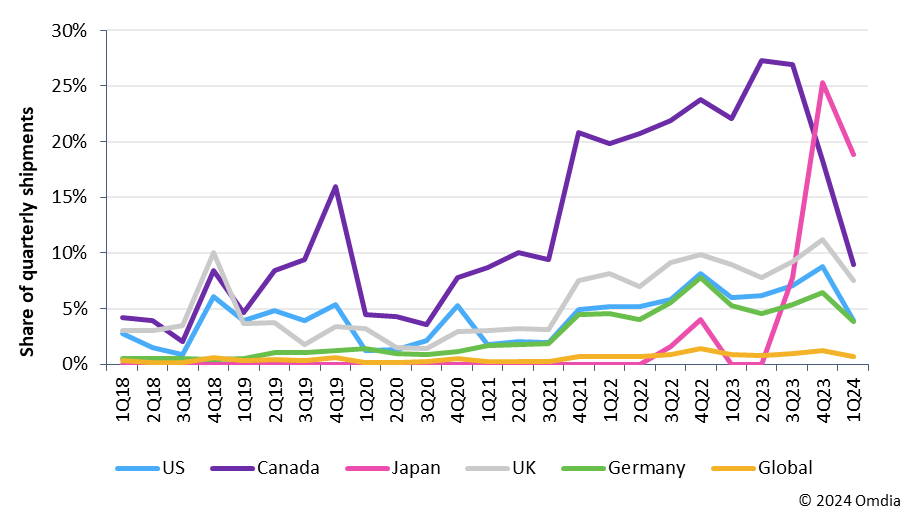
Developing first for Pixel and then leveraging the entire Android ecosystem has been Google’s AI strategy so far. Pixel phones accounted for just 1% of Android phone shipments in 2023. Even in its top markets, Pixel phones typically have less than a 10% share. However, with the Pixel 9s, Google is looking to expand into nine new countries, most of which are in Central and Eastern Europe.
Figure 1: Google Pixel share of Android phone shipments in its top five markets
 Source: Omdia
When will AI be profitable?
Monetizing and ensuring that the vast amount of investment being put into AI will pay dividends is a coming challenge for the industry. ChatGPT was made as a free product, costing $5bn to develop. Convincing people to pay for what used to be free is the biggest challenge of the AI industry. This extends beyond use in businesses and is increasingly becoming about personal lives. However, Google is laying the groundwork, with one year of Gemini Advanced included when buying a new Pixel 9 Pro phone.
AI’s commercial viability remains uncertain.
AI poses a threat to net-zero targets
Another key unanswered question is how to continue to develop AI capabilities without compromising companies and global net-zero carbon emission targets. This is due to the increasing data server computation AI causes and the subsequent increased electricity demands on data servers globally. The development of new models and the deployment of cloud models cause this increased demand.
The Organisation for Economic Co-operation and Development (OECD) predicts that large machine learning models (LLMs) will use over 85.4 terawatt hours of electricity each year by 2027. This would surpass the total electricity usage of Portugal, and without a plan to supply this increased demand with new renewable energy, it could delay the journey to net-zero.
Appendix
Further reading
Smartphone AI Market Landscape – 2024 (February 2024)
Author
Aaron West, Senior Smartphone Analyst, Components & Devices
