

The ZTE 5G Summit & User Congress 2024 took place in Istanbul, Turkey from November 5–7, 2024, during which ZTE, alongside various telecommunication players, were invited from across the globe to showcase the solutions that were implemented in various countries, addressing its unique challenges with ZTE as one of their key vendor partners.
Omdia view
Summary
Innovation in the age of 5G and AI was the key theme at the ZTE 5G Summit & User Congress 2024. The vendor showcased a range of solutions to enhance connectivity and potentially enable businesses to come up with new or improved applications as well as business models.
Improved applications with 5G and beyond networks
The conference, held under the theme "Flourish Through Intelligent Innovation," showcased use cases that have the potential to disrupt their respective markets. Conversations dug into existing and new advancements with 5G, 5G-Advanced (5G-A), AI, and various other tech.
While AI has been a hot topic and has certainly reshaped industries, discussions around it have become increasingly similar. It was refreshing to attend an event this year where "GenAI" and AI were not the sole focus. Instead, the focus of the event expanded to a more comprehensive vision: how bringing technologies together can create substantial advancements across sectors. This event offered a forward-looking perspective on tech-enabled evolution, with connectivity at the center of it all. Some selected use cases are below:
The low-altitude economy and maritime safety with 5G-A ISAC
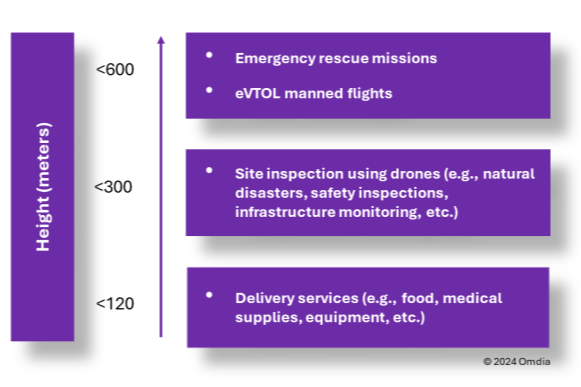
ZTE showcased its 5G-A Integrated Sensing and Communication (ISAC), which has been determined to be crucial for low-altitude and maritime use cases. For low-altitude applications, in comparison to older networks, ZTE highlighted that 5G-A ISAC provides better communication, navigation, and surveillance capabilities for drones and electric vertical take-off and landing (eVTOL) aircraft, ensuring efficiency as well as safety. Using recognition models, AI is used to enhance safety, such as to avoid birds and other drones while operating above ground.
Figure 1: Low-altitude applications
Source: ZTE
For maritime applications, where accidents and navigation challenges often result from limitations of previous solutions near ports or land, 5G-A ISAC addresses these issues by integrating radars with base stations. This enables 24/7 navigation through all weather conditions, real-time monitoring with a refresh rate of less than a second, continuous coverage over distances exceeding 10km, and improved sensing accuracy within 20 meters. Because sea vessels are quite large, this causes multiple points (or duplicates) of dispersion, causing false alarms when the ships sway. AI is used to determine the duplications, thus resolving the issues of false alarms whenever large sea vessels sway at sea.
Improved mobility in location-based VR entertainment
The virtual reality (VR) entertainment industry has been growing globally; however, hardware limitations have hindered scaling opportunities. One major challenge is that users must carry a heavy computing backpack attached to the VR headset to experience high-quality graphics. Unfortunately, the weight and heat from the backpack make extended use uncomfortable and increase the risk of damage or accidents. Adjacent solutions, such as headset rendering and Wi-Fi rendering, reduce the physical load on users but often come at the expense of graphics quality or limit the number of users per session, which restricts larger team-based experiences. In this case, ZTE’s solution involves having a MiFi device that weighs less than 200g attached to the headset that sends and receives transmissions to the baseband unit (BBU) with multi-access edge computing (MEC). This ensures that the graphics quality is retained with reduced physical weight while allowing multiple users.
Private 5G and wireless solutions for broadcasting events
ZTE showcased several use cases of broadcasting events that happened in China and Malaysia. The vendor highlighted that setting up large-scale events for broadcasting and streaming would often take a long time, and the video quality may not be up to the latest standards, especially for premium subscribers who are expecting superior-quality videos. Another notable example was that one of the camera crew operators disrupted a track athlete by accident with one of the cables attached to the camera, costing the athlete precious seconds. The solution deployed enabled cameras to be connected to 5G terminals in the backpack of camera crews, thus eliminating the exposure of bulky cables that get in the way or cause future unwanted incidents. Additionally, the 5G terminals are connected to the network with xGbps speeds and low latency. In addition to speed and latency enhancement, other noted benefits include faster deployment (within a day), highly reliable transmission (five hours without packet loss), and high-quality video (supports up to 8k).
A time of ongoing innovation—big and small
Networks, chipsets, AI, and other solutions are pushing boundaries and enabling new opportunities for the business and tech ecosystem. The event showcased other solutions, highlighting a time of ongoing disruptions where new innovations, efficiencies, and opportunities could happen. By harnessing 5G-A alongside various technologies, telecoms, vendors, and tech players are driving unprecedented levels of innovation. Some of the use cases offered a glimpse into potential advancements that could become mainstream within the next few years.
That said, not all solutions or business models are viable everywhere, as unique local conditions play a big part in deployments. For instance, drone delivery services may not be well-received in some countries, as they could impact employment rates and income sources—raising economic concerns. Additionally, an increase in daily drone traffic could also disrupt the natural aerial ecosystem, leading to resistance from regulators and environmental think tanks. Nonetheless, there are and will be solutions that will be more suited to local requirements.
Innovations have the potential to disrupt entire industries, even if they initially appear mediocre. Businesses must embrace innovation as a means of disruption that can drive unprecedented change. Past successes may no longer suffice, and businesses need to proactively rethink their business models and identify where innovation, combined with new-generation connectivity and various tech, could offer better services and value to their customers.
Author
Jensen Ooi, Principal Analyst, Service Provider Markets
