In May, Arnaud Deboeuf, chief manufacturing officer at Stellantis, warned the battery-electric-vehicle market could collapse if BEV prices don’t come down.
Well, it hasn’t collapsed yet. And even though Tesla and Mercedes-Benz have lowered BEV prices in China, BEV production costs remain sky-high due to inflation and ongoing supply-chain bottlenecks. Indeed, overall BEV sticker prices remain well above their internal-combustion-engine competitors.
When executives such as Deboeuf complain about high BEV prices, they are really complaining about the price of the battery that makes up between 35% and 40% of the cost of the vehicle.
And (just in case you live in a news bubble) that is because batteries are made from relatively rare, geographically constrained materials that are vulnerable to politics and supply disruptions.
Benchmark Minerals Intelligence anticipates “at least 384 new mines for graphite, lithium, nickel and cobalt are required to meet demand by 2035.” When recycling is factored in, the number remains still quite high at 336.
Fastmarkets expects to see a gap between supply and demand by next year. The company reports “global apparent demand is forecast to jump from 722,000 metric tons (mt) of lithium carbonate equivalent (LCE) in 2022 to 934,000 mt of LCE in 2023.” The company expects that jump in demand will result in an 89,000-mt LCE deficit in 2023.
These high costs and supply problems are pushing vehicle and battery makers to look for more abundant, less expensive materials for BEV batteries.
But it’s not so simple. There is no best formula that adequately addresses the five elements driving battery development: energy density, durability, performance, safety and cost. And any change in chemistry results in trade-offs among the five.
Furthermore, the lithium necessary for today’s BEV batteries is difficult to replace. It’s very lightweight and extremely conductive (a very important trait for batteries). The combination makes the metal extremely energy-dense and practically unique. Additionally, the chemistry common in today’s batteries has undergone decades of incremental improvements that further complicate replacing them. Not to mention the OEMs and battery manufacturers have well-established supply chains, years-long supply contracts and specific products and manufacturing processes built around these chemistries that make switching to something new that much harder.
Where Are We Today?
For the most part, the BEV industry relies on three major types of cathodes: nickel-manganese-cobalt (NMC), with a variation used primarily by General Motors that adds aluminum (NMCA), nickel-cobalt-aluminum (NCA) and lithium-iron-phosphate (LFP). These are generally paired with a graphite anode and a liquid electrolyte.
In fact, Adamas Intelligence reports “54% of battery capacity deployed onto roads globally in 2021 in new plug-in electric vehicles was powered by ‘high nickel’ cathode chemistries (i.e., NMC 6-, 7-, 8-series, NCA, or NMCA), 26% by ‘low nickel’ cathodes (i.e., NMC 5-series and lower) and 20% by ‘no nickel’ cathodes (i.e., primarily LFP).”
Some argue BEV batteries need new chemistries because the conventional lithium-ion battery (LIB) has reached its maximum capacity. That’s not quite true. The NMC 811 cathode has a theoretical capacity of 990 Wh/kg for every 3.6V battery. But the most powerful NMC-based battery on the market has a capacity of just under 300 Wh/kg, hardly at its max. While practical capacity always will be less than theoretical, researchers writing in the journal Nature caution, “It would be unwise to assume ‘conventional’ LIBs are approaching the end of their era; many engineering and chemistry approaches are still available to improve their performance.”
What’s Old Is New
So, despite the coming supply gaps, the first new chemistry will be the same old chemistry.
Bloomberg NEF forecasts NMC cathodes will continue to dominate the market through the end of the decade. However, the market shifts from 65% of cathodes using moderate amounts of nickel and cobalt (5- and 6-series) to 76% using high nickel, low cobalt mixtures (8- and 9-series as well as NMCA) by 2030. LFP gains slightly but remains relatively flat with 15% of the market.
MARKET SHARE BY BATTERY CATHODE TYPE
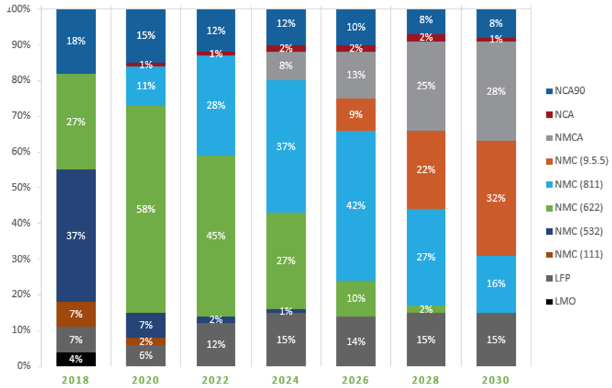
Bloomberg NEF
Silicon
The first real chemistry changes coming within the next two to five years is silicon as a replacement for the graphite anode.
Despite the wide gap between theoretical and practical capacities in traditional LIBs, researchers in the late 2000s were seeing diminishing returns on capacity improvements. This led many to consider new materials to replace the relatively simple graphite anode.
When considering the likely candidates for a graphite replacement, silicon is one of the top choices. It’s abundant, geographically dispersed and has more than 10 times the capacity of graphite.
Graphite has a theoretical energy capacity of about 370 mAh per gram (1,332 Wh/kg) – knowing exactly what this number means is less important than seeing it as a baseline for comparison. In order to make the numbers a little more familiar I converted mAh/gram to Wh/kg, the units commonly used to describe a battery’s energy density. A silicone anode by comparison has over 3,800 mAh (13,680 Wh/kg) energy capacity per gram.
Unfortunately, switching to a silicon anode doesn’t increase a battery’s energy capacity tenfold. That’s because the energy capacity of a traditional LIB is limited more by the cathode than the anode.
Commonly used cathodes such as NMC and NCA have usable capacities of roughly 170 mAh/g (612 wh/kg) and 185 mAh/g (666 Wh/kg), respectively, much lower than a graphite anode.
So, when using a silicon anode with existing cathodes, a battery cell’s gravimetric energy density increases 40% at most.
Silicon is limited by another drawback: It swells over 300% when lithiated (i.e., when the lithium ions are stored in the silicon). This causes the surface to crack and quickly degrades energy storage performance.
Nevertheless, several companies believe they have overcome these issues and are moving forward with a product launch.
Who’s Making It?
StoreDot: Started shipping samples in October for testing. The company plans to begin production by 2024. “StoreDot remains on target for mass production of its 100in5 cells by 2024 delivering at least 100 miles (161 km) of range in just five minutes of charging,” the company says.
Enevate: According to the online news site PushEVs, “Enevate announced a new production license agreement with the South Korean battery cell maker EnerTech International to commercialize Enevate’s silicon-dominant anode battery technology. Commercialization is scheduled for 2022 and pre-production batteries have already been built and tested by Enertech’s existing lithium-ion battery manufacturing equipment.”
Amprius: Its silicon nanowire anode has been in low-volume production since 2018. The company shipped its first commercially available 450-Wh/kg battery to a high-altitude pseudo satellite company in February. Automotive News reported, “The DOE granted Amprius $50 million to develop manufacturing of silicon nanowire anode technology. The Fremont, CA, company will use the funds to demonstrate it can scale battery manufacturing to provide a ‘first-of-its-kind large-scale production line for its ultra-high energy density batteries.’” The company is scaling to 2 MWh capacity by 2023 and is planning a gigawatt-scale production site in Texas or Georgia, but no timeline was given.
Interestingly, StoreDot, Enevate and Amprius all use the term “extreme fast charging” to claim their products can recharge to 80% within 5 minutes.
OneD: The company develops and licenses its SINANODE product on a per-customer basis. Its patented process infuses silicon nanowires onto powdered graphite using silane gas. The company then licenses the mixture as a drop-in anode replacement it claims has three times the capacity of traditional graphite anodes and reduces manufacturing costs. GM formed a joint development agreement with the company in September and plans to use the Sinanode product in its Ultium batteries, no timeline was given.
Sila Nano: It will begin production in Washington “in the second half of 2024, with full start of production under way in the first half of 2025,” the company reports. Mercedes-Benz plans to use the technology in the electric G-Class starting in 2025.
Group14: The Porsche-backed company produces what it calls “a micronized silicon-carbon powder, tunable by design and drop-in ready.” It currently supplies StoreDot.
SolidPower: The maker of solid-state electrolyte batteries has been developing a silicon-dominant anode since 2017. However, the company won’t produce it at scale until 2026.
24M: The Volkswagen-backed company is using dual (one specific to the anode, anolyte, and one specific to the cathode, catholyte), semi-solid electrolytes with a high-silicon anode to target energy densities over 350 Wh/kg. So far, the company has made 280 Wh/kg cells. But its bigger selling point is its manufacturing process which the company says can reduce costs 50%. Freyr announced it will build a 34 GWh plant in Georgia using 24M’s manufacturing process.
This content is usually only available with a Wards Intelligence subscription. To access our other insights, as well as our market-leading automotive data and analysis, inquire about a subscription today.
Already a subscriber? Log-In Now.