The LED market remains in a multi-year slump as core segments weaken and price pressure persists. Yet pockets of promise are emerging. Mini LED adoption is rising, UV-LED efficiency is improving, and Micro LED is inching toward commercialization. Companies that pivot and innovate, and provide high-value one-stop shop solutions, will be best positioned for survival and recovery.
Update: The analyst has reassessed the market dynamics on recent M&A activities, highlighting a more accurate market outlook.
Omdia view
Summary
The LED market remains in a multi-year slump as core segments weaken and price pressure persists. Yet pockets of promise are emerging. Mini LED adoption is rising, UV-LED efficiency is improving, and Micro LED is inching toward commercialization. Companies that pivot to innovate and provide high value one-stop-shop solutions will be best positioned for survival and recovery.
A prolonged packaged LED market winter
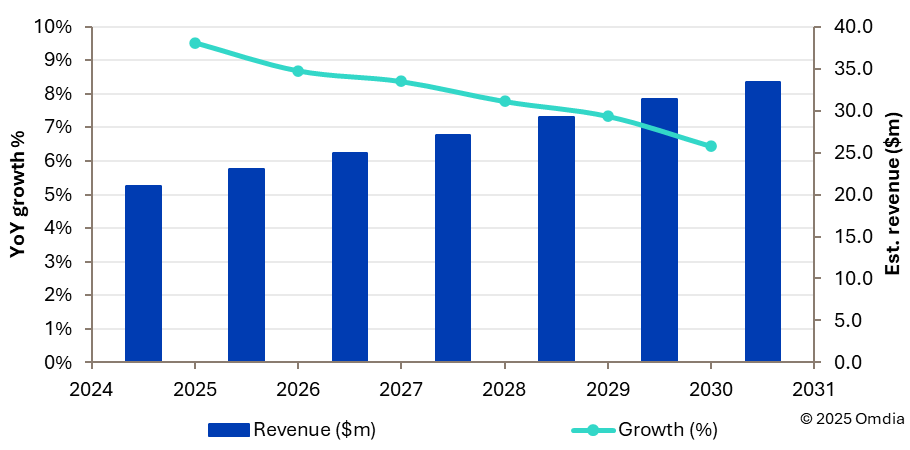
The global LED market remains in a prolonged winter that began after the short-lived COVID-19 era surge in 2021. With the end of the 0%-interest-rate environment, demand from consumer electronics, architectural projects, and broad infrastructure upgrades has cooled sharply. Structural oversupply and persistent ASP pressure continue to limit any meaningful rebound. Once the industry’s most reliable anchor—automotive lighting—is showing signs of growth fatigue, and global EV weaknesses are weighing on premium headlamp demand. LEDs used in EV charging stations offer incremental opportunities, but growth is tied to infrastructure rollout, which today is mostly happening through retrofits of malls, petrol stations, and mixed-use facilities rather than large-scale greenfield deployments. AI-related data centers are expanding rapidly, but their contribution to LED revenue remains modest. Hyperscale facilities prioritize long-lifetime, high-efficiency luminaires, which translates to slow replacement cycles and limited demand volume.
Figure 1: Data center LED lighting revenue estimates
 Source: Omdia
Other growth segments also struggled to deliver. For instance, UV-LED demand has softened across disinfection, industrial curing, and other applications, hindered by both weak macro conditions and technology bottlenecks. Despite OSRAM’s recent achievement of 10% UV-C LED wall-plug efficiency, real-world adoptions are still scaled gradually. This market remains around $350m in 2024, with high-single-digit CAGR potential, but not yet large enough to shift the global packaged LED landscape. Mini LED is one of the few volume drivers in 2024–25. Adoption is expanding across monitors, tablets, and large-format displays. However, steep ASP declines are muting revenue gains, which remain the industry’s long-standing challenge.
Further consolidation in LED companies
The proposed acquisition of Lumileds, a historic Western LED leader, by China's San'an Optoelectronics and Malaysia's Inari Amertron in August 2025 highlights China's growing influence and ambition, along with its Malaysian partner's OSAT capabilities, in creating a more vertically integrated chip-to-package solution and enhancing their global LED market position. Samsung Electronics’ steady exit from commodity LEDs since late 2024 reflects shrinking profitability and the need to concentrate resources on micro-LED and other high-value technologies.
Patents still matter, but they are no longer enough to defend margins on their own. As the market fragments across UV, mini-LED, micro-LED, sanitization modules, horticulture, and green-energy applications, the next generation of winners will be those that move beyond chip-level competition. A shift toward integrated, application-specific, one-stop solutions will be the differentiator.
All in all, while the core LED market is experiencing slow growth, several pockets show genuine promise. UV-LED efficiency is finally improving, mini-LED is penetrating more device categories, micro-LED is progressing from pure R&D to early commercialization, and demand for energy-efficient solutions remains structurally supported by global sustainability policies. The industry is transitioning from commodity competition to specialized, high-performance applications. Companies that position themselves early, combining strong IP with system-level integration, will be well-placed to capture the next wave of profitable growth in 2025 and beyond.
Author
Chang-Sheng, Lim, Research Analyst, LED