Omdia view
Summary
At the Mplify (formerly MEF) Global NaaS Event (GNE) held on November 10–14 in Dallas, Texas, there were clear signs of an industry undergoing a sea change. Artificial intelligence (AI) has attracted hundreds of billions of dollars in global investment over the past three years, drawing in hyperscalers, neo‑scalers, data‑center operators, manufacturers, vendors, and, of course, network operators as part of the ecosystem. Carriers benefit not only by supplying the connectivity that underpins this expanding ecosystem of AI hosts and consumers, but also by becoming major adopters of AI themselves—both internally and for partners and clients. At GNE, the Mplify Alliance and its participating members offered tangible proof of how the business is evolving.
Mplify Alliance adds AI across its stable of interests
For years, the Mplify Alliance has been working on aspects of Network-as-a-Service (NaaS) to create comprehensive, automated operational models. Four primary elements in its focus include the following:
- Connectivity for AI: This incorporates NaaS across Carrier Ethernet (CE), wavelengths, Ethernet over broadband, and dedicated/broadband internet services. Mplify will certify CE against AI performance profiles. Training, distributed inferencing, and agentic AI that crosses domains will each have preferred network services and specific performance requirements.
- Automation for AI: This supports lifecycle service orchestration (LSO) NaaS payloads. It will add AI interfaces via model context protocol (MCP) and agent-to-agent (A2A) communications.
- Cybersecurity for AI: This carries forward the Alliance’s work on Secure Access Service Edge (SASE), Security Service Edge (SSE), Zero Trust, plus quantum-safe services.
- Revenue services for AI: This dips into roles the industry will play with GPU-as-a-Service (GPUaaS) and AI Model-as-a-Service.
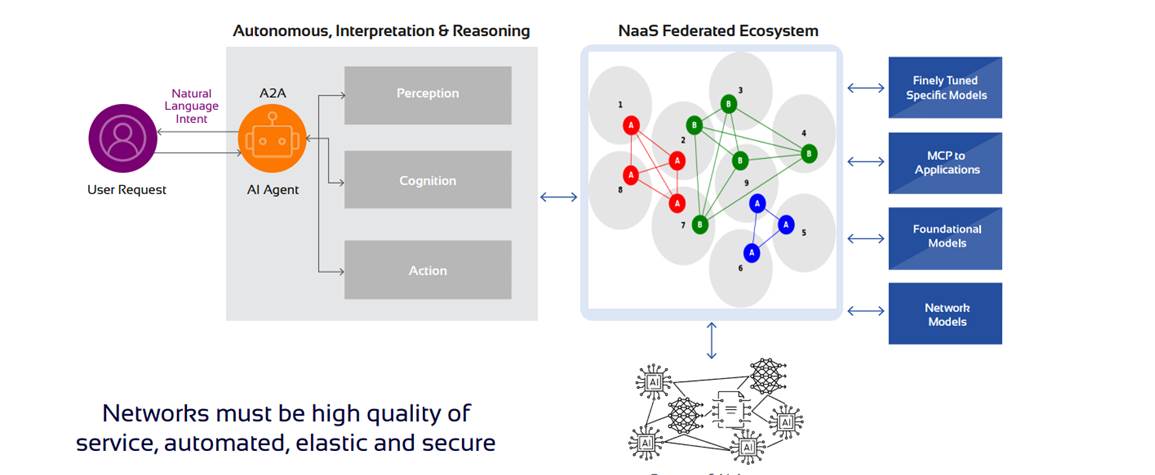
In a future world where AI agents initiate requests and make decisions, those agents will need to understand network services definitions and characteristics, and how to interact with them (see Figure 1). As part of its mission, Mplify is developing domain specific languages (DSLs) that AI agents and models can access to “learn” about network services, and eventually to use MCP as a wrapper around LSO APIs to place orders and make configuration changes. The Mplify Alliance expects to extend its role of standards and consensus building, and to certify that solutions adhere to standards agreed upon by its working groups.
Figure 1: In the agentic era, NaaS is the infrastructure for AI
 Source: Mplify
Renewed appetite for wholesale capacity
In a GNE keynote presentation, Jeffrey Hulse, CEO of Verizon Partner Solutions, reported that wholesale has been reinvigorated by AI‑driven demand, with service orders increasingly led by hyperscalers. It’s a trend widely echoed by wholesale executives across the industry. But there is a price of entry. As Hulse notes, “carriers need to put billions on the table to make sure there are interconnected networks.” That means laying new dark fiber and deploying optical transport gear ahead of service orders—an investment strategy designed to shorten long‑haul buying cycles.
In the US, Lumen has reduced long‑haul service intervals for its intercity RapidRoutes wavelength services to an activation SLA of 20 days. The provider is benefiting from its all‑new national intercity fiber builds, paired with newly deployed colocation and amplification shelters across the country. Verizon is streamlining its provisioning systems with the goal of cutting its current US service interval of 30–60 days. In October 2025, AT&T launched its AT&T Express wavelength service, initially limited to connections between five US metros. When everything aligns just right, AT&T can deliver service activation in as little as 24 hours.
Operators at GNE report a wavelength services upswing, with market revenues staunching their year-over-year declines. Both carriers and data center operators see ravenous demand for data center interconnect (DCI) capacity: One provider noted service orders measured in Terabits of demand. Another observed 5X-10X increases in its capacity between data centers.
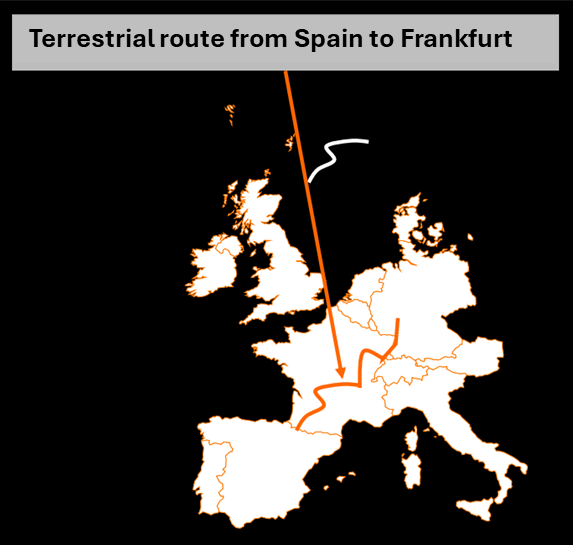
Franck Morales, Senior Vice President of Marketing & Business Development for Orange Wholesale International (and Mplify co‑CEO), showcased a new European intercity terrestrial route from Madrid to Frankfurt that the provider built specifically to serve hyperscalers (see Figure 2). It marks a notable role reversal. Historically, parent company Orange would define requirements and Orange Wholesale International would deliver. This time, the wholesale organization—driven directly by hyperscaler demand—is leading the deployment decision. And once a partner is on the Orange network, the provider gains opportunities to layer on additional services, whether from its Evolution Platform or other parts of the portfolio.
Figure 2: Orange Wholesale International’s new terrestrial fiber route
Source: Orange Wholesale International
Data center boom, cloud glitches
At GNE, service provider executives reflected on the aftershocks of recent major cloud‑provider disruptions. Digital Realty executives highlighted the boom in DCI demand and the deployment of NVIDIA SuperPODs across their facilities. The operator is now supporting rack densities of 150kW with liquid cooling, and some of its flagship sites are rated for 100MW.
DCI underpins internet, cloud, and increasingly AI exchanges hosted in major data centers—driving enterprises to establish their own data‑center presence to connect into these ecosystems. Digital Realty executives also noted a growing trend of “cloud repatriation,” driven by high cloud‑hosting costs and service disruptions. Organizations are pulling certain applications and datasets back from public clouds and returning platform hosting to private data centers.
GNE took place soon after a fresh round of cloud services issues. In October, AWS experienced an extended (15-hour) US disruption that knocked thousands of major internet destinations offline. Nine days later, Microsoft Azure experienced its own extended (eight-hour) service disruption due to a configuration error. Google Cloud Platform had its turn at significant disruption earlier in the year, in the US in June. Also, the week after the GNE event, major internet services provider CloudFlare suffered a three-hour disruption due to a configuration error.
However, the concern by cloud users goes beyond these outages. Some enterprises thought they had fully protected cloud connectivity via redundancy across multiple availability zones. In some cases, these redundancy plans did not protect against outages, exposing a weakness in architecture design.
Conclusion: People need AI, and AI still needs people
At GNE, Orange Business executives described the continued evolution of the provider’s in-house AI as “Live Intelligence.” Live Intelligence was first developed to improve Orange’s internal processes by automating tasks, helping employees operate more efficiently. These internal AI use cases then became external leverage. Orange Business made AI instances of Live Intelligence available to clients, together with professional services to help with training and deployment.
As impressive as AI automation may be, Orange Business executives emphasize that “we are still in the physical world.” Telcos play a critical role in bridging AI tools with human expertise across major service centers (MSCs), cybersecurity operations centers (cyber SOCs), and consulting and professional services. Ultimately, it takes people and knowledge to translate customer requirements, customize service wraps, and execute migration projects. While AI automation and streamlining will continue to reshape the business, for the foreseeable future there remains clear need—and value—for expert support that responds to requests, and for skilled technicians that show up on‑site to connect cabling and install hardware.
Appendix
Author
Brian Washburn, Chief Analyst, Telco B2B Solutions