

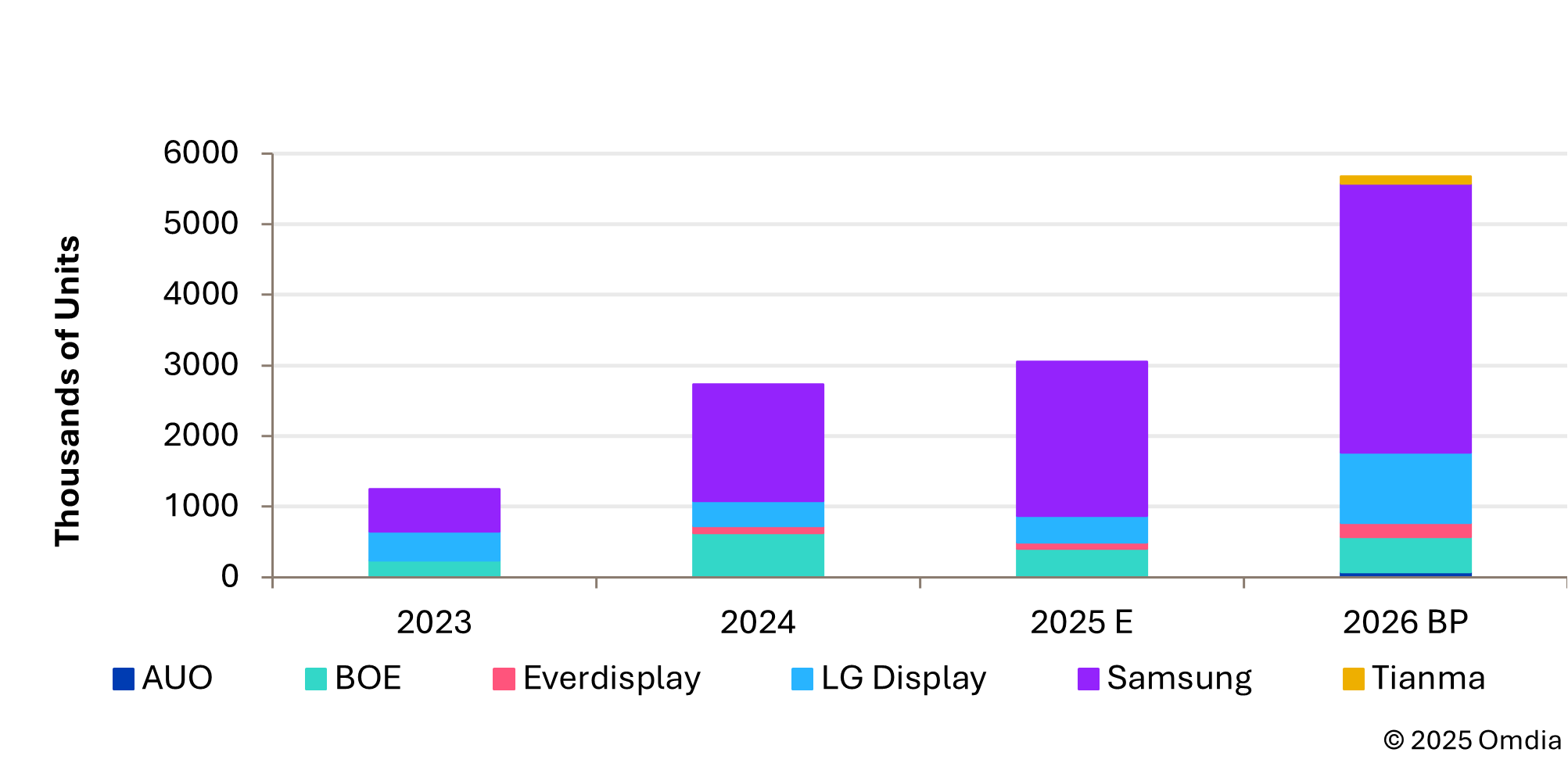
LONDON, December 16, 2025: Global automotive OLED panel shipments are on track to grow 11.8% year-on-year (YoY) growth in 2025, reaching approximately 3.05 million units, according to Omdia’s Automotive Display Market Intelligence Service. While shipments continue to increase in absolute terms, the pace of adoption is moderating as electrification and digitalization continue to reshape the automotive industry.
Several factors are slowing OLED penetration, signaling a transition from technology feasibility validation toward a more value-driven and application-focused adoption strategy:
- Intensifying competition in the automotive market.
- Rising cost sensitivity among OEMs.
- Delayed EV launches by several European automakers.
Automotive OLED adoption faces stricter cost-efficiency criteria
Market dynamics indicate that automotive OLED is now being evaluated against stricter cost-efficiency criteria. Increased supplier participation and intensified competition have driven panel prices down by approximately 15–20% compared with two years ago. However, OLED remains more expensive than mainstream automotive display technologies such as LCD.
In several markets, particularly within China’s new energy vehicle segment, OLED cockpit implementations have largely been limited to conventional suspended center stack displays and flat panel screens. These designs have yet to fully leverage OLED’s inherent advantages, including true black performance, seamless cockpit integration, and the design flexibility enabled by bendable form factors.
As cost efficiency becomes a primary decision driver, some OEMs have reassessed their display strategies. They are shifting near-term volume programs back to FALD LCD or more mature LCD solutions.
Flexible and Tandem OLEDs are reshaping cockpit design
Despite these challenges, ongoing technological progress continues to expand the long-term potential of automotive OLED. The mass production of tandem OLED has further validated AMOLED as a viable automotive display technology in terms of brightness, lifetime, reliability, and performance stability.
OEM demand is gradually evolving from simple OLED adoption toward solutions that enhance vehicle-level value through differentiated design and functional integration. One example is Porsche’s next-generation Cayenne EV. It features a L-shaped center stack display seamlessly integrated with a passenger display offering switchable privacy mode, enabled by a single-piece, irregular-shaped OLED structure. Such applications highlight the role of flexible OLED in defining next-generation premium cockpit designs.
As European automakers continue to roll out new EV platforms, flexible OLED is increasingly being positioned as a key design enabler for luxury and flagship models. Meanwhile, ongoing overcapacity and gradual cost reductions are expected to improve the competitiveness of rigid OLED solutions, supporting broader penetration into mid- to high-end vehicle segments after 2027.
Samsung Display leads a highly concentrated automotive OLED market share
From a supply chain perspective, the automotive OLED market remains highly concentrated. Samsung Display is expected to command more than 70% market share in 2025, supported by its scale and cost advantages in rigid OLED production. BOE is projected to follow with a low double-digit share.
Looking ahead to 2026, incremental demand is expected to be driven primarily by European OEMs. with Samsung Display expected to maintain its leadership position and LG Display expected to increase its share as additional projects enter mass production.
“Automotive OLED is transitioning toward a more disciplined growth phase,” said Wray Wang, Research Analyst at Omdia. “Cost efficiency, differentiation, and sustainable value creation will increasingly define its adoption trajectory.”
Figure 1: Automotive OLED Shipment and Forecast
The analysis and data in this release are from Omdia's Automotive Display Market Intelligence Service, which provides detailed market tracking, technology forecasts, and competitive analysis for the global automotive display supply chain.
More insights
Assess the marketplace with our extensive insights collection.
More insightsHear from analysts
When you partner with Omdia, you gain access to our highly rated Ask An Analyst service.
Hear from analystsOmdia Newsroom
Read the latest press releases from Omdia.
Omdia NewsroomSolutions
Leverage unique access to market leading analysts and profit from their deep industry expertise.
Solutions