


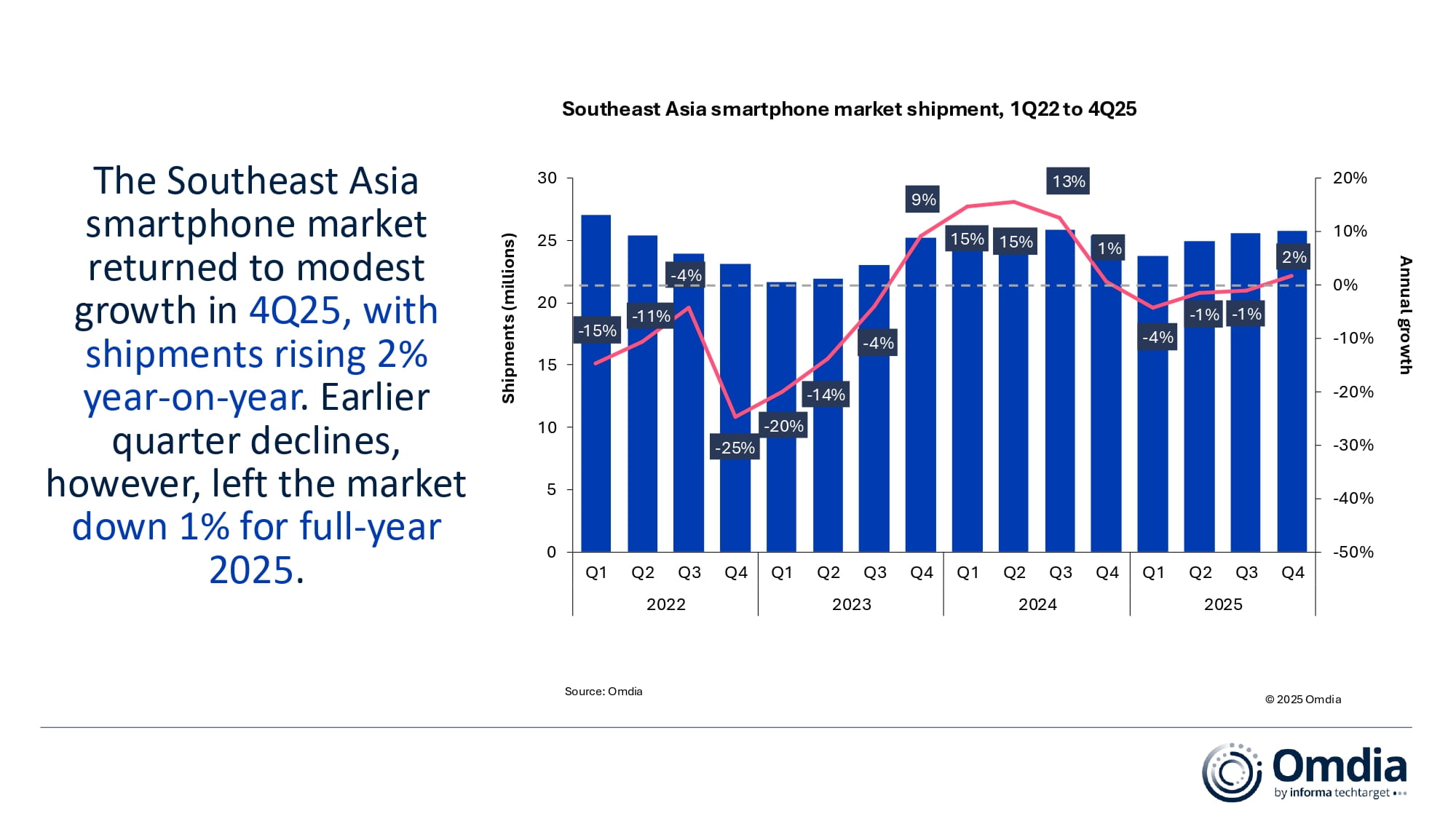
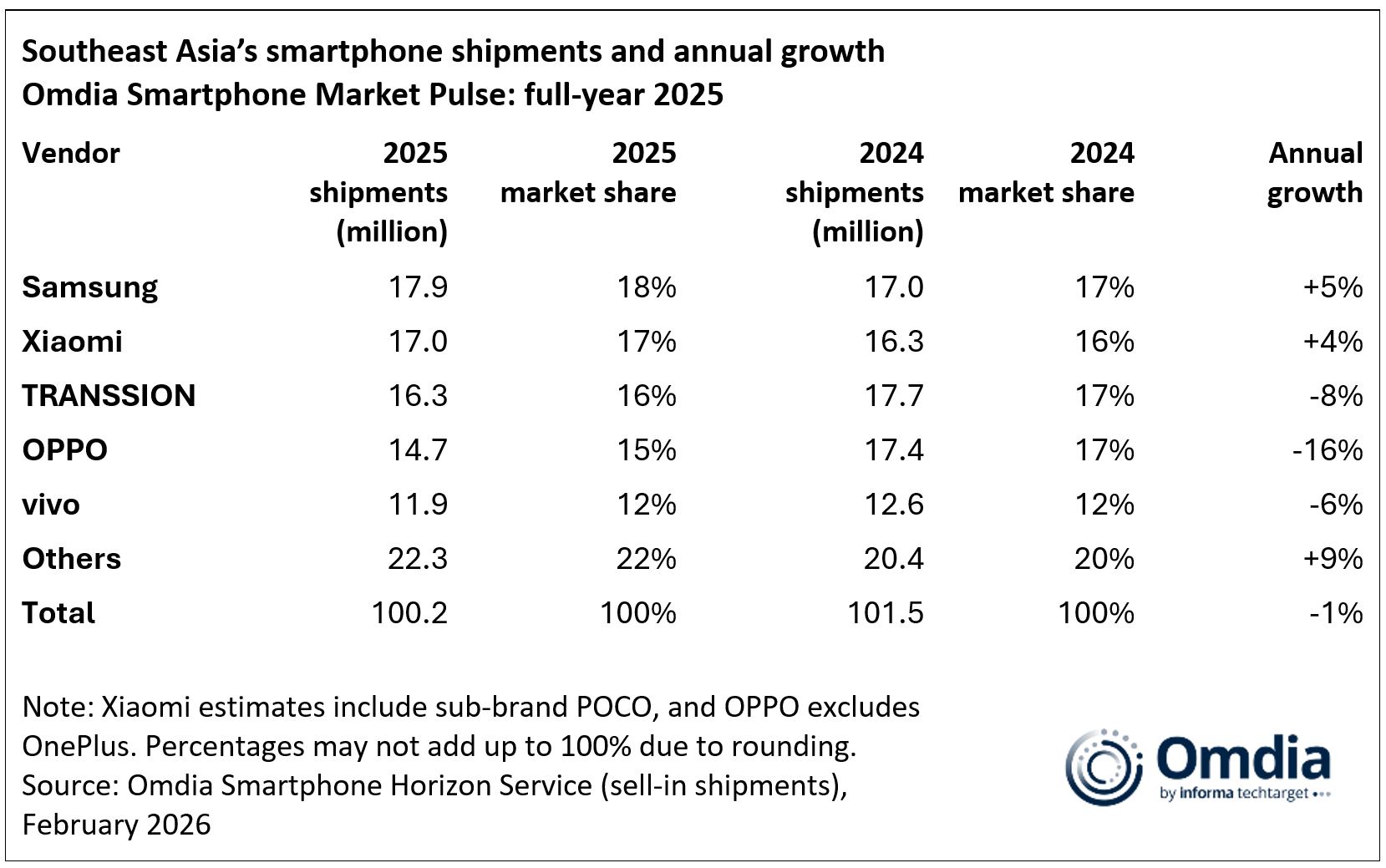
LONDON, February 13, 2026: Latest research from Omdia shows that Southeast Asia’s smartphone shipments reached 100 million units in 2025, representing a 1% year-on-year decline, as softer performance in the first three quarters weighed on the overall market. However, the region returned to growth in 4Q25, with shipments rising 2% year-on-year to 25.8 million units, reversing three consecutive quarters of contraction and signalling improved momentum toward year-end.
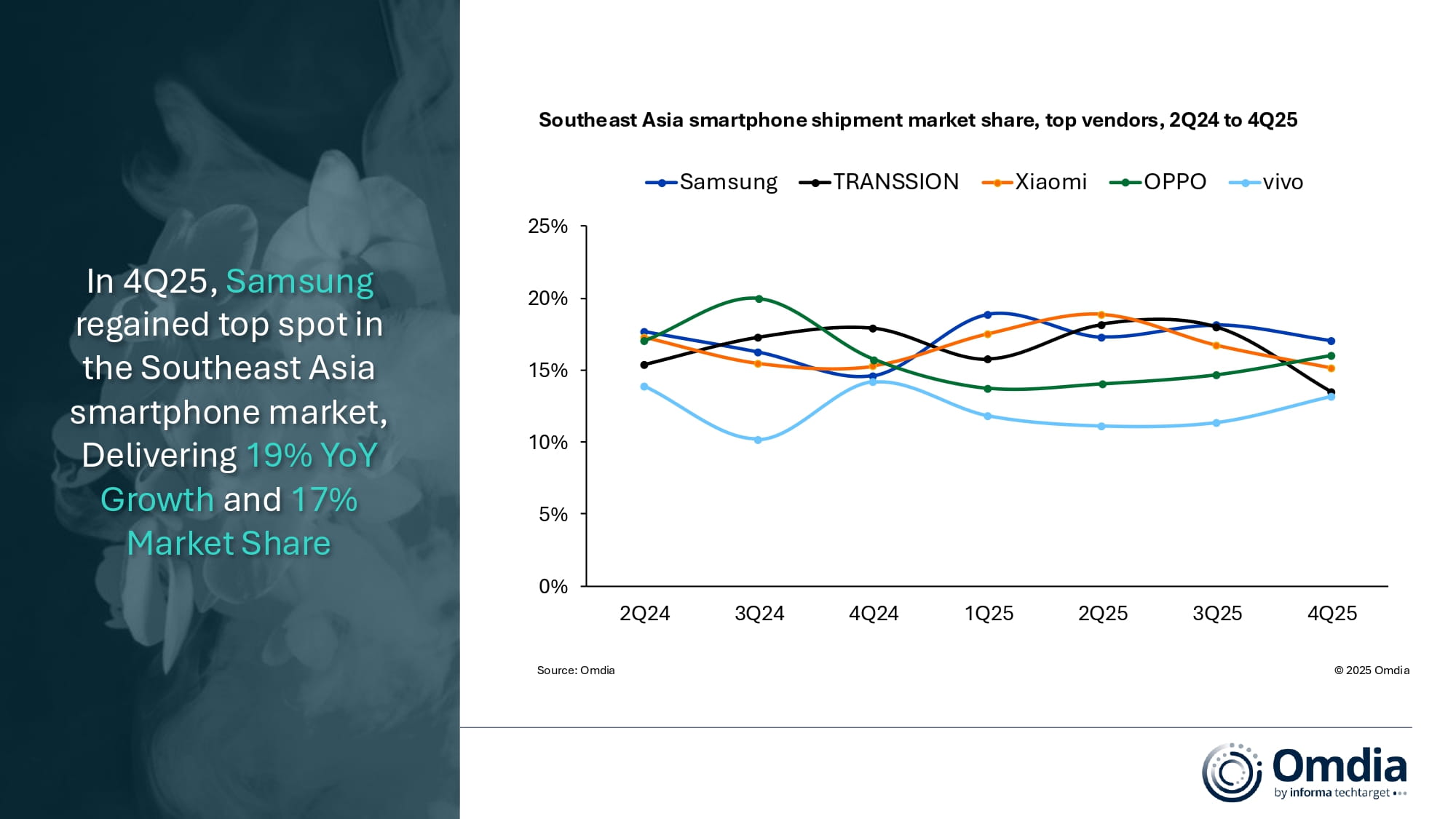
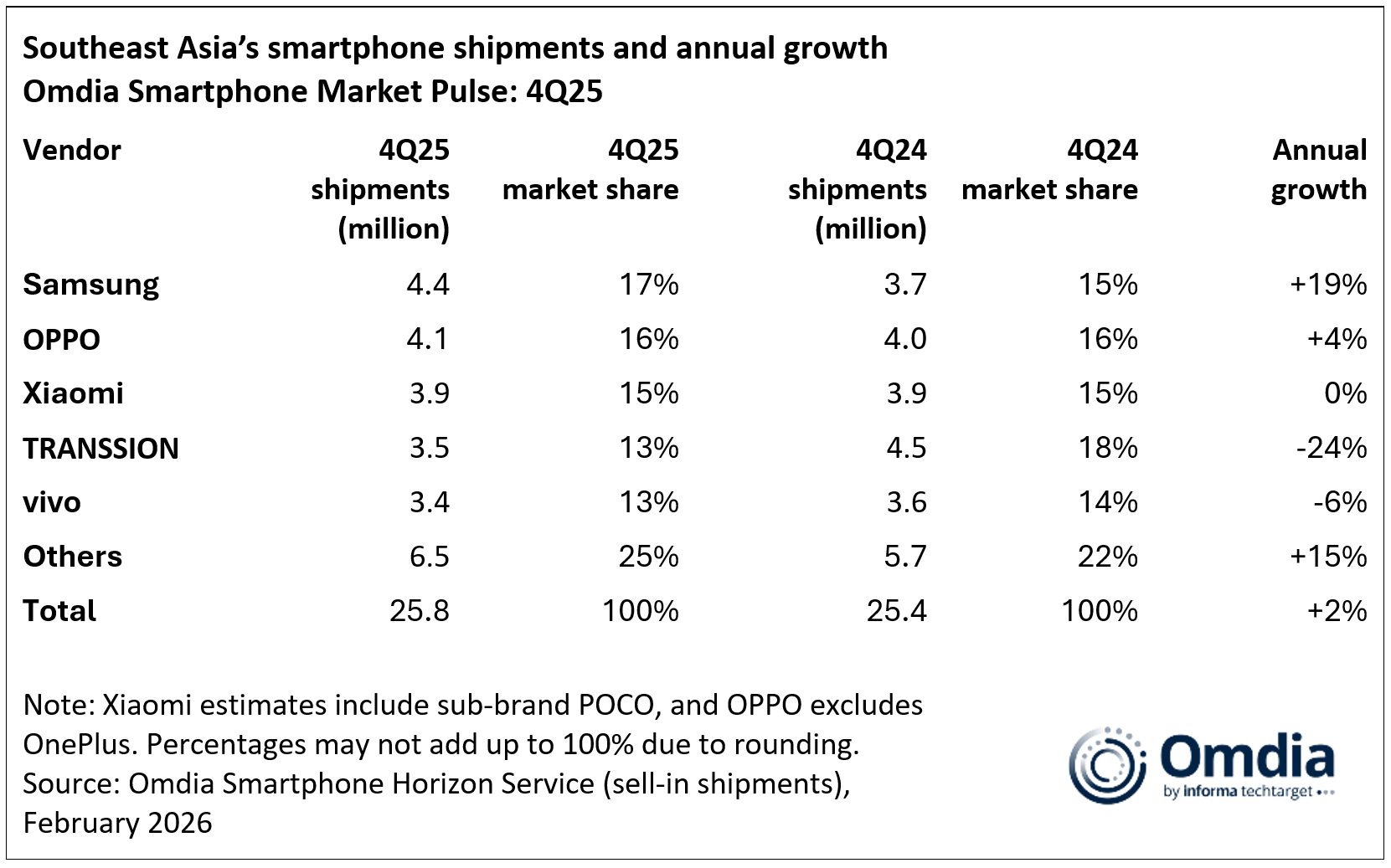
Samsung led the Southeast Asia smartphone market in 2025, increasing shipments by 5% to 17.9 million units and expanding its market share to 18%. Samsung also topped the market in 4Q25, shipping 4.2 million units to secure a 17% share, representing a 19% year-on-year increase in quarterly volume. The strong finish was supported by the successful rollout of the Galaxy A17 series, which delivered meaningful specification upgrades over the Galaxy A16 and reinforced Samsung’s competitiveness in the affordable segment.
Xiaomi recorded the second-highest shipment volume for the full year, with shipments rising 4% to 17.0 million units, lifting its share to 17%. In 4Q25, Xiaomi shipped 3.9 million units, placing third for the quarter with a 15% share, as a greater proportion of new portfolio launches had already shipped in 3Q25.
TRANSSION was third in full-year shipment volume, despite shipments declining 8% to 16.3 million units, with share easing to 16%. In 4Q25, TRANSSION accounted for 3.5 million units, the fourth-largest shipment total for the quarter, reflecting a 25% year-on-year decline as shipment corrections played out across major markets following aggressive expansion over the previous two years.
OPPO accounted for the fourth-largest shipment volume in 2025, shipping 14.7 million units, a 16% year-on-year decline, with a market share of 15%. In 4Q25, OPPO delivered the second-highest quarterly shipment total at 4.1 million units, capturing a 16% share and growing 4% year-on-year, supported by the Reno 15 series and updates to its A-series portfolio.
vivo completed the top five for the year, with shipments declining 6% to 11.9 million units, maintaining a 12% share. In 4Q25, vivo shipped 3.4 million units, representing a 13% share and a 7% year-on-year decline. While annual volumes softened, vivo increased average selling price (ASP) by 11%, reflecting a greater emphasis on higher-value devices.
“Amid rising cost pressures, brands are increasingly adopting channel-centric strategies to safeguard margins,” said Research Manager Chiew Le Xuan. “According to Omdia’s monthly tracker, POCO recorded its highest-ever monthly shipments in November, with its contribution reaching an all-time high of 21%, driven by strong 11.11 promotional sales momentum. While the launch of the entry-level POCO C71 weighed on overall ASPs, it played a critical role in sustaining volumes, driving POCO shipments up by double 4Q25, helping to cushion cost pressures in the entry segment. As an online-exclusive brand, POCO’s expansion into entry-tier devices also proved financially accretive, complementing Xiaomi’s new retail strategy.
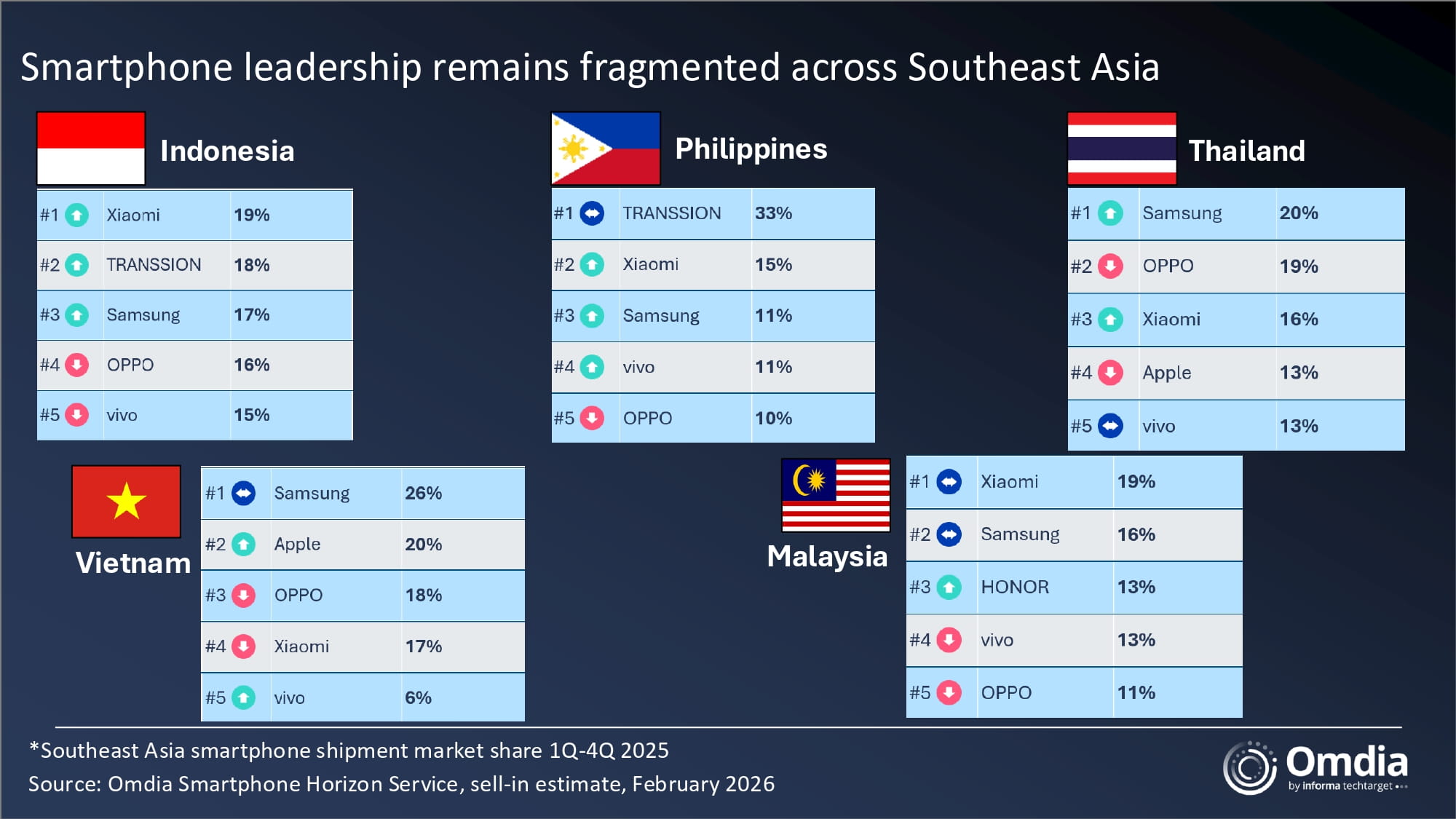
“More broadly, vendor performance across Southeast Asia continues to be shaped by country-specific dynamics, with growth increasingly dependent on effective portfolio localisation,” Chiew added. “One notable example is HONOR: its total shipments doubled YoY in 2025, supported by strong growth across key markets including the Philippines, Singapore, Thailand and Vietnam. This growth was underpinned by a targeted portfolio strategy. Higher-spec models such as the X9d and telco-focused devices like the 400 Smart gained traction in Malaysia, while more affordable models such as the X6c performed well in more price-sensitive markets like the Philippines.”
“Vendors closed 2025 with a cautious outlook for 2026, as rising memory and storage costs are set to become a more meaningful constraint on product strategy. Memory and storage already account for more than 30% of the bill of materials for smartphones priced below US$200, and with over 60% of devices shipped in Southeast Asia falling into this segment, cost inflation raises fundamental questions around pricing, specifications, and portfolio positioning next year.
“While the full impact of higher memory pricing will emerge gradually, it is expected to become more visible from mid-2026 as increased component costs flow through to device manufacturing costs. Early signals are already evident, with recent launches such as Samsung’s Galaxy A07 5G and Xiaomi’s Redmi Note 15 series priced higher than their predecessors, pointing to the direction of travel for future launches.
“At the same time, rising costs reduce vendors’ ability to absorb pricing pressure through margin support, weakening traditional volume-driven levers such as back-end rebates and inventory loading. This makes aggressive channel stuffing followed by rebate-led stock clearance less sustainable. As a result, vendors are increasingly required to engage channels through healthier, value-led models - focusing on product differentiation, portfolio mix optimisation, and sell-out quality - rather than relying purely on volume economics,” said Sheng Win Chow, Senior Analyst at Omdia.
More insights
Assess the marketplace with our extensive insights collection.
More insightsHear from analysts
When you partner with Omdia, you gain access to our highly rated Ask An Analyst service.
Hear from analystsOmdia Newsroom
Read the latest press releases from Omdia.
Omdia NewsroomSolutions
Leverage unique access to market leading analysts and profit from their deep industry expertise.
Solutions