

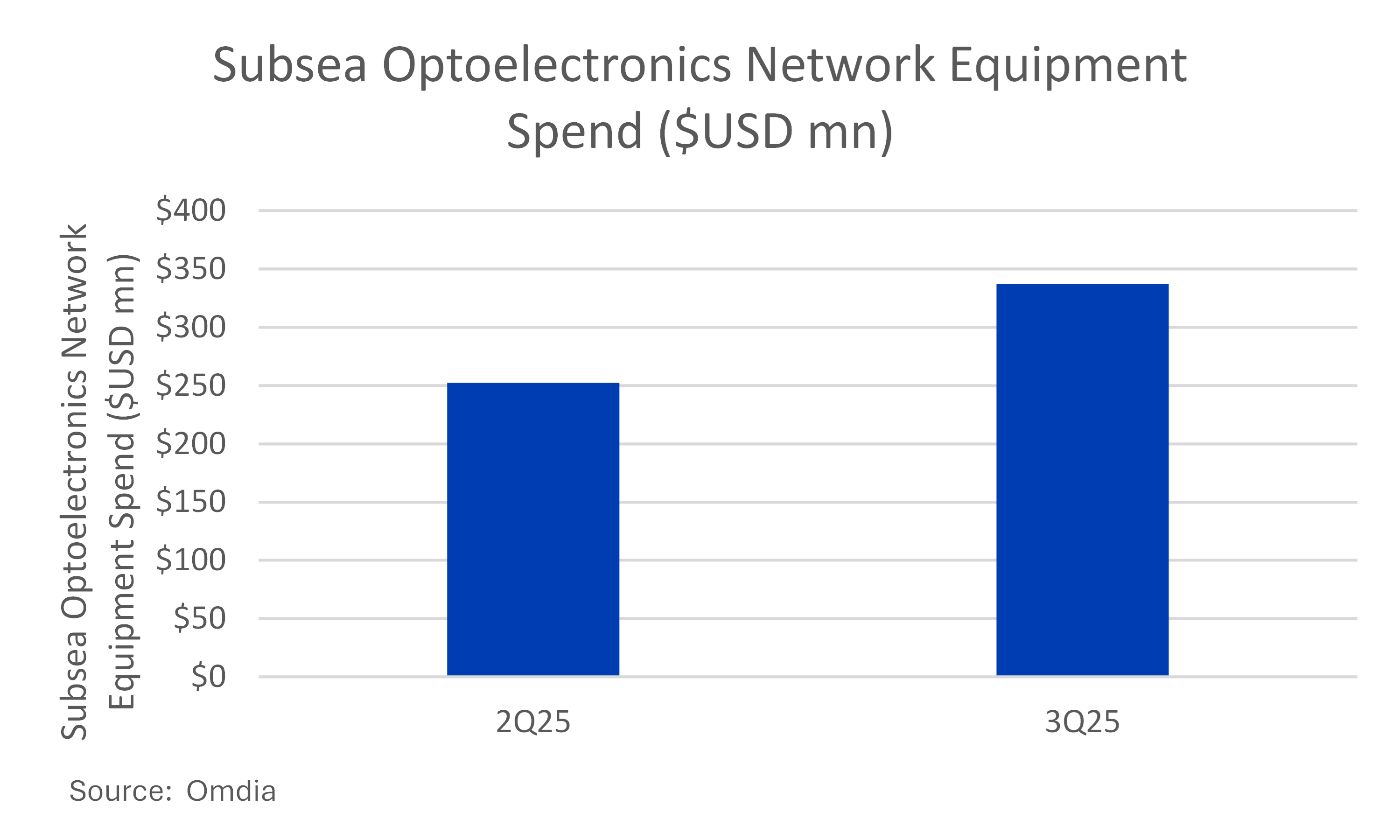
LONDON, February 3, 2026: The subsea optoelectronics network equipment market grew to $337 million in 3Q25, up 32.5% from 2Q25. This robust growth comes as the AI infrastructure build-out supercycle catalyzes a significant terrestrial and subsea network refresh, a trend highlighted at PTC’26.
“Omdia is forecasting robust subsea network growth in 2026 driven by the completion of more cables, to meet the demands of global AI networks. The mesh model, with the assistance of increased transmission capacity, will enable more resilient networks. Omdia expects the mesh model to propagate into other ocean basins,” said Ian Redpath, Research Director, Transport Networks, at Omdia.
At PTC’26, two major architectural approaches were highlighted for building global-scale subsea network infrastructure to support these AI networks. The classic approach is to build the largest bandwidth subsea cable possible in a point to point configuration, interconnecting high value sites on different continents. The point-to-point approach optimizes for latency and construction overhead because costs can be spread over the maximum amount bandwidth transmission.
However, as the geopolitical environment is in flux, reliability and network robustness have risen to the fore as design criteria. Consequently, Google has introduced a new approach to ocean-crossing infrastructure, and is in the process of completing a subsea network mesh spanning the entire Pacific Ocean. Google’s subsea network features mid-Ocean nodes of Hawaii, Guam, Fiji and French Polynesia, while the end-point nodes touch the four continents of Asia, Australia, North and South America.
The Google network design prioritizes network robustness, allowing traffic to be re-routed from a mid-ocean node around a single segment failure. It will deploy substantial mid-ocean routing capabilities to enable mid-ocean packet rerouting if needed. To support this, the company said it carefully selects the locations for its connectivity hubs to minimize the distance data must travel before it can switch routes.
“We are beginning to see the early green shoots of more mesh development,” Redpath added, “In the Southern Indian Ocean, Google has deployed the Umoja cable from Australia to South Africa, paired with terrestrial links up to Kenya. In the Northern Indian Ocean, Google has announced the Dhivaru cable with mid-Ocean nodes at Christmas Island and the Maldives. Christmas Island has two pre-existing links to Mandurah (near but diverse from Perth) and Darwin, with a fourth link announced to connect with Thailand. The Western terminus of Dhivaru is Oman, which has emerged as a key global node for a Bab al-Mandab, Red Sea bypass. In the Atlantic, Bermuda and the Azores have been introduced as mid-Ocean nodes.”
At PTC’26, Meta’s massively ambitious Waterworth cable was also highlighted as an answer to network robustness. The global cable will cross the Pacific from the California coast to Australia and Southeast Asia, cross the Indian Ocean, connecting India and South Africa and finally cross the South and North Atlantic, connecting Brazil and the US Eastern Seaboard. While Waterworth will support intra-regional traffic, the preeminent design criteria is a backup route, circumnavigating vulnerable network choke points.
More insights
Assess the marketplace with our extensive insights collection.
More insightsHear from analysts
When you partner with Omdia, you gain access to our highly rated Ask An Analyst service.
Hear from analystsOmdia Newsroom
Read the latest press releases from Omdia.
Omdia NewsroomSolutions
Leverage unique access to market leading analysts and profit from their deep industry expertise.
Solutions