


AI capital and MSP consolidation are at the forefront of industry developments. Shield Technology Partners is reshaping the landscape with AI-backed venture funding, decentralized operations, and a tech-first strategy, raising critical questions for the MSP channel. As one of the pioneering platforms in this space, Shield’s model emphasizes long-term innovation, founder continuity, local branding, and customized technology integration, marking a shift toward AI-driven operational efficiencies and competitive dynamics within the MSP ecosystem. This blog explores the emergence of this new rollup category, and analyzes how Shield's partnership with OpenAI and its "evergreen" capital structure challenge traditional private equity models in the managed services market.
AI capital is converging with MSP consolidation. In the past year, a new category of rollups has emerged: MSP platforms backed not by traditional private equity, but by AI-minded venture investors.
The most visible of these is Shield Technology Partners, funded with more than $100 million from ZBS Partners and Thrive Holdings, the evergreen investment arm affiliated with Thrive Capital. Shield has already acquired seven MSPs across the United States, with plans to double that count by the end of 1Q26.
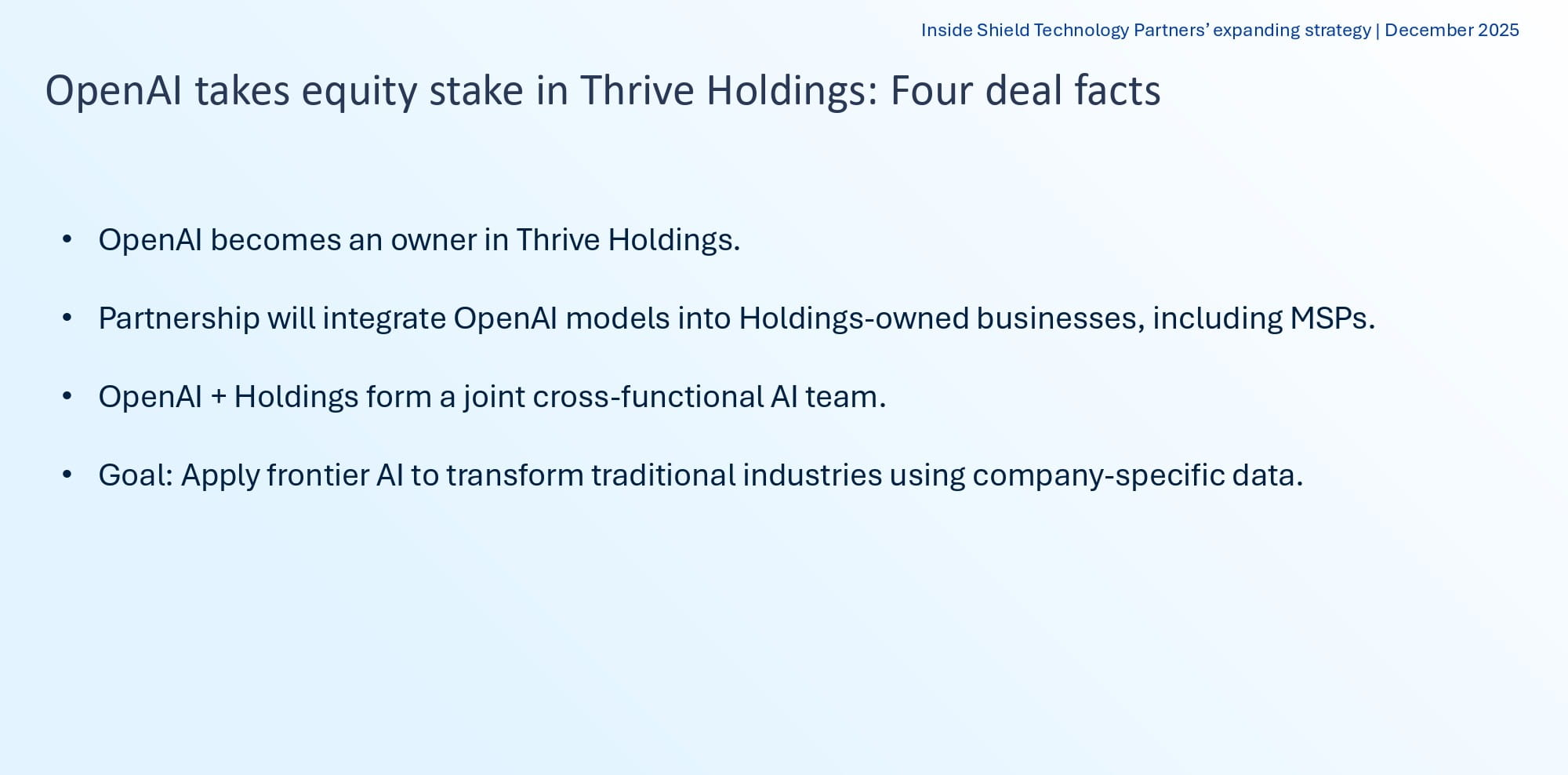
Shield’s model raises critical strategic questions for the channel. Unlike PE-backed rollups, which typically operate on leveraged capital structures and fixed exit timelines, Shield is positioning itself as a long-duration platform with a technology-first operating model. The stakes are now higher: on December 1, 2025, OpenAI announced that it has taken an equity stake in Thrive Holdings, Shield’s VC backer. The deal calls for OpenAI to be compensated for its stake from future financial returns generated by Thrive Holdings. It also grants OpenAI access to Thrive Holdings’ operating companies’ data to train its AI models. In exchange, Thrive Holdings’ operating companies, such as Shield, will get direct access to OpenAI talent and models.
For MSP owners weighing future liquidity events, this creates a new competitive dynamic: a rollup with evergreen VC capital, a decentralized operating structure, and a proprietary automation engine that aims to reduce manual IT ticketing tasks within MSP businesses. Shield Technology Partners is one of the earliest and most visible rollups in this emerging category. To put Shield’s model in context, we are evaluating it through a four-part lens used across our MSP rollup research.
How we compare MSP rollups
As part of a broader Omdia assessment of MSP rollup models, we evaluate each platform across four core differentiators:
- Centralized or decentralized operations
- Founders and/or key leadership exit or remain onboard post-investment
- Local brands are retained or absorbed
- Whether acquired MSPs are required to migrate to a standardized RMM/PSA platform or are allowed to retain their existing stack, a decision that determines which vendors become embedded at the parent-company level
What differentiates Shield’s approach for MSP owners
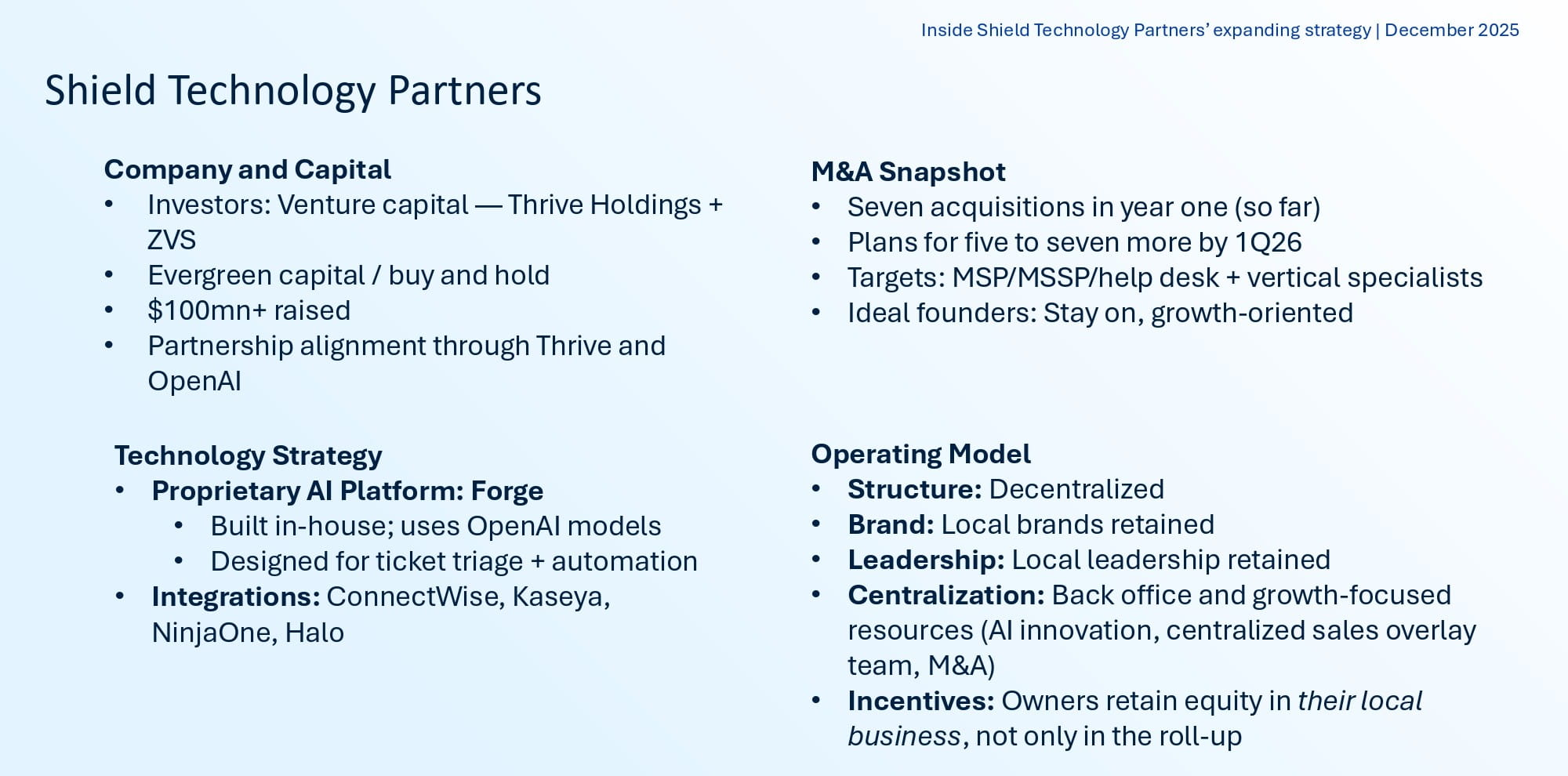
Shield is explicit about building a decades-long brand, not a time-boxed platform. Its capital structure enables it to prioritize innovation. It offers:
• Operating structure: A decentralized, founder-led model
Shield acquires MSPs that are growth-oriented and founder-led. It prefers that founders stay with the business, continue to lead their teams, and remain owners. Back-office functions such as HR are centralized, but MSPs retain local leadership, operating independence, and existing technology stack.
Shield calls this a “partnership model,” where owners remain incentivized to grow their local business rather than assimilate into a single operating entity. This model follows the decentralized approach favored by Evergreen/Lyra and New Charter MSP rollups.
• Leadership continuity: Owners remain in charge with rolling liquidity
Shield’s backing by Thrive Holdings gives it a long-term investment horizon, similar to Evergreen/Lyra’s buy-and-hold approach. Liquidity opportunities for MSP founders occur every three to five years, allowing owners to:
• roll equity
• retire
• transition leadership internally
There is no stated timeline for selling the platform, going public, or consolidating the rollup for exit.
• Brand strategy: Local brands and market identity preserved
Acquired MSPs retain their local brands rather than adopting a Shield-branded identity. This supports Shield’s broader thesis that regional reputation and customer familiarity remain competitive advantages in managed services.
• Technology strategy: A multi-stack approach with Sentinel & Spectre as the automation layer
MSPs retain their existing tech stack. Shield has developed Sentinel & Spectre, its internal triage and automation engine, which integrates with four major MSP platforms: ConnectWise, Kaseya, NinjaOne, and HaloPSA.
The Sentinel & Spectre platform:
• Classifies tickets into full, partial or no-automation buckets
• Summarizes ticket context and retrieves historical resolutions
• Automates simpler tasks such as password resets and onboarding
• Uses OpenAI models, while the engineering of the platform remains entirely in-house
Shield’s execution so far
Acquisitions to date range from MSP organizations with 10 to 80 employees, averaging about 35, and include vertical specialists in healthcare (specifically dental) and oil and gas.
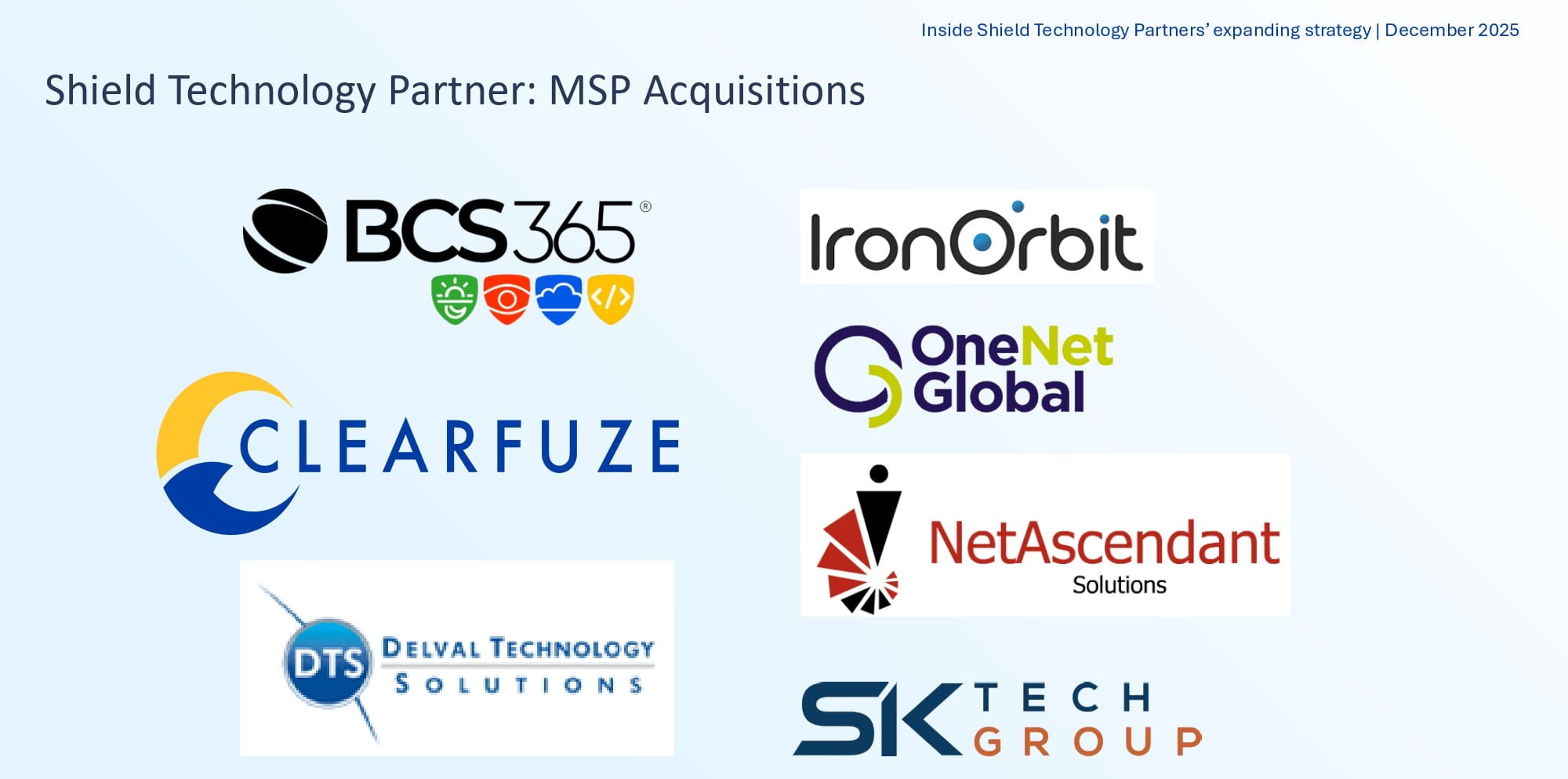
The companies acquired are primarily located in the US and Canada, reinforcing Shield’s decentralized, multi-market approach. The footprint supports Shield’s thesis that local identity and specialization are competitive strengths in managed services.
Future considerations for the MSP ecosystem
The new OpenAI investment in Thrive Holdings puts the spotlight on how AI is poised to change the MSP market. It will not be an overnight change. However, investors and AI companies see opportunities in managed services. Here are some of the key questions we are examining:
- Will the competitive gap between AI-forward MSP rollups and their more traditional competitors widen? (And how soon?)
- How will the MSP vendor ecosystem of RMM, PSA, and cybersecurity vendors respond?
- Will this change how MSPs evaluate their potential acquirers?
- How soon will AI become a fundamental structural component of the MSP stack?
- Should MSPs be worried about so-called circular money in the AI business? How would an AI bubble, if it were to happen, impact MSPs?
- Will this lead to vendor lock-in, preventing the use of other competitive AI models, such as Microsoft Copilot, Google Gemini, Anthropic’s ClaudeAI, and others?
More from author


More insights
Assess the marketplace with our extensive insights collection.
More insightsHear from analysts
When you partner with Omdia, you gain access to our highly rated Ask An Analyst service.
Hear from analystsOmdia Newsroom
Read the latest press releases from Omdia.
Omdia NewsroomSolutions
Leverage unique access to market leading analysts and profit from their deep industry expertise.
Solutions
