


Global automotive OLED market overview
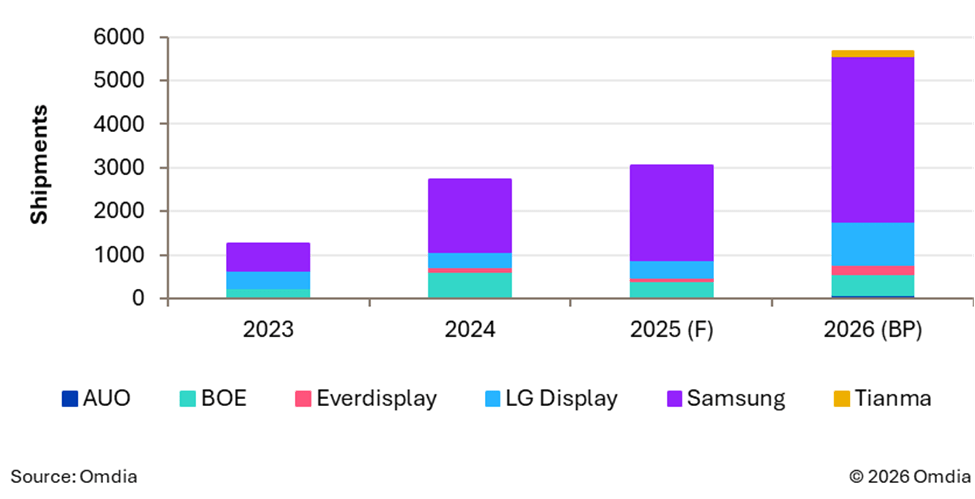
In 2025, global automotive OLED panel shipments were projected to reach approximately 3.05 million units, representing a year-on-year (YoY) increase of 11.8%. However, this marks a notable slowdown compared with the previous year, with overall penetration rising by only around 0.06 percentage points. While automotive OLED shipments continue to grow in absolute terms, growth momentum has clearly weakened. This is driven by delayed EV launches among European OEMs, intensified competition within the automotive industry, and heightened sensitivity to cost control. Under these conditions, automotive OLED penetration into the mass market is likely to remain slow in 2026. By contrast, the ramp-up of hybrid OLED mass production is likely to support incremental growth in the mid-range to high-end automotive OLED segment.Challenges in automotive OLED: cost vs. differentiation
The slowdown in automotive OLED adoption is primarily attributable to two factors: persistently high pricing and a lack of user-perceivable differentiation that justifies the premium.
From a cost perspective, the increase in suppliers and intensifying competition have driven automotive OLED panel prices down by approximately 15 to 20% compared with two years ago. However, pricing remains elevated relative to other mainstream automotive display technologies, limiting broader deployment.
In terms of differentiation, OLED cockpit implementations in Chinese new energy vehicles (NEVs) have largely been limited to suspended center stack displays or large tablet-style screens. Such designs fail to fully leverage AMOLED’s “true black” characteristics, cockpit integration aesthetics, or the high degree of design flexibility enabled by bendable OLED form factors. As cost efficiency becomes the primary decision driver, some OEMs are shifting back toward full-array local dimming (FALD) LCD or even conventional LCD solutions.
Figure 1: Porsche Cayenne EV interior
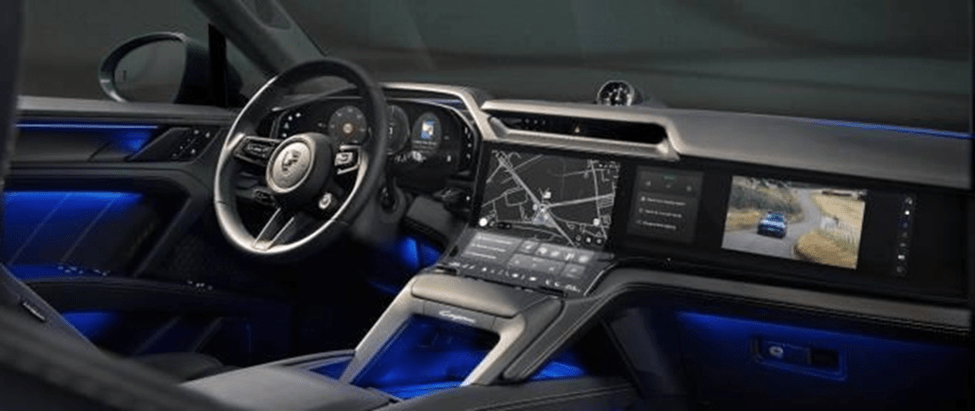
Source: Porsche
Adoption trends: tandem and flexible OLED displays
The mass production of tandem OLED panels has effectively validated AMOLED as a viable automotive display technology in terms of brightness, reliability, and lifetime performance. OEM demand for OLED is currently evolving from basic technology adoption toward differentiated design and higher value per vehicle.
A notable example is Porsche’s next-generation Cayenne EV, which features a 12.25-inch L-shaped center stack display integrated with a 14.95-inch passenger display offering switchable privacy mode. This is achieved through a single-piece, irregular-shaped bonded OLED structure.
As European OEMs continue to roll out new EV models, luxury brands are increasingly using flexible OLED panels to define their next-generation cockpit designs. Meanwhile, as the market works through overcapacity and costs continue to fall, rigid OLED panels should gradually penetrate broader mid-range to high-end market segments after 2027.
Automotive OLED supply chain and market share
From a supply chain perspective, Samsung Display should exceed a 70% share of the automotive OLED panel market in 2025, supported by its cost and scale advantages in rigid OLED production. BOE should follow with approximately 13% market share.
In 2026, as Chinese OEMs increasingly pivot toward FALD LCD solutions, incremental automotive OLED demand should be driven primarily by European automakers. Samsung Display is likely to maintain its dominant position, while LG Display’s share could increase to around 18% as additional projects enter mass production. By comparison, although Tianma has entered the automotive OLED panel market, Chinese panel makers face challenges in achieving a near-term breakthrough in shipment volumes owing to reduced OLED panel demand from domestic OEMs and the relatively high cost of flexible OLED solutions.
Figure 2: Automotive OLED panel shipments and forecast
More from author


More insights
Assess the marketplace with our extensive insights collection.
More insightsHear from analysts
When you partner with Omdia, you gain access to our highly rated Ask An Analyst service.
Hear from analystsOmdia Newsroom
Read the latest press releases from Omdia.
Omdia NewsroomSolutions
Leverage unique access to market leading analysts and profit from their deep industry expertise.
Solutions
