

Omdia view
Summary
With its headquarters in Silicon Valley in California, TruTag Technologies stands at an increasingly important intersection between digital supply chain/authentication and digital healthcare. TruTag’s technology platform, which feeds into a larger Internet of Things (IoT) platform, uses silicon-based “edible barcodes” (TruTags) embedded in capsules and tablets. This technology is paired with a user-controlled smartphone app where users can authenticate that their medication came from the proper supplier and was intended for them. With consumers increasingly moving to online pharmacies, the threat of counterfeit drugs entering the supply chain has increased exponentially, and this technology can help mitigate that risk. Furthermore, the technology demonstrates that IoT innovation does not only depend on embedded connections but also platforms that can harness the internet via smartphones and other devices. This analyst insight provides an overview of TruTag’s technology as well as highlights how can communication service providers (CSPs) and other IoT players prepare and position themselves for the growth of IoT in healthcare and healthcare-related supply chains.
Reimagining the supply chain
Health and pharmaceuticals have always been difficult verticals for IoT players to address as regulation, liability, consumer reluctance, and long product development cycles have all proven to be major hurdles. With the onset of COVID-19, many have recognized that the cost of not addressing these two verticals with IoT solutions is simply too high and, as a result, interests and investments in the verticals have skyrocketed. Fear of the contagion has pushed more consumers away from local pharmacies to online drug distributors where medications, especially for chronic conditions, can be scheduled and delivered at regular intervals. With the disintermediation of the trusted local pharmacy and with fewer in-person doctor visits, both real fear and perceived fear of bad actors capitalizing by selling counterfeit medications has increased. These threats have been exacerbated with the creation of new and highly valuable COVID-19 vaccines. There has been intense competition by countries, hospitals, and individuals to secure vaccinations and bad actors could prey on the high demand, especially if individuals are willing to cut corners to secure a vaccination. TruTag’s authentication helps to mitigate this possibility.
TruTag was founded in 2011, focusing on pharmaceutical authentication and reducing industry losses because of counterfeit drugs in the supply chain and missed dosages by patients. According to a study in 2020 by the Center for Medical Economics and Innovation at the non-partisan Pacific Research Institute, counterfeit drugs put patients in harm's way, hinder drug innovation, and lead to job losses. The $200–431 billion study cites that lost sales are far greater than the $27.7 billion total addressable market (TAM) that Omdia forecasts for 2021. Beyond economic loss, fake pharma results in the mortality and morbidity of millions of people each year. The World Health Organization (WHO) estimates that there are more than 1 million deaths annually from counterfeit and substandard drugs, causing global financial impacts of $21 billion.
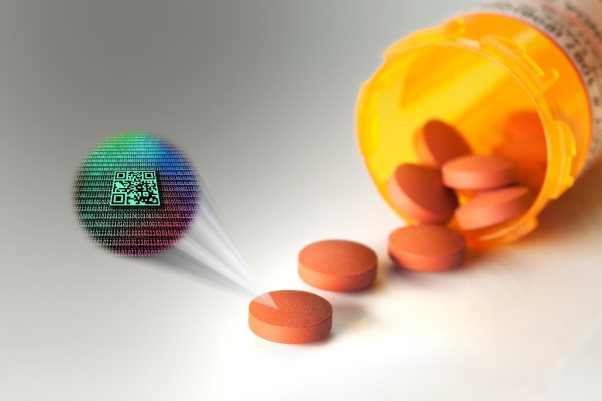
TruTag Technologies’ objective is to enable the mass digitization of medicines in the pharmaceutical industry through its smart medicine solution. The solution entails the application of edible, spectrally encoded, microscopic particles directly onto medicines that a cellphone app can detect. The application, which uses a blockchain ledger confirming that the medication is genuine and intended for the patient, can then authenticate the medicine. The spectrally encoded particles can serve as trusted “crypto-anchors” to physical dosage forms, allowing the “last mile” of the blockchain to be securely connected to the physical items. Of importance to note, the solution does not rely on cellular tracking, this will hopefully assuage consumer fears around tracking. However, some consumers will likely be resistant as they often are with new technologies, especially in matters related to personal health.
Aside from quality control, hospitals and doctors can also use the application to monitor if patients are taking their prescribed medication at the appropriate time. Assuring the patients have truly taken their medication is extremely important for clinical trials, treatments that require follow-up (like the second COVID-19 vaccine shot), and patients with memory impairment.
Figure 1: Tablets with digital “TruTags”
Source: TruTag
TruTag’s technology is low cost—a fraction of a cent per tablet/capsule—making it possible to address use cases in both mature markets as well as developing markets where even over-the-counter medicines are often counterfeited. From a manufacturer’s standpoint, the technology is not only easy to apply to both capsules and tablets but also in the vials in which a treatment like the COVID-19 vaccine is shipped. From an end-user standpoint, the solution seems easy to follow and does not require the purchase of any new equipment or device. The simplicity of the solutions is important especially given that they will be often used by the consumer, many of whom are likely elderly or unwilling to adapt to new or complicated technology.
CSPs should revisit healthcare as wireless connectivity is making medicine and supply chains more dynamic
With all the death and despair that COVID-19 has created, one cannot underestimate the extent of the destruction created by this blight. The destruction has been so great that it is transforming consumer behavior and how technology is changing and adapting to address new consumer behaviors.
On the surface, TruTag’s technology does not appear to provide increased opportunity to CSPs. However, if one steps back, one can see how TruTag’s technology could be incorporated into a larger end-to-end asset tracking or supply chain/cold chain solution that ultimately reaches and engages the patient to help improve health outcomes. This single technology for digitizing medicine can make every tablet/capsule a data point, which can help improve clinical trial administration, scope, and diagnose quality incidents for better product recall processes, authenticate and trace product in the supply chain, and support patient adherence to medication regimens.
CSPs could partner with TruTag and offer pharmaceutical companies or hospitals the ability to not only validate the authenticity of a drug but also to lay on top of that solution the ability to monitor where and how the drugs were transported. Ensuring that a drug is transported/stored at a certain temperature, ensuring that medication is taken before it expires, or ensuring that the location of drugs can be tracked internally across a hospital that could span several buildings with many different floors would be of great value, especially for costly drugs.
CSPs, if they have not already, must have internal resources allocated who can help address IoT opportunities in healthcare. If CSPs are going to provide more than simply connectivity, they must have a level of competency and subject matter expertise, even if they have struggled to address healthcare in the past. COVID-19 has accelerated the need for IoT to address precise medicine distribution while also reducing some government friction that IoT players have faced in the past, so CSPs could find it easier to help bring solutions to market.
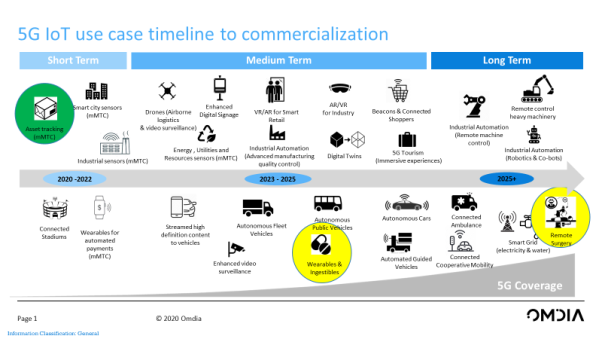
For CSPs, the changes presented by COVID-19 are a foothold to address the changing healthcare industry. Omdia believes that in the near term, CSPs and their partners should explore using LTE/5G to address healthcare needs, such as asset tracking, and look to aggregate or supplement what can be provided by start-ups. As seen in figure 2, CSPs should also prepare for new use cases emerging around wearables and ingestibles that can not only address location and biometrics but also applications that can use this data to make predictive and prognostic diagnoses. Omdia has already witnessed several CSPs working with medical device makers so that medical images can be seen in real-time by doctors often located in other cities or where machine learning can be used to read COVID-19 tests. With the eventual emergence of 5G for mission-critical communications, machines with the ability to enable doctors to perform surgeries remotely could emerge.
Figure 2: Selected 5G use cases in the healthcare vertical
Source: Omdia
However, CSPs do not need to wait for a robust 5G rollout. As the TruTag solution indicates, there are plenty of opportunities for IoT to address longstanding (or new) issues in the healthcare space using LTE, wired, and even short-range solutions, such as Bluetooth devices, that can ingest vital patient readings. While the regulatory and liability issues tied to the healthcare market will continue to present unique challenges, a solution like TruTag demonstrates the value IoT can bring when properly implemented in the space. Overall, Omdia believes there will be growing acceptance of IoT in healthcare. While this has in part been brought upon by the COVID-19 outbreak, such changes are likely to have a lasting impact. As a result, CSPs and other players must prepare and position themselves for the growth of IoT in healthcare in the years to come.
Appendix
Further reading
COVID-19 IoT Strategies 2021 and Beyond (March 2021)
CSPs’ Strategic IoT Responses to COVID-19 (October 2020)
COVID-19 Market Impact: IoT 2020 (June 2020)
“COVID-19 slows meter market but accelerates software spend in future” (April 2020)
“The post-COVID-19 world will see the rise of smarter homes” (April 2020)
COVID-19: Telco and Government Responses to the Global Pandemic (April 2020)
Despite COVID-19 smart speaker market expands during 1Q20 (April 2020)
“COVID-19’s impact on the cellular IoT market” (April 2020)
“COVID-19 in private networks” (April 2020)
“IoT is set to play a growing role in the COVID-19 response” (April 2020)
“IoT wins and challenges in the COVID-19 world” (April 2020)
“IoT impact of COVID-19: An early view” (March 2020)
Author
John Canali, Senior Analyst, IoT
