

Many enterprises have already adopted hybrid working practices, including asynchronous methods. So, why are they now adopting new collaboration services despite these changes?
Omdia view
Summary
Although some vendors claim to be “redefining” or “reimagining” the future of work, many enterprises have already figured out hybrid working for themselves. Significant changes implemented during the pandemic have become formal practices, and asynchronous working methods are now commonplace. So why are enterprises now adopting new services to collaborate?
Do we need new co-creation workspaces and asynchronous tools?
During the pandemic, one significant challenge was how remote and distributed team members could align their work schedules and collaborate. Most enterprises use unified communication as a service (UCaaS) to collaborate in real-time (via meetings and business chat) or asynchronously store content in a channel’s file repository and invite team members to collaborate and comment on it. However, as hybrid work becomes more prevalent, organizations seek new ways to support diverse and distributed teams, mainly when working across time zones.
Scheduling meetings across time zone differences can be challenging; coordinating conference calls and collaborating on content through a file-sharing model is suboptimal for many organizations. Consequently, various collaborative, co-creation workspace services are emerging, such as Microsoft Loop, Notion, Miro, Lucidchart, and Zoom Docs. These apps offer modular and flexible ways to manage work, reduce “context switching” (the shifting from one application or task to another), simplify workflow, and oftentimes integrate within existing tools such as email, UCaaS, and other technologies.
Many of these co-creation workspaces use content blocks or components to organize data, manage projects, track tasks, take notes, share ideas, and create content through customizable layouts or templates. Colleagues can be alerted to changes using “@” mentions, which helps them maintain context, collaborate, and keep on track.
While UcaaS heavily focuses on real-time communication, co-creation apps provide a flexible, asynchronous workspace for team members to collaborate on content from one central location optimized to their schedule, not necessarily to fit in with others. Furthermore, workflow is not consigned or reliant on a single app or tool—it can be maintained across different interfaces and solutions. Finally, co-creation workspace solutions typically include mobile, desktop, and browser-based versions, making on-the-go collaboration easier instead of relying on mobile versions of Microsoft Office and other content creation apps to update content.
What will this mean for UCaaS vendors?
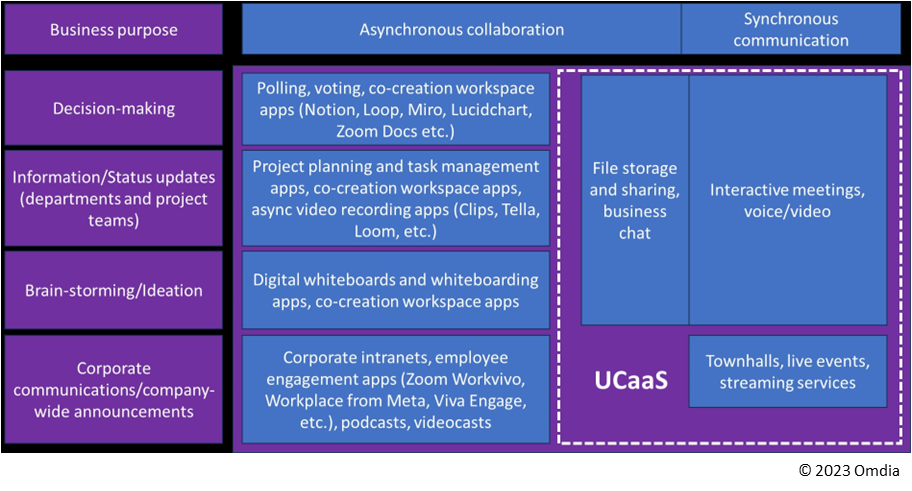
One prominent example of a co-creation workspace solution is Notion, a platform that allows users to create, share, and manage various types of content, such as notes, databases, wikis, calendars, and Kanban boards. Notion has been gaining popularity among both individual and organizational users as it offers a high degree of flexibility, customization, and integration with other tools and services. Notion poses a potential threat to a segment within the collaboration market as it challenges the dominance of traditional productivity suites, such as Microsoft Office 365 and Google Workspace, and encroaches on the domain of UCaaS vendors (see Figure 1).
Figure 1: Mapping business purposes to technology solutions
 Source: Omdia
Co-creation workspace vendors are likely to disrupt the UC&C landscape, and UCaaS vendors need to keep a close eye on them. Indeed, preempting this potential disruption, Zoom has announced Zoom Docs, a cloud-based document collaboration platform that allows users to create, edit, and share documents in real time within Zoom meetings or chat. Microsoft has also launched Microsoft Loop, a co-creation workspace platform currently in public preview. With these solutions, teams can collaborate on different types of content and improve productivity and innovation in distributed and hybrid work models.
UCaaS vendors should expand their scope and target a larger market by exploring the co-creation segment. This means shifting focus from traditional messaging around real-time communications and meetings to a more productivity-oriented narrative. To differentiate, they can partner with existing vendors or develop their solutions organically through product development or acquisition. This approach will provide enterprise customers with a more comprehensive and integrated collaboration experience while offering a potential new revenue stream for UC&C vendors.
Appendix
Author
Tim Banting, Practice Leader, Digital Workplace