This report provides analysis of IoT solutions announced at Mobile World Congress (MWC) 2025.
Omdia view
Summary
Mobile World Congress 2025 (MWC25) took place in Barcelona, Spain from March 3–6. Even with many communications service providers (CSPs) facing headwinds, over 109,000 attended according to the GSMA, by all accounts, this was a strong showing. The strong physical attendance was matched with many significant announcements that will shape the industry in years to come. This report summarizes key takeaways from the announcements and discussions Omdia had at MWC25 as well as the announcements made in the run-up to the event.
Organizations coming together as the world polarizes
Much of the discussion in meetings and on the floor at MWC 2025 was about geopolitical concerns. With tensions flaring between former allies and tensions between rivals becoming codified, there are major concerns about supply chain and overarching concerns about the shape (or lack thereof) of the new world order. In the face of these concerns, the GSMA announced strategic partnerships and collaboration opportunities with the 5G Automotive Alliance (5GAA), Japan Automotive Software Platform and Architecture (JASPAR), Outsight, Safran Passenger Innovations, and Seamless Air Alliance. This is on top of a previously signed partnership with the Automotive Edge Computing Consortium (AECC) signed last fall. For IoT, collaboration between the GSMA and automotive industry groups is important for maintaining alignment and helping to promote solutions that enhance safety, but also solutions that can scale.
It is increasingly important for groups representing CSPs like the GSMA to hear what other industries are saying about their needs, wants, and timelines. If the industry is going to benefit from technologies like 5G Advanced, AI, Open APIs, Network slicing, C-V2X, and others, alignment is crucial. Arguably, 5G was not as well aligned with industry needs and readiness. 5G was seen as an overarching technology that would shape enterprises, when in fact, enterprises and verticals evolve at their own pace and not simply because a technology is available. There is still time to find the right alignment for 5G. Equally important is having the right stakeholders prepared to collaborate on 6G.
Other key topics included improving quality of service in IoT for global reach through federated connectivity partners, which goes beyond roaming to local IMSIs and multiple eSIM profiles, as evidenced by the AT&T and Eseye and the NuvoLinQ/BICS and Kigen deal, which allows for failover in the case a provider cannot be reached or goes down; an essential element for devices in the field, often in hard to reach locations.
MWC 2025 also emphasized the true beginning of AIoT, with Omdia witnessing the emergence of integration of NPUs (Neural Processing Units) on MCUs, truly bringing AI to the edge in small packages-something that will continue to accelerate. Announcements in this area are more likely to happen at Embedded World (March 11–13 in Nuremberg, Germany).
IoT eSIM is just about ready for primetime
A lot of discussions at MWC concerned the growth in eSIM and the fact that SGP.32 is finally ready to be shipped to the market in the first half of 2025. Despite the technical specifications being finalized in 2023, it has taken another year of testing compliance and finalization of the standard to start shipping. Many of the interesting use cases centered on reducing SKUs for end devices as well as providing backup/failover solutions for end customers. Given that the customers may or may not switch providers over a device's lifetime, Omdia is encouraged to see use cases around failover and reduced SKUs that have a direct impact on improving supply chain efficiency and ensuring business continuity.
Thales and Cubic Telecom announced a partnership to better service software-defined vehicles (SVDs). The partnership will likely bring together Cubic’s strengths as a systems integrator, its understanding of SDVs, and its connectivity agreements with over 90 CSPs with Thales’ eSIM management platform. The announcement is significant in that the GSMA will soon start certifying solutions based on SGP.31/.32 (IoT eSIM) after a series of delays. Automotive OEMs are likely to be some of the most excited IoT enterprises to adopt the technology, which will make switching CSP profiles and thus networks far less expensive and time-consuming. Though it will take time for OEMs to come to market with solutions based on the IoT eSIM rather than SGP.01/.02 (M2M eSIM), in part because OEM development cycles are typically five years or more. Still development cycles are compressing, in part because of SDVs, as well as the connectivity that underpins their updates.
AT&T and Eseye unveiled a Global SIM Advanced (GSA), a multi-profile eSIM solution. The solution offers global connectivity with lower latency connectivity that localization can offer. The GSA features and AT&T bootstrap IMSI, and the GSA can store up to 9 additional network profiles on a single eSIM. For orchestration, the GSA uses a version of Eseye’s AnyNet eSIM and Infinity, Connectivity Management Platform. AT&T’s connected car business was partly run on its ability to offer OEMs a global SIM, though one that typically featured roaming. The SIM allowed OEMs to produce vehicles in one region and still connect the SIM to the network in the region where the vehicle was delivered. This solution is superior. It offers the benefits of network localization including reduced latency, which can be important for emergency crash notification (eCall) and features of autonomous driving. The solution has an added benefit of helping OEMs and other IoT enterprises comply with legislation that prohibits IoT devices from permanently roaming.
Giesecke+Devrient (G+D) and Amazon Web Serivces (AWS) announced that AWS’ cloud is powering G+D’s SGP.32 SIM solution (IoT eSIM). The combination of AWS global infrastructure and security capabilities provides continuity to G+D’s AirOn360 Entitlement Service and IoT Suite.
IDEMIA showed off its fully scalable iSIM solution powered by Qualcomm modems. iSIM or integrated SIM refers to SIM architected based on GSMA SGP.41/.42 and enables in-factory provisioning. The solution is reprogrammable and supports compliance with the new IoT GSMA specification. While still in the early stages, iSIM is well-suited for healthcare and asset tracking and will become more common in solutions like connected cars nearer to 2030.
NuvoLinQ launched an eSIM offering for cellular point-of-sale (POS) connectivity in partnership with BICS (a Proximus company) and Kigen. The solution offers backup connectivity options to ensure uninterrupted operations, allowing payment systems—such as card readers at retail stores or kiosks—to securely transmit and receive data, Deutsche Telekom with its main supplier, Nordic Semiconductor (advanced chipsets), promoted its concept of Make Everything Cellularly Connected (MECC) alongside its own NuSIM technology. The solutions reduce time to market for IoT enterprises, allow for greater scalability and increased flexibility, and stand on the benefits of cellular and satellite connectivity over Wi-Fi or Bluetooth such as global coverage and greater security. An IoT module with integrated NuSIM technology and Deutsche Telekom connectivity is installed into a device at the time of production. The approach highlights the growing number of SIM technologies and connectivity strategies that are available to IoT enterprises. Enterprises can manufacture at a far greater scale but only pay for connectivity when the device is activated. Effectively, devices can be manufactured with standby connectivity and devices sitting in warehouses or on shelves are not incurring additional connectivity costs beyond the one-time cost. Connectivity can be adjusted by changing data requirements through the NuSIM. Data insights are provided through Deutsche Telekom’s IoT platform which will allow enterprises to better understand the needs of their devices.
- One-time payment of €10 that includes hardware, software-based SIM, and connectivity.
Connectivity management platforms continue to be refined, APIs are essential
While a key feature of eSIM technologies is profile management, key industry players are continuing to improve their connectivity management platforms (CMPs). Verizon’s ThingSpace IoT platform continues to evolve, particularly with regard to global orchestration. Previously Verizon integrated Bell Canada and Telenor. At MWC 2025, Verizon and Singtel announced that Singtel would join Verizon’s Global Orchestration Platform, providing even greater coverage to Asia & Oceania. Also significant, Verizon announced initial plans to offer IoT connectivity services from satellite wholesale provider Skylo Technologies across remote areas in the US. The company will likely expand the offerings in the future.
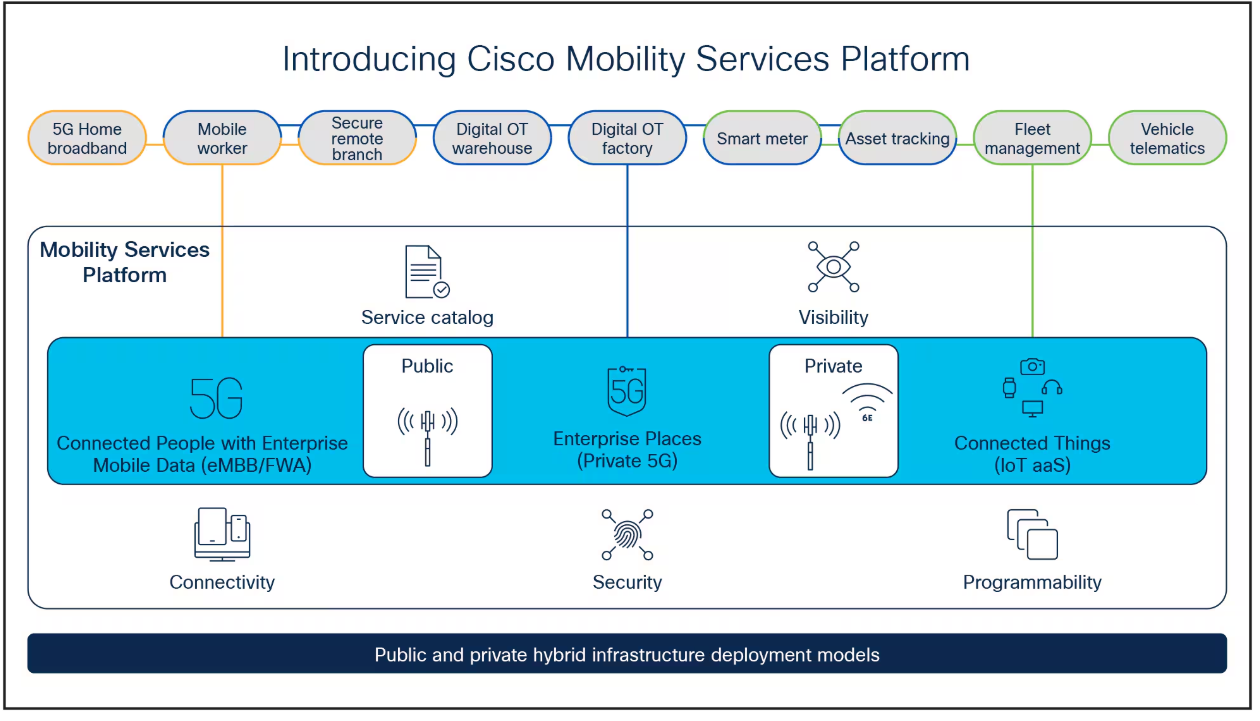
Cisco’sMobility Services Platform aims to empower CSPs by providing pre-integrated, cloud native 5G core network functions, it streamlines the complexity of mobile service delivery at scale. The global platform, which is offered as a platform-as-a-service, offers an extensive API ecosystem that is open to developers, CSPs, and enterprises. Cisco announced the following partners at MWC 2025:
- BT and Cisco announced a three-year renewal of their go-to-market Mobility Services Platform partnership, capitalizing on their long-standing relationship to accelerate IoT connectivity in the UK
- KPN and Cisco are renewing their relationship and strengthening their go-to-market partnership to accelerate IoT connectivity. This reinforces their mutual commitment to driving innovation and growth across Europe
- Cisco are working with Türk Telekom to drive the delivery of IoT services in Turkey
- Cisco is working with TIM Enterprise Italy to enable faster deployment of IoT applications and use cases across their extensive enterprise customer base
Figure 1: Cisco Mobility Services Platform
Source: Cisco
RedCap enthusiasm might be tepid, but developments are afoot
The lack of progress around Redcap cropped up in many conversations at MWC, including slow progress in China and lack of OEM adoption in general. The challenge of fragmented 5GSA rollouts, the fact that 4G LTE (from Cat 1 and Cat 1bis down to LPWAN) has proven to be good enough, and the fact that eRedcap is on the horizon have all been factors in slower than anticipated growth in Redcap.
Hyundai Motors and Samsung announced that they had successfully completed a 5G RedCap (Reduced Capacity) trial on a private network or P-5G RedCap. The trial was showcased at Samsung’s booth. The announcement is interesting as the RedCap ecosystem has been slow to materialize in part because the technology is dependent on 5G standalone (SA) rollouts which have been slow to rollout.
South Korean CSPs have been ahead of the curve with 5G SA rollouts and although this is on a private network, it will help show others what is possible on a more fully developed 5G rollout. The successful trial also is important to signal to device and module manufacturers to at the very least start ideation around new devices, so that they are ready to be tested and certified as the market develops. Samsung used its RedCap-powered private 5G network solutions including its virtualized 5G Core, baseband units, radios supporting 4.7GHz band, and an integrated Network Management System. The system leveraged wireless connected cameras to perform Hyundai Motor’s Diagnostic Scan (D Scan) to check whether vehicles were assembled properly.
Also announced was the joint effort to transform the Hyundai Ulsan Plant and Hyundai Motor Group Metaplant America (HMGMA) with private 5G. The announcement is important in what it signals to automotive OEMs about their manufacturing vision. Aside from most of the electric vehicle (EV) start-ups like Tesla, Nio, Rivian, Xiaomi, and others, the Korean OEMs (all part of Hyundai Group) have been particularly adept at tackling EVs and SDVs. Compared to their Europe, American, and Japanese counterparts, the Korea OEMs have had some of the most properly balanced production between EV and ICE and the fewest problems with their EVs. Because Hyundai employs some of the most advanced and efficient manufacturing techniques, it is better able to compete not just on price but also on quality as well as increasing worker safety. The company plans to deploy IoT solutions such as automated guided vehicles (AVGs) smart factory technologies and sensors, as well as a wide array of cameras and wearables.
Sequans Communications announced support for reduced capability (RedCap) 5G in its upcoming Calliope and Monarch products. The new third-generation versions of these solutions will continue to support 4G/LTE-based cellular IoT technologies, such as Cat 1bis and dual-mode LTE-M/NB-IoT, while providing a silicon upgrade path for 5G-based RedCap low-power IoT applications. This includes the ability to take advantage of enhanced (eRedCap).
- The Calliope 3 solution, a direct replacement for Calliope 2, adds 5G eRedCap, a feature of release 18-level 5G networks, to LTE-based Cat 1bis. This places it a step above the traditional cellular IoT low-power wide-area network (LPWAN) duo of LTE-M and NB-IoT in terms of power and performance. The Monarch 3 solution, replacing Monarch 2, also incorporates eRedCap, enhancing the company’s flagship dual-mode LTE-M/NB-IoT system.
Monarch 2 is designed to cater to the growing demand in industries such as smart metering, healthcare, and asset tracking.
5G Advanced and ambient IoT make some noise
While many CSPs have decelerated their deployments of 5G SA, network infrastructure provider, ZTE, and China Mobile, a CSP, showed off the benefits of 5G Advanced (5G-A). ZTE and China Mobile jointly launched the 5G-A Ambient IoT End-to-End Solution, comprising Ambient IoT Computing Base Stations, “e-Star” Ambient IoT tags, and the “e-Thing” Ambient IoT management platform. Not surprisingly, Chinese CSPs and vendors are leading the way with advanced networks. Based on 3GPP Release 18 and with new advancements in Release 19, 5G-A is also known as 5.5G as it is seen as a bridge to 6G networks. A key feature of 5G-A is 5G Ambient or Ambient IoT is that it enables some of the least complex devices can communicate with a wireless network. Often these devices are without batteries or have little energy storage and/or are unable to generate or amplify signals yet can still be used to detect changes in an environment. This could prove particularly useful in industrial settings as well as real-time item tracking and reporting. According to the companies, ZTE and China Mobile have successfully validated the 5G-A Ambient IoT Full-Scenario Solution in high-value applications, including smart warehousing, smart manufacturing, smart campuses, and smart exhibitions, paving the way for large-scale commercial deployment.
Qualcomm expands and refines its offerings with Dragonwing brand
Prior to the show, Qualcomm unveiled its Dragonwing brand for its products in three key segments: Industrial and Embedded IoT, Network Infrastructure, and Cellular Infrastructure. Dragonwing is a distinct brand from Snapdragon, which is used for smartphones, tablets, wearables, laptops, connected cars, gaming, and XR.
Dragonwing will target devices more commonly seen in industrial settings like cameras, robots, industrial wearables and handheld devices, point-of-sale (PoS) terminals, safety and monitoring systems, and even drones. It will also be used for cellular infrastructure offerings and Wi-Fi access points. Both Dragonwing and Snapdragon share horizontal features such as AI, high performance, low power computing, and connectivity.
Early into the show, Qualcomm announced Dragonwing Fixed Wireless Access (FWA) Gen 4 Elite Platform. The platform has been billed as the world’s first 5G Advanced FWA platform. It features a Qualcomm X85 5G modem tri-band Wi-Fi i7, 14km millimeter Wave (mmWave) 5G connectivity, and download speeds of up to 12.5 Gbps. Impressively, it delivers 14 kilometers (8.7 miles) of long-range 5G mmWave performance, non-terrestrial (NTN or Satellite) communication capabilities, and Dual SIM Dual Active (DSDA) for high-performance aggregation, reliability, and remote management. The platform is ready for the increased integration of AI and edge computing.
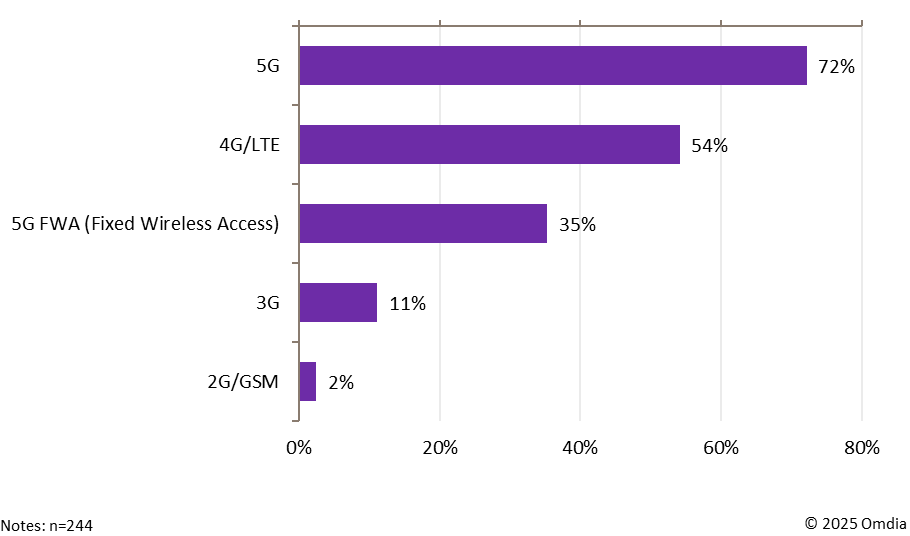
Omdia’s research shows that IoT enterprises are increasingly exploring FWA. Of the 244 enterprises using or planning on using cellular technology, over one-third are using or considering FWA. In regions with weak fiber penetration, this technology is even more important. While this technology will face some competition from Low Earth Orbit (LEO) satellite connectivity, it will take additional time for that market to materialize. Qualcomm, rightly, equipped its platform with NTN capabilities, though this is likely as a backup rather than a primary form of connectivity.
Figure 2: Which cellular technologies are you currently or considering using for your IoT solutions?
Source: Omdia
V2X receives a push but the market is still waiting for the OEMs
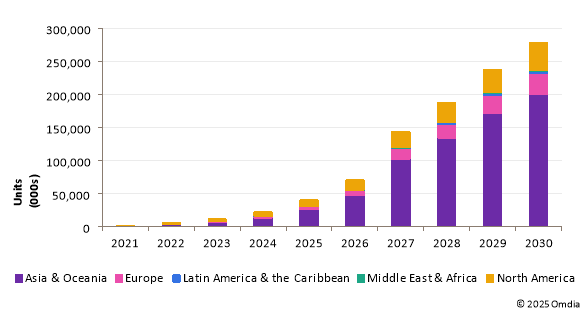
Harman, a subsidiary of Samsung, presented its Ready Aware, vehicle-to-network (V2N) solution and is collaborating with HERE Technologies (HERE) to develop advanced, direct, and cloud-based vehicle-to-everything (V2X) driver assistance systems that will help OEMs comply with Europe New Car Assessment Program (NCAP) 2026. Ready Aware is technology that provides drivers with in-vehicle, contextual alerts on a variety of road hazards and at intersections, it already supports 15 use cases. The system features a cloud-based analytics engine and utilizes machine learning to provide insights into potential road conditions and hazards. HERE, which collects and models tons of data around mapping, navigation, and location services, including the data OEMs need to comply with European Intelligent Speed Assistance (ISA), provides much of the data needed to make Ready Aware robust and compliant with Euro NCAP 2023. The partnership between Harman and HERE will help OEMs comply with NCAP 2026 protocols surrounding advanced crash avoidance Data for Road Safety (DFRS). In Omdia’s view, Ready Aware and subsequently the requirements for NCAP 2026 should spur OEMs to really start implementing solutions based on cellular vehicle-to-anything (C-V2X) technology.
Wind River and Aptiv made a compelling case that CSPs can save automotive OEMs money on memory and computing by hosting C-V2X applications at the network edge. Perhaps this argument will spur OEMs and CSPs to get creative in their discussions of C-V2X business models as well as drive a technology that serves as a public good.
Figure 3: Global C-V2X forecast by region (all devices)
Source: Omdia
Accelerating the IoT Edge with AI
Arm strengthens its position in IoT with Armv9 platform edge AI platform
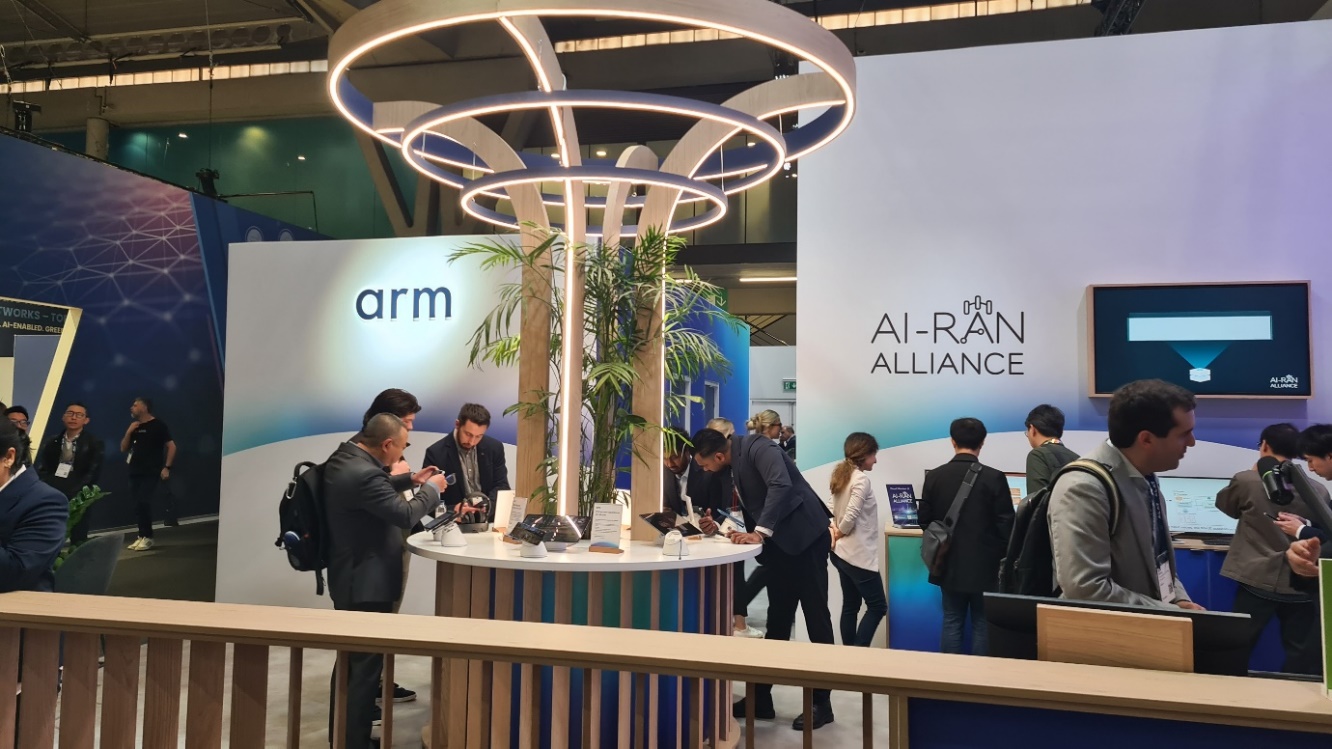
Arm launched its Armv9 Edge AI platform in a pre-MWC announcement on February 26. It is another advancement in IoT and edge computing. Integrating the Cortex-A320 CPU and Ethos-U85 NPU to enable on-device AI processing with over one billion parameters will allow real-time decision-making without relying on cloud connectivity, improving efficiency and reducing latency. The Cortex-A320 delivers better machine learning (ML) performance and significantly higher scalar processing than its predecessor, making it ideal for industrial automation, smart surveillance, and embedded AI applications. Additionally, enhanced security features, including Pointer Authentication (PAC), Branch Target Identification (BTI), and Memory Tagging Extension (MTE), strengthen data protection for applications in critical sectors like healthcare, finance, and automotive.
Figure 4: Arm at MWC 2025
Source: Omdia analyst photo, Mobile World Congress 2025
With backing from AWS, Siemens, and Renesas, the platform is positioned to accelerate edge AI adoption by offering lower latency, higher efficiency, and reduced cloud dependency. As industries seek cost-effective, scalable AI solutions, Arm’s platform aims to provide a versatile and secure option for developers and enterprises integrating intelligent edge computing into their ecosystems.
Beyond performance and efficiency, the platform’s AI capabilities open new possibilities for IoT innovation. By enabling AI-driven automation, predictive maintenance, and enhanced security, it empowers industries to build smarter, more responsive IoT systems. As AI adoption at the edge grows, Arm’s platform positions itself as a foundational technology, shaping the next generation of AI-powered IoT solutions.
Fibocom unveiled its Nebula series, a lineup of high-performance AI modules offering computing capabilities ranging from 1 to 50 TOPS (Tera Operations Per Second). With Nebula Series Fibocom is aiming to capitalize on the growing demand for edge AI solutions across various sectors, including smart cities, autonomous vehicles, and industrial automation. By providing scalable AI processing power, the solution enables enterprises to enhance operational efficiency, reduce latency, and improve data security by minimizing reliance on cloud-based processing.
Major announcements around AI at the edge are expected at Embedded World, the major show for the embedded hardware industry, which follows MWC.
Hybrid networks incorporating cellular and NTN
Quectel introduced two new modules at the MWC: the SC200V LTE smart module and the LG680P GNSS module. The SC200V is designed to enhance advanced multimedia devices, offering LTE connectivity and smart capabilities suitable for a range of applications including POS systems, handheld devices, vending machines, and in-vehicle systems. The LG680P GNSS module provides high-precision positioning, catering to industries that require accurate location tracking such as precision agriculture, intelligent robots, and surveying.
Nordic Semiconductor showcased the NTN capabilities of its nRF9151 low-power System-in-Package (SiP). This includes 3GPP-compliant low earth orbit (LEO) NTN connectivity, which promises to revolutionize IoT by allowing small and cost-sensitive IoT devices to achieve standardized connectivity anywhere across the globe.
Murata and Rohde & Schwarz introduced the world’s first Voice over Narrowband Non-Terrestrial Network (NB-NTN) testbed. This innovative demonstration marks a significant leap in 3GPP-based satellite connectivity, enhancing safety and communication capabilities in areas without terrestrial network access.
Prior to the show, Mavenir, and Terrestar Solutions Inc. successfully completed an industry-first Voice over NB-IoT (Narrowband Internet of Things) call in NTN (Non-Terrestrial Networks) mode. The achievement was conducted over a 3GPP-standardized NTN S-band spectrum, avoiding interference common in terrestrial networks. Designed to work with GEO satellite delays as well, the network ensures consistent coverage despite higher latency.
Appendix
Further reading
IoT Enterprise Survey: Summary Report - 2024 (September 2024)
“C-V2X clarified in the US, but hurdles remain” (January 2025)
Passive IoT: RFID, passive, Bluetooth, and eIoT (December 2023)
5G in IoT: Status and Emerging Use Cases (September 2024)
“Verizon redoubles its IoT efforts with Global IoT Orchestration” (August 2023)
Satellite IoT Market Analysis – 2024 (July 2024)
Author
Andy Brown, Practice Head, IoT
John Canali, Principal Analyst, IoT
Shobhit Srivastava, Senior Principal Analyst, IoT