At CES 2026, open-ear headphones moved beyond form-factor differentiation toward scenario-driven value. As designs converge, future growth is increasingly shaped by system-level capabilities across sports, workplace productivity, and AI-enabled interaction.
Omdia view
Summary
At CES 2026, open-ear headphones were no longer presented primarily as a form-factor innovation. While the “open” wearing concept initially defined this category, this year’s show focused on how open-ear designs support broader functionality and more clearly defined usage scenarios. Rather than competing on structure alone, vendors are increasingly positioning open-ear headphones as platforms for additional capabilities, including hearing support, real-time communication, and AI-enabled interaction.
Several products showcased at CES 2026 reflected this change in emphasis. These include: the first OTC hearing product adopting a clip-on structure in the form of open-ear wireless stereo (OWS) headphones, aligning with the rapid growth of clip-on OWS designs; more OWS product featuring a nontraditional noise-reduction mechanism beyond conventional ANC approaches; enhanced AI translation designed for real-time multilingual communication; and an AI photography OWS reference design that delivers an AI-glasses-like experience through multimodal interaction. These showcases suggest not just feature expansion, but a structural shift in how open-ear headphones create value.
As the open-ear form factor becomes more widely adopted, design alone is no longer sufficient to sustain differentiation. The direction seen at CES 2026 suggests that vendors are increasingly looking to expand use cases and embed additional system-level capabilities. This raises a more practical question for the category: if structural advantages are becoming baseline, where will the next phase of growth come from?
The market is still growing, but the growth of drivers has shifted
The open-ear headphone market continues to expand. According to Omdia, open-ear products accounted for more than 10% of the global personal audio market, with annual shipments exceeding 30 million units by 2025. As the category scales, however, both product strategies and competitive dynamics are undergoing structural changes.
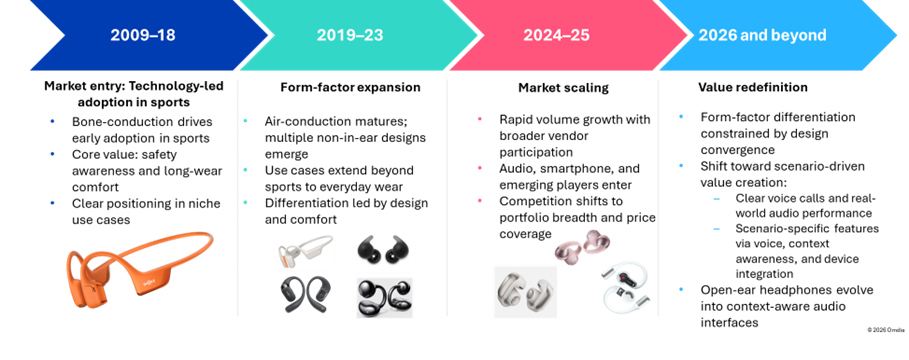
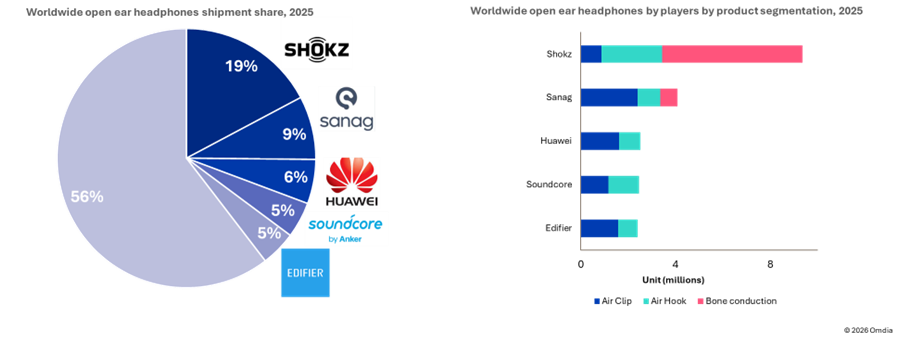
Early growth was largely driven by bone-conduction technology, which faced clear technical barriers and aligned closely with sports- and safety-focused use cases. As consumer awareness and acceptance broadened, the market diversified into multiple architectures, including air-conduction, ear-hook, and clip-on designs. During this transition, Shokz continued to rank first globally in open-ear headphone shipments for three consecutive years from 2023 to 2025 (according to Omdia), reflecting how early technical barriers and scenario alignment translated into sustained scale.
Figure 1: The evolution path of open-ear headphones
 Source: Omdia, Shokz, Xiaomi, Sony, Huawei, Bose, Nothing
However, as alternative architectures diffused and manufacturing complexity declined, form-factor innovation shifted from a source of differentiation to a baseline requirement. With vendors converging on designs that balance comfort, cost efficiency, and manufacturing scalability. By 2025, air-conduction clip-on products had become the primary growth engine of the category, achieving triple-digit shipment growth and being adopted across a wide range of vendors. The relative ease of implementation lowered entry barriers, accelerating new vendor participation and keeping the market fragmented. The top five players account for less than 50% of total shipments, and competitive positions remain in flux. Notably, traditional audio incumbents have yet to establish sustained dominance, whereas more agile players, such as Sanag and Soundcore, have gained traction by rapidly scaling clip-on form factors.
At the same time, open-ear structures are subject to persistent physical constraints, including sound leakage, limited low-frequency performance, and sensitivity to wind noise. These limitations, combined with ongoing price pressure, as reflected in the contraction of the US$100–150 segment to around 16% of the market (according to Omdia), reduce the effectiveness of competing purely on hardware architecture or incremental audio performance improvements. Within these constraints, performance-led differentiation increasingly delivers diminishing returns.
As highlighted at CES 2026, vendors are now reframing the value of open-ear headphones around what they uniquely enable: long-term wear, continuous environmental awareness, and low-friction interaction. As form-factor advantages narrow, future growth is more likely to be driven by scenario-based applications that require high usage frequency, extended wearing time, and open listening, most notably in sports, workplace productivity, and AI-mediated interaction.
Figure 2: Shokz led the open-ear headphone market with a double-digit share, supported by its early advantage in bone-conduction technology
 Source: Omdia, Shokz, Sanag, Huawei, Soundcore, Edifier
Sports: From safe wear to real-time feedback and integrated fitness ecosystems
Sports and fitness are the most mature and well-defined application scenarios for open-ear headphones, supported by a large and growing base of active users. In 2024, approximately 247 million people in the US participated in at least one sports or fitness activity, with around 170 million classified as high-frequency participants (according to SFIA statistics). In China, roughly 500 million people engage in sports regularly, accounting for 37.2% of the population (according to statistics by China’s General Administration of Sport (GAS)). Despite differences in statistical definitions, both markets show a broad, tiered participation structure that underpins further functional integration.
Open-ear headphones have achieved meaningful adoption in sports use cases, driven by their non-occlusive design, which directly addresses situational awareness and safety requirements. This makes them well-suited to endurance sports such as running and cycling, as well as training in shared environments. As a result, open-ear headphones have moved from a niche alternative to a sport-first audio category, where safety, comfort, and long-duration wear form the core value proposition.
This first stage of maturity has been driven predominantly by wearability and safety rather than by deeper performance intelligence. At the same time, sports behavior is becoming increasingly data-driven and scientific. Platforms such as Strava reached 180 million global users in 2025 (according to Strava), including approximately 50 million monthly active users, reflecting a shift from basic activity logging toward performance optimization and process management. However, during exercise, access to performance data still relies heavily on visual interfaces such as smartwatches. In high-intensity or continuous activities such as sprinting or road cycling, frequent visual checks are difficult, disruptive, and can introduce safety risks. This visually dominant interaction model imposes a high cognitive load under physical strain, limiting the transition from post-activity analysis to real-time intervention.
Open-ear headphones offer a pathway to address this limitation by translating selected performance metrics. By converting key metrics, such as heart rate, cadence, and oxygen saturation, into real-time auditory cues via integration with smartwatches and fitness platforms, they address a key bottleneck in current sports data interaction. This allows open-ear headphones to move beyond passive, safety-focused equipment toward real-time feedback terminals that support pacing, fatigue management, and rhythm guidance, effectively serving as a lightweight coaching layer without interrupting exercise flow. Over time, such capabilities could also extend beyond endurance sports into team training, rehabilitation, and gym-based fitness, particularly when combined with AI-driven personalization.
Despite these opportunities, key constraints remain, including data accuracy under high-motion conditions, battery endurance for extended use, and system-level integration with mainstream wearables and fitness platforms. Progress in these areas will determine whether open-ear headphones can evolve from auxiliary accessories into core interaction terminals within the sports and fitness ecosystem.
Workplace productivity: From “meeting ready” to workflow integration
In workplace scenarios, the relevance of open-ear headphones is tied to a large, structurally stable, yet historically under-examined user base: the global knowledge workforce. Across China, the US, and Europe, the global knowledge workforce comprises hundreds of millions of desk-based and knowledge-oriented workers, including more than 80 million technical professionals in China, more than 70 million workers in management and professional roles in the US, and approximately 40% of employed people in the EU working primarily while seated, which represents a predictable, high-frequency usage population (see Eurostat, U.S. Bureau of Labor Statistics, and China Daily in the Further Reading).
As hybrid work becomes more established, the productivity challenge has shifted beyond simply being “meeting-ready” toward enabling continuous information processing across an always-on workflow. Many professionals rely on noise-cancelling, in-ear devices to maintain focus in digital environments. While effective for immersive listening, these designs introduce trade-offs in workplace settings, including physical occlusion, reduced environmental awareness, and increased fatigue over long working hours. This can result in missed non-verbal cues, slower responsiveness, and weaker informal collaboration.
Open-ear headphones address these constraints by supporting what can be described as social transparency: the ability to remain aware of the surrounding environment while participating in prolonged digital communication. In workplace use cases, effectiveness depends less on absolute audio quality and more on sustaining clear, private, and efficient information processing without isolating the user from their physical context. Non-occlusive designs enable all-day wear and reduce listening fatigue, making them better suited to continuous task switching and long meeting schedules.
As collaboration platforms such as Microsoft Teams and Zoom continue to expand their daily active user bases, growth of 16.2% and 19.6%* (Sensor Tower) in 2025 indicates that the intensity and duration of online meetings have increased. User expectations are shifting from basic audio functionality toward features such as real-time transcription, meeting summaries, translation, and cross-platform integration. Audio devices are increasingly expected to function as workflow interfaces rather than standalone peripherals.
Open-ear headphones provide a structural pathway to the next stage by maintaining environmental awareness by default, rather than relying on software-driven transparency modes that still require physical occlusion. This architectural difference supports continuous wear and lower interaction friction, helping users balance focus and collaboration throughout the workday. Their all-day wearing comfort further reduces fatigue from prolonged use. As expectations for real-time transcription, meeting summaries, and AI-powered translation continue to rise, open ear headphones are evolving from passive audio receivers into active information interfaces.
Trends highlighted at CES 2026 suggest that workplace audio devices are evolving toward the role of information filters, tools that not only transmit sound but also capture, process, and distil relevant information in real time. While challenges remain around cross-platform integration and multi-speaker recognition, the combination of frictionless wearability, persistent environmental awareness, and embedded AI capabilities positions open-ear headphones to move beyond meeting-centric use and become integrated components of workplace productivity systems.
Conclusion
The initial growth phase of open-ear headphones, driven largely by form-factor differentiation, is approaching maturity. As physical design advantages become more widely replicated, future growth is increasingly tied to system-level value creation in high-frequency usage scenarios. Across sports, workplace productivity, and AI-mediated interaction, open-ear headphones are being repositioned as continuous interfaces that support low-friction interaction while preserving environmental awareness.
AI plays an enabling role in this transition by supporting contextual processing, real-time assistance, and on-device intelligence. Recent industry developments, including Apple’s acquisition of Q.ai, reflect a broader focus on low-latency, on-device AI execution. While form-factor differentiation continues to narrow, the growth outlook for open-ear headphones remains positive as the category evolves toward sustained wear, scenario-specific integration, and more intelligent interaction across everyday use cases.
Appendix
Further reading
Strava, “Strava Releases 12th Annual Year in Sport Trend Report, Revealing That Doomscrolling Is Out, Movement Is In” (December 2025)
TechCrunch, “Strava eyes IPO as Gen Z trades dating apps for running clubs” (October 2025)
China Daily, “Pool of skilled workers widens” (September 2025)
SFIA, “SFIA’s Topline Report Shows 247.1 Million Americans Were Active in 2024” (February 2025)
General Administration of Sport of China, 全民健身谱写“体育强则中国强”新篇章_国家体育总局 (September 2024)
Eurostat, “Sit at work? You are one of the 39%” (March 2019)
U.S. Bureau of Labor Statistics, Employed persons by detailed occupation and age
Author
Cynthia Chen, Research Manager, Connected Life, Consumer