


LONDON, January 15, 2026: Analysis from Omdia’s new report 2G and 3G Switch-off Regulations and Policies reveals that Europe is leading global 2G/3G network decommissioning, with a strong focus on retiring 3G services. This trend is largely driven by the continued importance of 2G for M2M and IoT applications in several European markets. Countries including Germany, Belgium, and the Netherlands have already phased out 3G while retaining limited 2G coverage for legacy use cases. In the UK, all MNOs have committed to shutting down 2G and 3G networks by 2033, aligning with national goals to free up spectrum for 5G expansion. However, all UK 3G networks are expected to be switched off by early 2026.
“With the growing adoption of 4G and 5G, mobile network operators are switching off their 2G, 3G, or both networks to free up resources, reassign spectrum, reduce complexity and save costs, as the cost of operating all four networks simultaneously is extremely high” said Sarah McBride, Principal Analyst, Regulation, at Omdia.
According to the report, the focus in Asia-Pacific has been on shutting down 2G networks, with Japan leading the way as the first country to fully decommission 2G. North America has completed its 3G shutdowns, with the US finalizing the process at the end of2022 and Canada concluding its phase-out in 2025. Meanwhile, in Africa, 3G is expected to be phased out before 2G, as a significant portion of the population still depends on basic 2G services for voice and SMS.
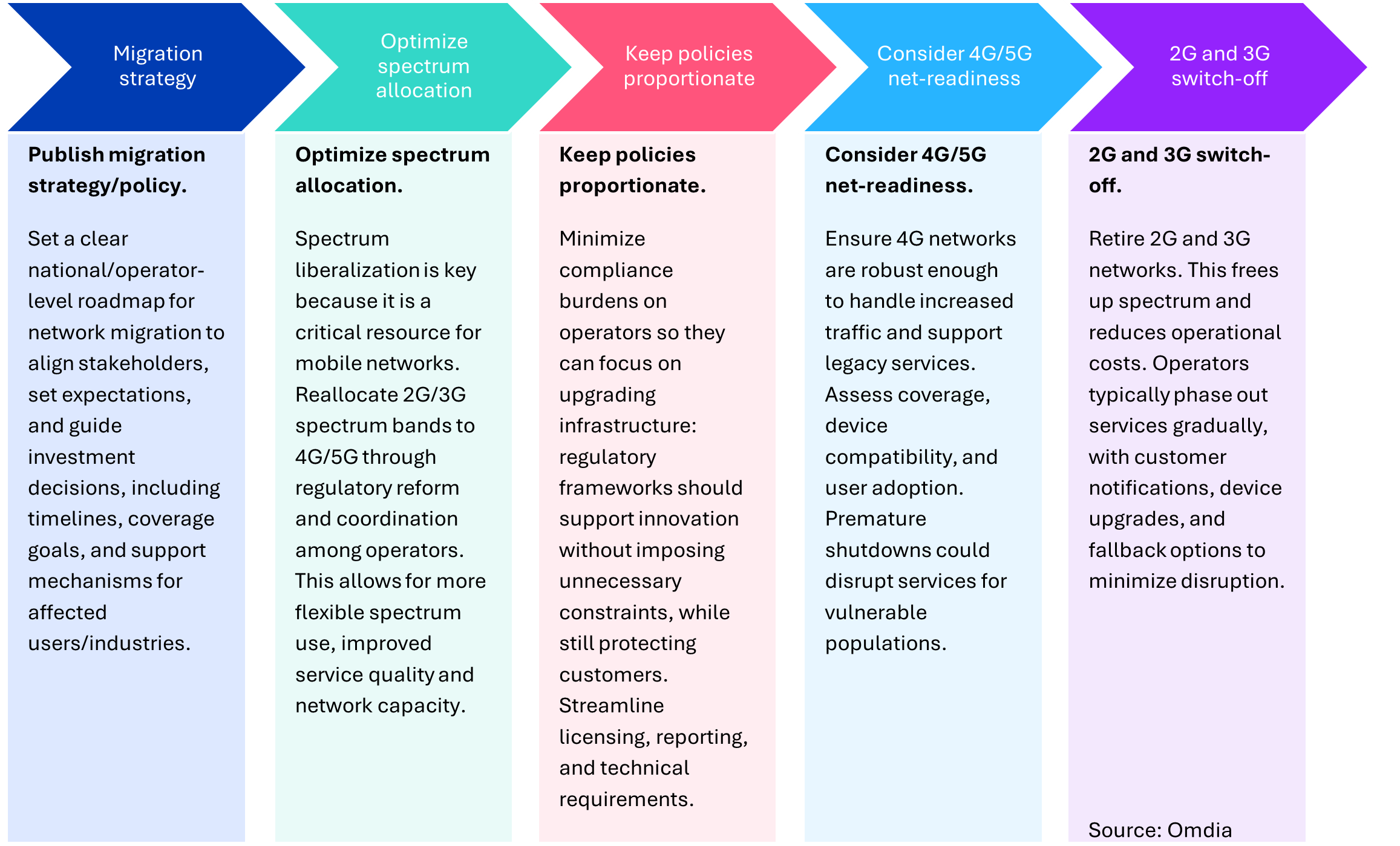
Switch-off processes have largely been initiated by operators. However, in some cases, the switch-off is mandated, approved or overseen by the government or regulator. “This can involve supervising the switch-off program to ensure consumers are protected, approving spectrum-use changes or even requiring operators to ask permission from the regulator before switching off services”, explained McBride. To ensure efficient spectrum use, regulators should enable technology-neutral licensing across existing spectrum, rather than waiting for license expiry to introduce technology neutrality. Ultimately, a successful network switch-off (Figure 1) should involve collaboration between regulators and MNOs.
“As the phase-out of 2G and 3G networks accelerates, consumer protection has emerged as a major concern for regulators”, McBride noted. Vulnerable users such as the elderly, rural populations, IoT users, and those using legacy devices face the greatest risk of service disruption. “To address this, regulators are mandating clear and transparent communication strategies, which include timelines and details of alternative services, structured migration plans, and technical support to ensure a smooth transition” explained McBride.
“Proactively implementing consumer protection measures is essential to ensuring inclusive and disruption-free legacy network shutdowns” concluded McBride.
Figure 1: Steps in the switch-off process
More insights
Assess the marketplace with our extensive insights collection.
More insightsHear from analysts
When you partner with Omdia, you gain access to our highly rated Ask An Analyst service.
Hear from analystsOmdia Newsroom
Read the latest press releases from Omdia.
Omdia NewsroomSolutions
Leverage unique access to market leading analysts and profit from their deep industry expertise.
Solutions