Omdia analysts outline four trends that will shape the technology landscape in Asia Pacific in 2028.
Omdia view
Summary
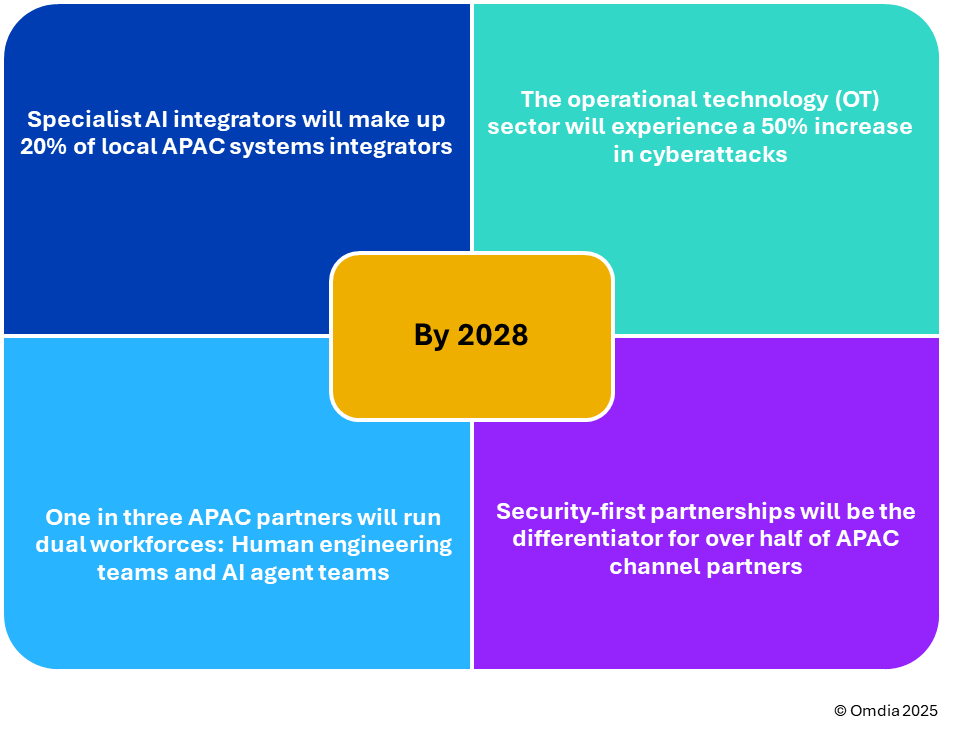
At the December Asia Pacific (APAC) Canalys Forum 2025 in Da Nang, Vietnam, Omdia analysts outlined four trends that will shape the technology landscape in 2028 (see Figure 1).
Figure 1: Four key trends for 2028
 Source: Omdia
These insights are designed to inform technology vendors, channel partners, and IT/security professionals about emerging opportunities and challenges.
Specialist AI integrators will make up 20% of local APAC systems integrators
Omdia’s research reveals that 45% of channel partners see governance as the biggest challenge their clients face in implementing AI solutions, and almost 20% more quoted value realization as the next biggest barrier. As AI continues to progress, realizing its full value will rely on partners’ ability to design and implement automation deliberately to enhance overall efficiency. Effective AI solutions will be shaped by a thorough understanding of the use case, selecting the right process to automate, and applying the appropriate models and software.
With their existing expertise in facilitating technical integration and their deep understanding of their client’s needs and business processes, systems integrators (SIs) are well positioned to lead this shift. As demand for AI-ready architectures and governed automation increases, a new cohort of specialist AI integrators will emerge across the region.
By 2028, these specialists are expected to represent 20% of the local SI population, helping clients overcome implementation barriers and accelerating AI transformation across APAC.
The OT sector will experience a 50% increase in cyberattacks
Omdia’s Security Breaches Tracker shows a 38% increase in cyberattacks from 2024 to the first half of 2025. As supply chains shift and more countries bring manufacturing capabilities to home ground, combined with the slow but steady convergence of IT and OT, by 2028 we are likely to see a 50% increase in cyberattacks on the OT sector.
There are three key reasons why OT is such an attractive target for ransomware groups:
- The notorious cybersecurity talent shortage is even more pronounced in OT due to the need for highly specialized and rare skills to protect unique OT environments
- The challenge of reconciling two worlds with distinct objectives: IT prioritizes confidentiality, integrity, and availability (CIA), while OT has the non‑negotiable priorities of safety, reliability, and availability (SRA)
- The significant technical hurdle of gaining visibility into OT assets, monitoring legacy systems, and responding to incidents through micro‑segmentation.
Organizational IT and security teams will need partner support in building OT security expertise, including regular risk assessments and the implementation of advanced security solutions for OT environments.
One in three APAC partners will run dual workforces: Human engineering teams and AI agent teams
By 2028, one-third of APAC channel partners are expected to adopt dual workforces, integrating human engineering teams with AI agent teams. This shift reflects the growing role of AI in streamlining operations, enhancing decision-making, and driving innovation.
Early deployment patterns are already visible across the region. Partners are using AI tools to take on many repetitive tasks – from code creation and testing to documentation and configuration – while human teams focus on design, architecture, governance, and complex customer requirements.
This is happening faster in APAC than anywhere else because of three structural pressures: persistent talent shortages, high growth expectations, and the increasing demand and pressure to deliver across markets. As a result, partners cannot rely on headcount expansion alone to meet customer needs.
And this is the core intention: AI is not replacing human value; it is extending the value. This hybrid human-plus-AI model gives partners access to scale and capabilities that human teams cannot provide on their own. As AI becomes embedded in day-to-day operating rhythms, this blended workforce model will become a defining characteristic of how APAC partners compete, execute, and deliver outcomes.
Security-first partnerships will be the differentiator for over half of APAC channel partners
Omdia’s latest IT Buyer Insights research reveals that 49% of APAC organizations have made security and risk management a top three priority for 2026. However, while two-thirds have built resilient digital infrastructure, the remaining third are vulnerable, which creates a massive opportunity gap.
It is the “platform moment” for cybersecurity in the channel – the partners positioned to capture most of the growth will be those who embed security into every customer conversation, every partnership, and every engagement.
By 2028, cybersecurity will not just be a side element – it will be the horizontal foundation upon which successful channel partnerships are built.
Next steps for vendors and channel partners
The predictions outlined in this report highlight significant opportunities and challenges for technology vendors, channel partners, and IT/security professionals in APAC. By 2028, the region will witness transformative changes driven by AI integration, cybersecurity priorities, and the evolving needs of critical infrastructure.
By proactively addressing these trends, organizations can position themselves as leaders in the APAC technology landscape, ensuring sustainable growth and resilience in the face of rapid change.
Appendix
Further reading
2026 Trends to Watch: Managed Security Services (November 2025)
“The $151bn cybersecurity opportunity in EMEA by 2030: Smart partnerships will reap success” (October 2025)
Authors
Aditya George, Analyst, Channels
Jonathan Ong, Senior Analyst, MSS
Sheena Wee, Principal Analyst, Channels
Maxine Holt, VP Research, Enterprise & Channels