

AT&T and Cisco look to enable Business Mobile Convergence (BMC) by integrating AT&T's mobile network with Cisco Webex Calling to provide a single number identity to foster better hybrid work for personal and corporate-owned devices.
Summary
AT&T and Cisco have announced a new version of Webex Go in which corporate-liable AT&T phone plans can be easily integrated with Webex Calling plans to provide Webex users a single identity based on the mobile phone number of their AT&T phone.
In this report, we discuss this announcement and its implications for business mobile communications, including:
- Why vendors and enterprises must support an increasingly mobile workforce.
- Why integrating mobility with unified communication (UC) solutions is now so important.
- What a new mobile-first experience looks like for corporate users.
Cisco Webex Go by AT&T: One phone number, many benefits
Webex Go is a mobile solution from Cisco Webex that allows mobile device users to make and receive phone calls using their Webex Calling phone number. In this joint initiative, Cisco and AT&T have integrated Webex Go with AT&T’s IP Multimedia Subsystem (IMS)—part of AT&T’s core network. Consequently, Webex Calling users will have a single AT&T phone number used on a mobile device, a Webex desk phone, and a Webex app running on personal computers and tablets. With this integration, mobile phone users will make and receive calls using the mobile phone’s native dialer; however, these calls will traverse AT&T’s VoLTE (Voice over Long-Term Evolution) or 5G mobile network.
Without this integration, Webex Calling users must use the Webex app to place a call over the mobile phone’s data network, which sometimes has lower quality and less availability. However, the cellular network provides users with broader geographic calling availability and HD audio over AT&T’s cellular network. Users wishing to escalate the phone call to a Webex meeting can easily do so by “elevating” the call to Webex.
With this integration, all mobile phone calls become subject to an organization’s compliance policies as established in Webex Control Hub for Webex Calling, including call recording, call logs, and call analytics. For the first time, IT administrators can see and obtain calling statistics on all calls, whether made from a mobile device, a Webex desk phone, or the Webex app.
AT&T is also enabling a fast-track capability for Webex, which prioritizes Webex data and video media over AT&T’s wireless data network. This “fast track,” coupled with a direct interconnect between AT&T’s and Cisco’s networks, means that Webex meetings and video streaming will perform better when using Webex on an AT&T mobile device than competitive carriers.
Unanswered calls—directed to the AT&T mobile phone or to a Webex device or app—will have a single voice message store. Post-launch, Short Message Service (SMS) will also be integrated with Webex messaging.
Finally, if an emergency services phone call (e911) is initiated from the mobile handset, then AT&T’s 911 service handles the call; otherwise, if a phone call is initiated from a PC, desk phone, or the Webex mobile app, Cisco’s Webex Calling 911 service handles the call.
Unlike competitive offers, there is no monthly recurring per-user charge. Companies order their AT&T corporate liable phones and phone numbers, subscribe to Webex Calling, import the mobile phone numbers into Webex Control Hub, and assign them to Webex Calling users. No end-user activation is required—activation occurs automatically once the AT&T mobile phone number is assigned to a Webex Calling user. This simple and elegant onboarding solution incurs no additional monthly fees beyond the AT&T phone subscription and the Webex Calling subscription.
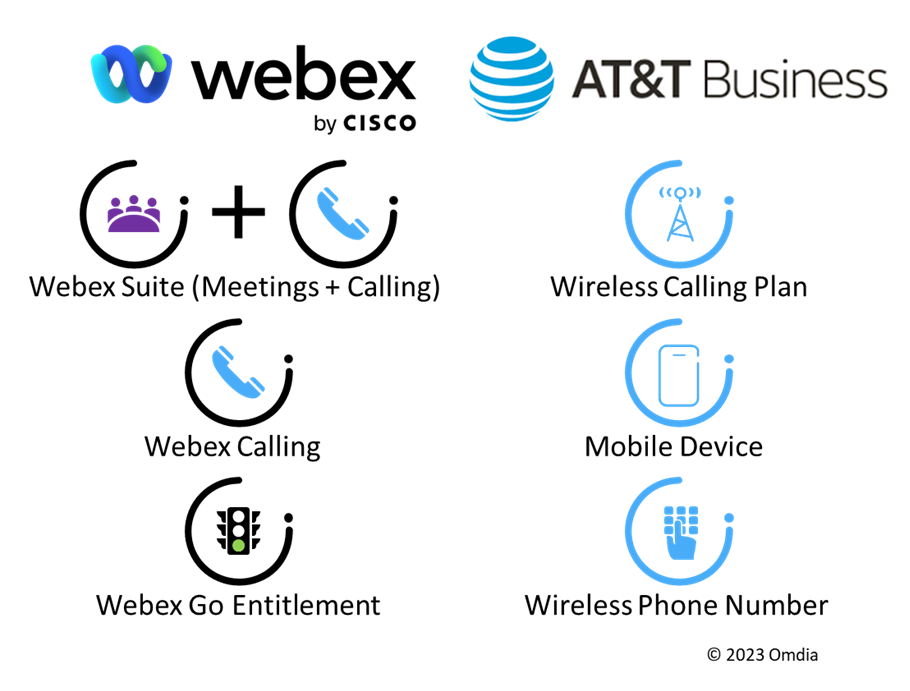
Figure 1: The Cisco/AT&T joint go-to-market strategy
 Source: Omdia
In the joint go-to-market, AT&T will sell the Corporate Responsibility User (CRU) wireless plan, the mobile device, and provides the phone number. Cisco Resellers/VARs will sell Webex Suite or Webex Calling, including the Webex Go entitlement.
This solution is expected to become generally available in 4Q23. Upon launch, AT&T will brand the solution AT&T Cloud Voice for Webex Go. Cisco will brand it as Webex Go by AT&T.
Cisco now supports both BYOD and CRU
Before this announcement, Cisco had a version of Webex Go that allowed users to bring-your-own device (BYOD) and use an embedded subscriber identity module (eSIM) in their mobile phone for Webex Calling. In that scenario, the user would have a personal phone, their own number, and data plan from their preferred mobile carrier CRU—Cisco would provide a second Webex Calling phone number.
In the BYOD version of Webex Go, phone calls traverse the Cisco mobile network, while any meetings and video data would use the data plan from the user’s personal number. This BYOD version of Webex Go is still available from Cisco.
By partnering with AT&T to create this new IMS core-based Webex Go offer, Cisco becomes the first telephony-enabled UC as-a-service (UCaaS) provider to support CRUs and BYOD phones using either Webex Go’s two operating models. This flexibility allows enterprises to use the Webex Go model that most closely aligns with their business philosophy and operating principles.
Why “mobile first” matters
For many employees, work has become inherently more mobile by nature. A more mobile-first approach to work is becoming the norm as businesses look to optimize operations and employee experiences in response to the massive workplace disruptions experienced over recent years. However, the digital infrastructure and practices in place supporting work are not optimally compatible with these diverse and mobile-centric work styles.
Fragmentation between the mobile connectivity, communication, and management capabilities organizations rely on negatively impacts business operations and employee experiences. There is a lack of convergence between the tools and infrastructure supporting workplace mobility and the different people and teams that play an essential role in the overall ecosystem. BMC is a concept that advocates for greater synergy between those responsible for enabling and managing workplace mobility (people) and for richer integration between mobile infrastructure and digital capabilities (technology). This strategic, unified approach is essential given the need to support a more mobile workforce and business continuity within modern business operations.
Work is inherently more mobile
The past few years have brought about turbulent times for employees, employers, and the dynamics within the workplace. Employees encounter various social and economic challenges and know what working environments and tools make them productive, while employers struggle to optimize their office environments, business processes, and procedures. Consequently, many hybrid working practices are still in the formative stages. As more employees conduct work outside the confines of the physical office, mobility has become a pervasive workplace characteristic. From knowledge workers looking to interact with business systems and processes in more modern and intuitive ways to the frontline employees benefiting from new digital technologies that aid their duties, mobility has a more significant impact on everyday work than ever before.
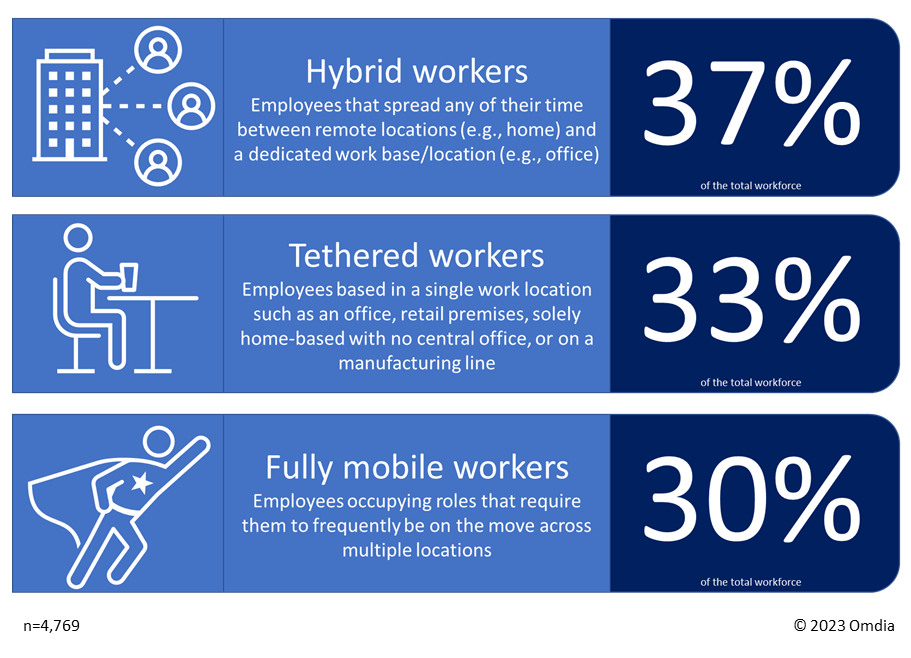
A 2022 Omdia survey of over 4,000 IT decision-makers reinforces that work styles are becoming more mobile: respondents reported that 67% of their total employee base will permanently work in either a hybrid or fully mobile fashion from now on.
Figure 2: Work styles have become more mobile
 Source: Omdia
These work style changes bring new business challenges and opportunities, including supporting and enabling more mobile-centric work. Building a digital infrastructure that supports this more mobile-centric approach to work is essential. Key areas to consider are how mobile devices and applications are managed and secured consistently alongside a more traditional IT estate.
Hybrid work (commuting into the office for parts of the working week) has become an established practice for many organizations. However, the flexibility to work remotely or in an office depends on an organization’s hybrid work strategies and is determined mainly by corporate culture, business processes, and the technology it chooses to deploy.
Technology challenges surfaced when organizations transitioned to remote work in March 2020; however, changing to more permanent hybrid work styles becomes more complicated as a dispersed and mobile workforce requires continuous, seamless connectivity across business platforms, devices, channels, and locations. Delivering consistent and easy-to-use employee communications and collaboration experiences is the cornerstone of hybrid work, and as such, a more mobile-centric approach that includes both the required hardware and end-user support needs to become pervasive.
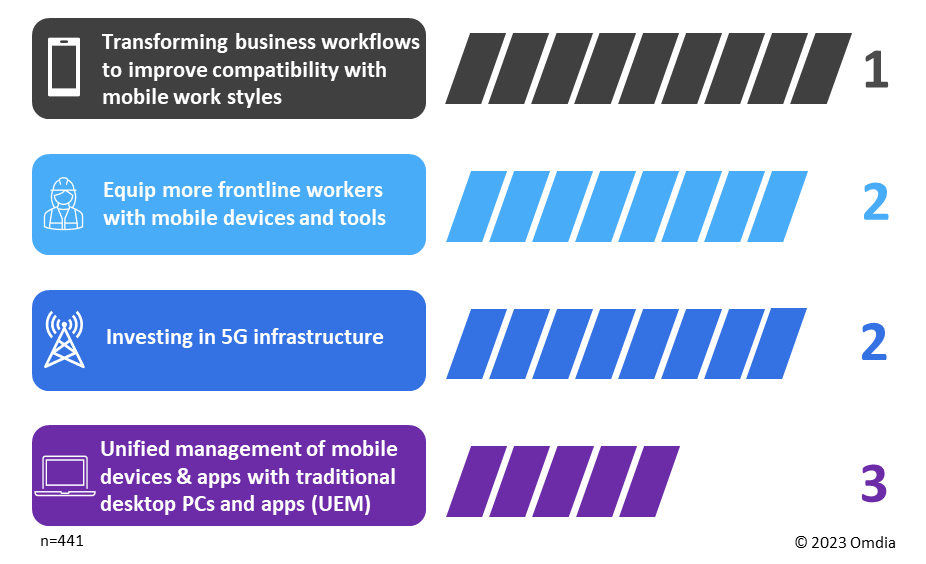
In the 2022 Future of Work Survey, Omdia also explored the workplace mobility objectives businesses are prioritizing, as shown in Figure 3:
Figure 3: Workplace mobility objectives
 Source: Omdia
The responses show how businesses are looking at workplace mobility more strategically and broadly to support evolving and diverse work styles. In addition to unifying how the mobile app and device ecosystems are managed and secured, businesses are increasingly focusing on new areas, including transforming workflows for mobile and remote employees, investing in new mobile connectivity and collaboration capabilities, and enabling new segments of the workforce—notably the frontline—with mobile capabilities.
Mobile fragmentation is costing global businesses billions
Mobile communications, mobility management, mobile security, and a focus on transforming processes and workflows to get work done are all critical considerations. However, the lack of integration across these capabilities negatively impacts administrative and end-user experiences and business security.
While mobility is now essential to how the majority of us now work, the digital infrastructure and practices supporting it are suboptimal. Many businesses depend on a siloed set of different mobile collaboration, security, management, and productivity capabilities. This negatively impacts employee and administrative experiences while also being costs and risks exposing businesses to security risks. For example, in September 2022, US regulators fined 16 financial firms a total of $1.8bn because employees communicated about financial business matters (including equity and debt deals) on personal devices via SMS and WhatsApp. For highly regulated firms, such as those in the financial industry, these types of communication are required to follow the recordkeeping requirements outlined in federal securities and exchange laws. This was not happening, and the respective businesses had no visibility nor auditing power over the communications that were taking place.
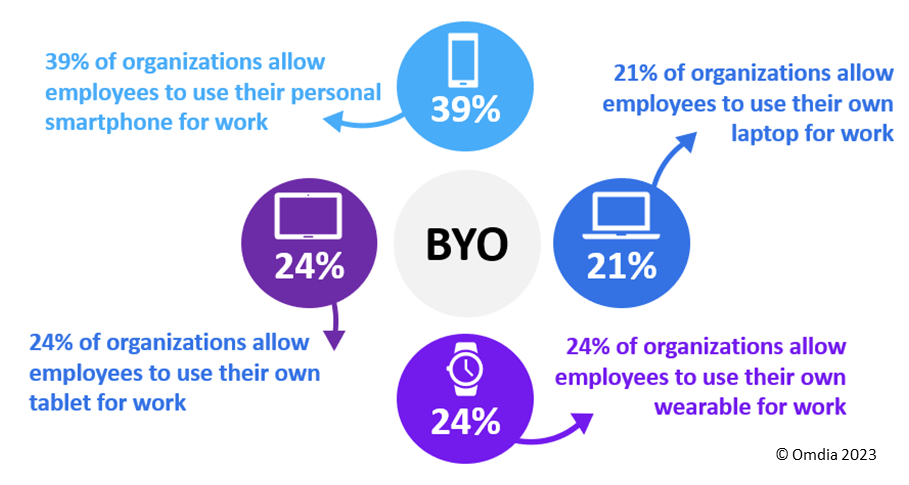
Employees gravitate towards BYO behavior when they experience friction using corporate-provided and secure systems. Omdia data shows that BYO activity is rising, especially across smartphones. As Figure 4 shows, 39% of businesses allow employees to use their personal smartphone devices for work purposes:
Figure 4: BYO activity is on the rise
 Source: Omdia Future of Work Survey
A driver of this BYO trend has been businesses struggling to provide the devices and capabilities employees need and want at the speed and scale required. Employees feel that non-corporate apps work is often better than those sanctioned by their organization. Consequently, “shadow IT” (people relying on their personal devices and applications to remain productive), flies under the radar of IT. This can expose businesses to severe consequences and financial penalties when not appropriately managed or secured. Therefore, companies must have the appropriate visibility and security controls in place across the entire mobile business value chain.
A more converged and integrative approach to mobility, referred to by Omdia as BMC, brings mobile security, management, productivity, connectivity, and analytics together at the infrastructure, administrative, and user level.
BMC
Business mobility (i.e., being a productive employee regardless of location) is complex, and catering to more mobile-centric work styles makes it a digital competency that enterprises need to get right. Two attempts at convergence have tried and failed to meet this need.
The first was fixed–mobile convergence (FMC), which tried to make the mobile device part of enterprise private branch exchange (PBX)-based communications by forking inbound calls and simultaneously ringing a person’s desk phone and the person’s mobile device. Outbound calls from the mobile device required dialing strings of digits to first reach the PBX, followed by dialing the number the user wanted to call. FMC was an awkward technology that failed to achieve mainstream adoption primarily because it used proprietary technology, lacked development and integration between the mobile network operator (MNO) and UC vendor, and was, frankly, hard to use.
A second approach organizations tried to use to address the challenges of hybrid work used “over-the-top” mobile apps that UC vendors provided. These mobile apps also require end-users to select the UC app to make and receive calls instead of using the mobile phone’s native dialer. These calls were data calls, not cellular ones, using a Wi-Fi connection or the mobile operator’s data services. These UC apps on mobile devices never gained much traction as they were hard to use. Furthermore, as texting (SMS messaging) became more prominent, use of the UC app often fell by the wayside because the phone’s native SMS messaging was much easier to access and more pervasive than messaging on the UC app. Finally, as mobile users could use these over-the-top apps on any mobile operator’s data network, MNOs lacked meaningful differentiation and were consequently disintermediated, left to provide mere data connectivity services.
Organizations know that connectivity, management, security, and productivity are all critical mobile competencies that need to be considered for hybrid working. Yet, a key IT challenge is managing this disparate mobile and UCaaS infrastructure, as it typically consists of multiple points of management and administration. Furthermore, as any associated communications data is stored in silos, there is difficulty in getting any meaningful usage and adoption metrics to help guide future strategy.
Mobile network operators and collaboration platform vendors, such as Cisco Webex and Microsoft, have recently begun working together to allow the mobile device to become natively integrated with the collaboration solution. It is this fuller integration of the mobile carrier, its devices, and the mobile phone number with the UCaaS solutions that have given birth to BMC—a term Omdia uses to define the solutions mobile carriers and UCaaS vendors now offer to address these user experience and IT management issues.
BMC advocates for greater synergy between those responsible for enabling and managing workplace mobility (people) and for richer integration between mobile infrastructure and digital capabilities (technology). This strategic, unified approach is essential given the need to support a more mobile workforce and business continuity within modern operations.
BMC combines an MNO’s core network with a UC vendor’s solution to provide a rich digital collaboration and productivity platform. BMC will drastically change how mobile services are provisioned and consumed by the enterprise, with positive implications from an employee experience perspective and from the IT management and risk management perspective.
Figure 5: The BMC market opportunity: US workforce breakdown by user persona
 Source: Omdia 2002 Future of Work Survey
In the chart above, hybrid workers are employees that spend some time in the office and some time working at home. Mobile workers spend almost 100% of their time away from the office. Tethered workers are staff that must be present in a specific location to do their work.
Omdia believes a large target audience for BMC solutions consists primarily of hybrid and mobile workers—approximately 47% of the 164 million people in the US workforce. Both will significantly benefit from the features BMC solutions offer (Table 1 below provides an example of some of these BMC integration features), along with the reduced costs associated with having a single mobile phone number serve as a person’s unique identity.
Carrier and UCaaS vendor BMC approaches
SIM (subscriber identity module)
SIM cards are small plastic cards that contain unique information about specific mobile networks that allow users to receive calls, send messages, or connect to mobile internet services. Solutions such as Microsoft’s Teams Phone Mobile utilize a SIM card and a corporate-provided mobile to provide BMC features within Microsoft Teams.
However, such a solution requires MNOs to provide SIM-enabled mobile numbers via a porting order before the operator can upload the numbers to an organization’s tenant. When uploaded, enterprises can then assign those mobile numbers to CRUs.
eSIM
eSIM technology is a programmable way for smartphones to store carrier information (including phone numbers) on a user’s device, rather than installing a physical SIM card.
Typically, eSIM technology allows you to have more than one SIM (i.e., more than one phone number or carrier on one device), allowing users to potentially have one number for personal use and another for business. US MNOs, including AT&T, T-Mobile, and Verizon, support eSIM, and almost all of the newer smartphones are eSIM compatible.
IMS core integration
Regardless of SIM or eSIM approaches, MNOs must connect their IMS network with the UC vendor’s service to provide BMC features. Currently, in the US, only AT&T and Verizon have this capability—with AT&T working to provide Webex Calling and RingCentral to their customers and Verizon offering Microsoft Teams Phone Mobile to their corporate clients (AT&T integration with RingCentral is branded AT&T’s Office@Hand).
IMS integration provides several important end-user features:
Table 1: Example IMS integration features
Feature | Capability |
Voice quality | Mobile phone calls traverse the MNO’s VoLTE or 5G voice network, utilizing the operator’s quality of service (QoS) mechanisms to ensure high-quality voice traffic. Calls are placed using the device’s native dialer. |
Single business number and mid-call features | Users can make and answer business calls and take advantage of enterprise-grade PBX-like calling features regardless of device (smartphone, office phone, tablet, or laptop). |
Handover of calls to alternate devices | In-progress calls can switch to alternate devices and/or elevate from a voice call to a meeting. |
SMS and chat integration | SMS text messages typically sent from a smartphone can be integrated into the chat capabilities of the UCaaS client (this capability is a roadmap item for both Microsoft Teams Mobile and Webex Go). |
Mobile presence | If a user is on a call on their mobile phone, their UC service shows the user’s presence status to “in a call.” |
Security and compliance | Additional IT compliance and control capabilities allow enterprises to call record and log calls. |
Source: Omdia
BMC and the need for a single point of administration
While BMC offers users a simplified calling experience, a simplified management experience benefits IT departments. Webex Control Hub—the administrative portal for all of Cisco’s cloud collaboration products—provides a means of provisioning and managing users, licenses, Webex devices, and security policies. Control Hub also offers detailed analytics, diagnostics, and reporting.
There has historically been a lack of convergence between the tools and infrastructure supporting mobile users and those supporting collaborative workers. Although AT&T provisions the mobile device, integrating the mobile phone into Webex Control Hub allows organizations to provision the mobile phone number as a Webex Calling number, and once integrated, the mobile device’s calling statistics surface in Webex Control Hub, helping organizations manage, and analyze mobile workforce solutions from a single pane of glass.
This aligns well with BMC, where an integrative approach to the user experience, management capabilities, devices, and services are vital. The integrative approach Cisco and AT&T adopt is essential to optimizing modern business operations for the hybrid workforce.
What does this mean for enterprises?
- BMC puts productivity at the core: As an evolution of the FMC predecessor, BMC capabilities have a rich digital collaboration and productivity platform at the core. This new capability has the potential to drastically change the way that mobile services are provisioned and consumed by the enterprise.
- Flexibility: Cisco can now provide organizations with a BMC calling solution based on Webex that works for corporate-owned devices or BYOD users.
- Easy management: Administrators will be able to assign mobile phone numbers for Corporate Responsible Users as Webex Calling numbers from within Webex Control Hub.
- No additional add-on licensing: AT&T Cloud Voice for Webex Go incurs no additional monthly fees beyond the AT&T phone and Webex Calling subscriptions.
- Reduce costs: Webex Go by AT&T allows customers to reduce or eliminate fixed lines for their mobile workers, and it eliminates the need for workers to have two phone number identities: one for their mobile device and another for their desk phone.
- Evolution of Business Mobility: Business mobility is becoming even more pervasive and embedded in many business processes. Demand for solutions that better help mobilize the workforce, such as this offering from AT&T and Cisco, is high. BMC is also the key to unlock the frontline worker’s digital potential.
What does this mean for rivals?
UC vendors
- Microsoft Teams: In March 2022, Microsoft announced Operator Connect Mobile (now Teams Mobile); however, Microsoft and its MNO partners do not currently offer an eSIM-based solution for BYOD users. Consequently, this limits Microsoft’s total addressable market opportunity for BMC.
- Other UCaaS vendors: Zoom, 8x8, and other Cisco Webex competitors have not announced any BMC plans. Consequently, enterprises will have to rely on traditional “over-the-top” apps which do not offer a native dialer experience, mid-call features, mobile presence, and other features. The requirements to support a more hybrid and remote workforce places these vendors at a disadvantage.
MNOs
- Verizon: Verizon is after the Microsoft Teams Phone subscriber base, which according to Omdia’s UCaaS market report, is 14% of all telephony-enabled UCaaS seats.
- Other MNOs: MNOs such as Vodafone are also working with Microsoft and RingCentral to offer a tailored offering of BMC to its customer base. It will be critical for MNOs to offer differentiation via a deep integration of this functionality with their platform and by making it easy for enterprises to roll out these solutions across their hybrid workforce quickly.
A better relationship with enterprise customers: It is no secret that MNOs are keen to build on their core connectivity offerings to become a more valuable and strategic digital partner for enterprises. Getting closer to the enterprise is a crucial mandate for MNOs, and BMC can support efforts to achieve this. Mobile connectivity, configuration, and collaboration will be an essential foundation for MNOs in the battle to stay relevant to enterprises. The visibility, seamless provision, and administration of mobile services BMC supports will help bring MNO services closer to enterprise stakeholders.
BMC is here to stay
BMC in which mobile calling plans, devices, and phone numbers are integrated with UCaaS calling plans and collaboration will soon become established practices for many organizations. Omdia believes that solutions like Webex Go by AT&T will ultimately be adopted by most hybrid and mobile workers, who already carry a mobile device, and by leading organizations to enable their frontline workers. All will be well served by a business mobile communications and collaboration solution integrated on both the front and back end.
Appendix
Methodology
This report was prepared using information gathered from vendor events and analyst briefings, vendor meetings, technology assessments, interviews with end users, and Omdia datasets.
Further reading
Market Fundamentals: Business Mobile Convergence (BMC) and the Future of Work (April 2023)
“AT&T and Cisco Announce New Version of Webex Go as a Boost to Mobility for the Modern Workforce” (June 2023)
“AT&T and Cisco Introduce Webex Go” (March 2022)
IT Enterprise Insights: IoT, Cloud, AI, & 5G – 2023 (November 2022)
2022 Future of Work Survey (January 2023)
Authors
Tim Banting, Practice Manager, Digital Workplace
Brent Kelly, Principal Analyst, Digital Workplace
Adam Holtby, Principal Analyst, Digital Workplace
Prachi Nema, Principal Analyst, Digital Workplace


